




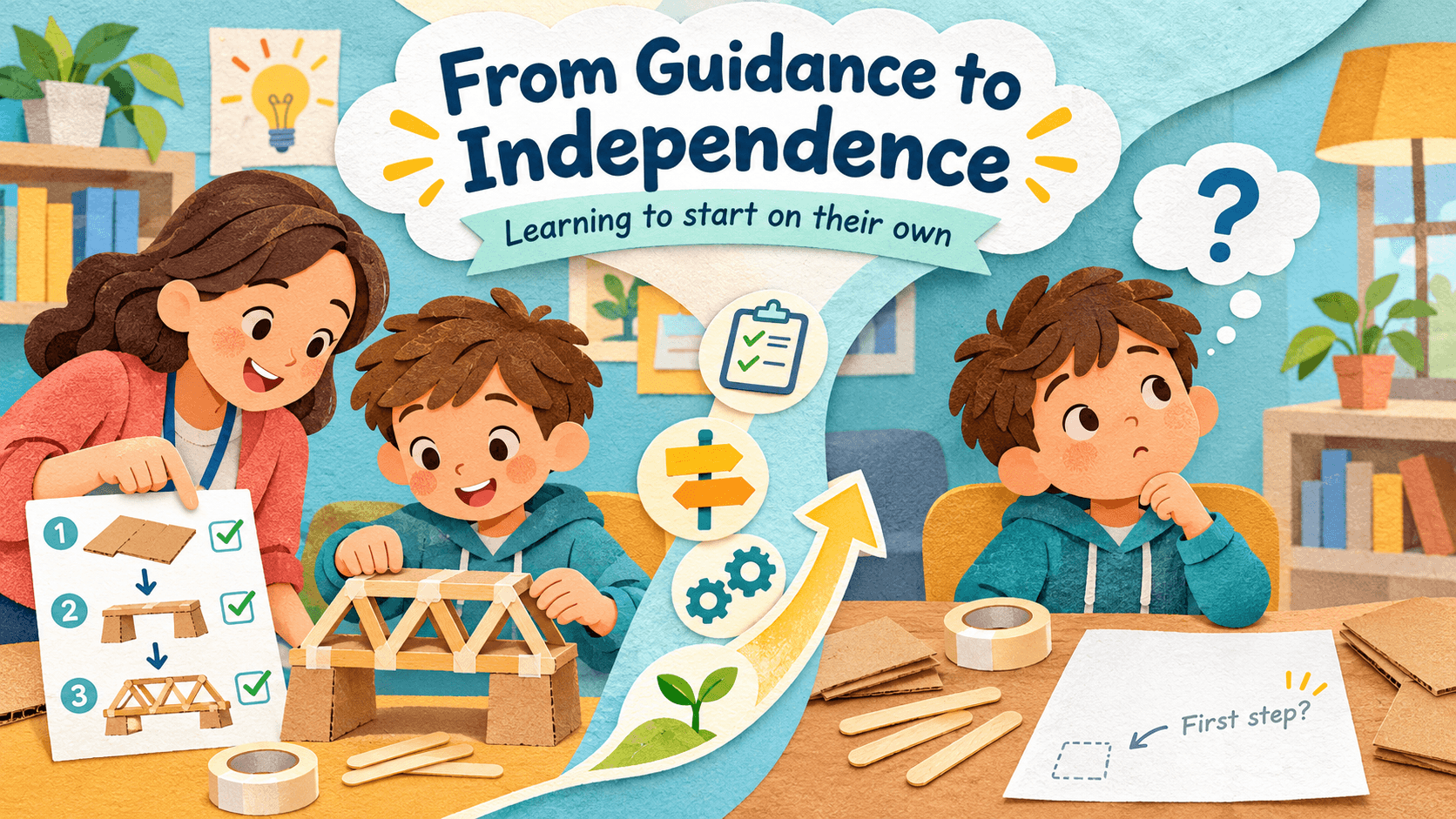

Your child builds a science model perfectly when the teacher explains every step. But when you ask them to create something similar at home, they immediately say, "I don't know how to start."
You wonder why they can complete an activity successfully at school but struggle to do it independently.
For parents exploring Top Schools in Bangalore, including Goldenbee Global School (GBG), Bannerghatta, Bangalore, understanding how children develop independent learning skills is an important consideration.
The difficulty is not always a lack of knowledge or confidence. Following instructions and making decisions independently require different skills.
Why Can Children Follow Instructions but Struggle to Make Their Own Plans?
When children follow instructions, someone else has already decided what needs to happen and in what order.
Imagine a Class 4 student building a bridge using cardboard and tape. Their teacher explains which materials to choose, where to place them and how to connect the pieces.
The child follows every step and completes the bridge successfully.
Now imagine asking the same child to design another bridge without instructions. Suddenly, they struggle to decide where to begin.
This happens because independent work requires more than understanding directions. Children must plan, organise materials, remember their goals and adjust when something goes wrong.
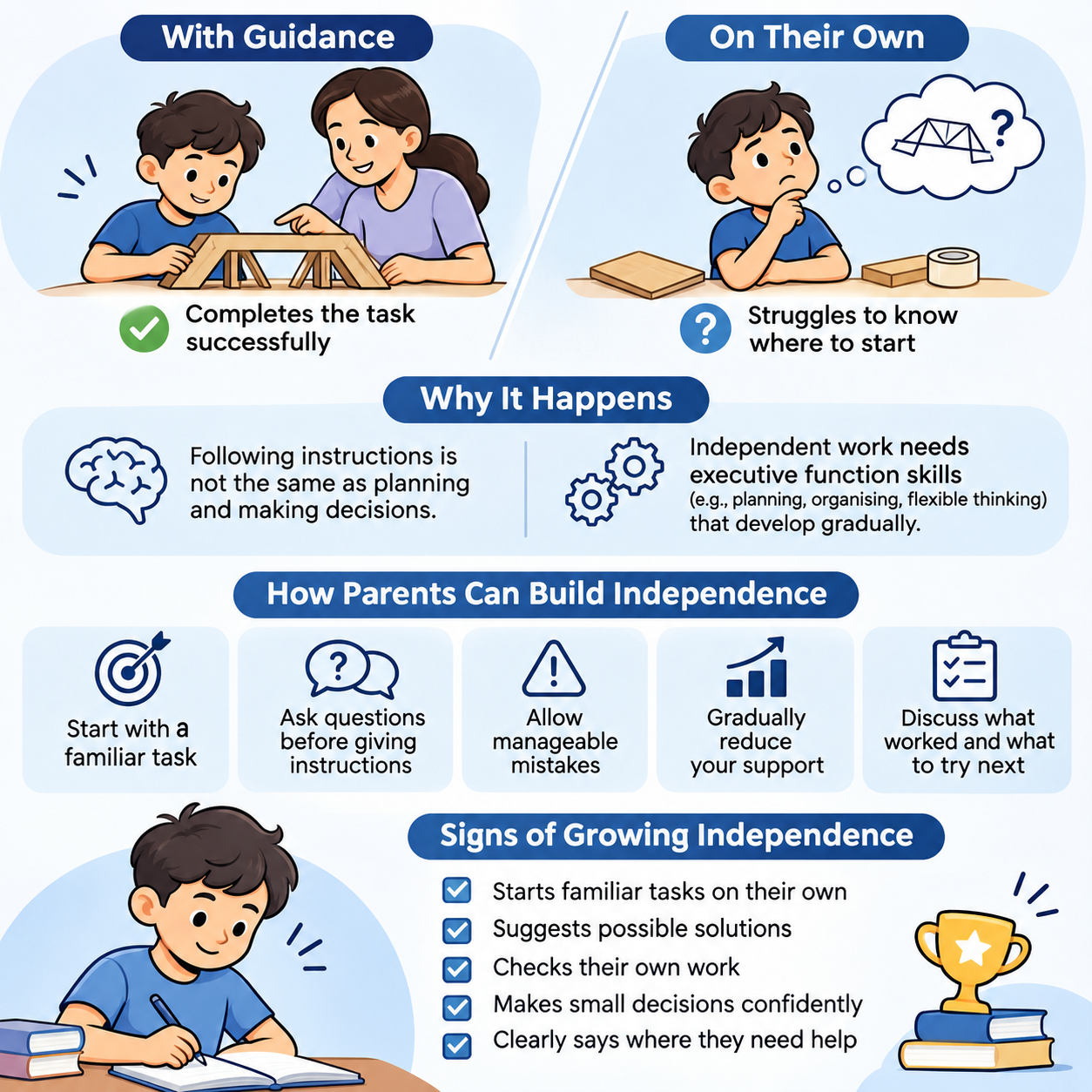
These abilities are connected to executive function skills, which help us manage tasks and decisions.
According to Harvard University's Center on the Developing Child, skills such as planning, attention and flexible thinking develop gradually through practice and supportive experiences.
A child may understand how to build a bridge but still need help planning the process.
This does not mean they failed to learn. It means they are developing another important skill.
How Can Too Much Guidance Make Children Depend on Instructions?
Parents and teachers naturally want children to succeed. Sometimes, however, adults provide so much guidance that children have few opportunities to make decisions.
Consider a parent helping their child prepare a school project.
The parent selects the topic, gathers the materials, decides the layout and explains exactly what to write.
The child completes the project neatly but contributes very few independent decisions.
When given another project, they may expect the same level of support.
Educational researchers describe a useful approach called scaffolding. It involves providing enough assistance for a child to manage a task, then gradually reducing that assistance as their ability improves.
For example, a parent might initially demonstrate how to organise a project. Next time, they could ask the child to suggest the steps. Eventually, the child may plan independently while knowing that help is available.
The goal is not to stop guiding children.
Instead, it is to recognise when they are ready to take responsibility for small parts of a task.
How Can Parents Help Children Become More Independent Without Leaving Them Struggling?
Independent learning develops through manageable opportunities to think, choose and solve problems.
Parents can encourage these skills through everyday activities rather than expecting children to complete difficult assignments entirely alone.
1. Start with a familiar activity
Choose something your child already understands, such as organising their school bag, preparing a simple poster or arranging study materials.
Familiar tasks allow children to concentrate on planning rather than learning everything from the beginning.
2. Ask questions before giving instructions
Instead of immediately explaining what to do, ask, "What do you think the first step should be?"
If your child struggles, offer a small hint rather than the complete solution.
3. Allow manageable mistakes
Suppose your child chooses the wrong materials for a craft project. Rather than correcting them immediately, ask whether those materials will work.
Small mistakes can create opportunities to rethink decisions.
4. Gradually reduce your involvement
During the first project, you might help plan the activity. During the next, let your child create the plan and ask for help when necessary.
5. Discuss the experience afterwards
Ask what worked, what was difficult and what they might change next time.
The Education Endowment Foundation highlights the importance of helping children plan, monitor and evaluate their learning.
These conversations can encourage children to think about their decisions instead of simply waiting for instructions.
What Signs Show That a Child Is Becoming More Independent?
Independence does not mean completing every activity without assistance.
Progress often appears through small changes in everyday behaviour.
For example, a child who previously waited for reminders may begin organising homework materials independently.
Another child may attempt a difficult question before asking for help.
Parents can look for signs such as:
- Starting familiar tasks without repeated instructions.
- Suggesting possible solutions when something goes wrong.
- Checking completed work independently.
- Making small decisions without constant reassurance.
- Explaining exactly where they need assistance.
These changes may develop at different speeds depending on the child's age, experience and the difficulty of the task.
If a child continues struggling with familiar, age-appropriate activities despite suitable guidance, parents can speak with teachers to understand what additional support may help.
Independent Learning at Goldenbee Global School, Bannerghatta
Goldenbee Global School (GBG), Bannerghatta, Bangalore, lists a STREAM Innovation Lab among its learning facilities. Such spaces provide a relevant context for parents to ask how practical activities balance instructions with opportunities for independent thinking. Families comparing the Best schools in Bangalore can explore how schools encourage children to plan, make decisions and solve problems. The availability of learning spaces alone does not establish how independently students use them.

Conclusion
Children who follow instructions successfully may still need practice managing tasks independently.
The solution is not to remove guidance suddenly or expect them to solve every problem alone.
Parents can begin with small decisions, provide support when necessary and gradually allow children greater responsibility.
Over time, these everyday opportunities can help children become more confident in planning, trying different approaches and learning from their experiences.
For more information on this and similar schools, check out this list of the best schools in Bangalore.






 as a preferred source on