




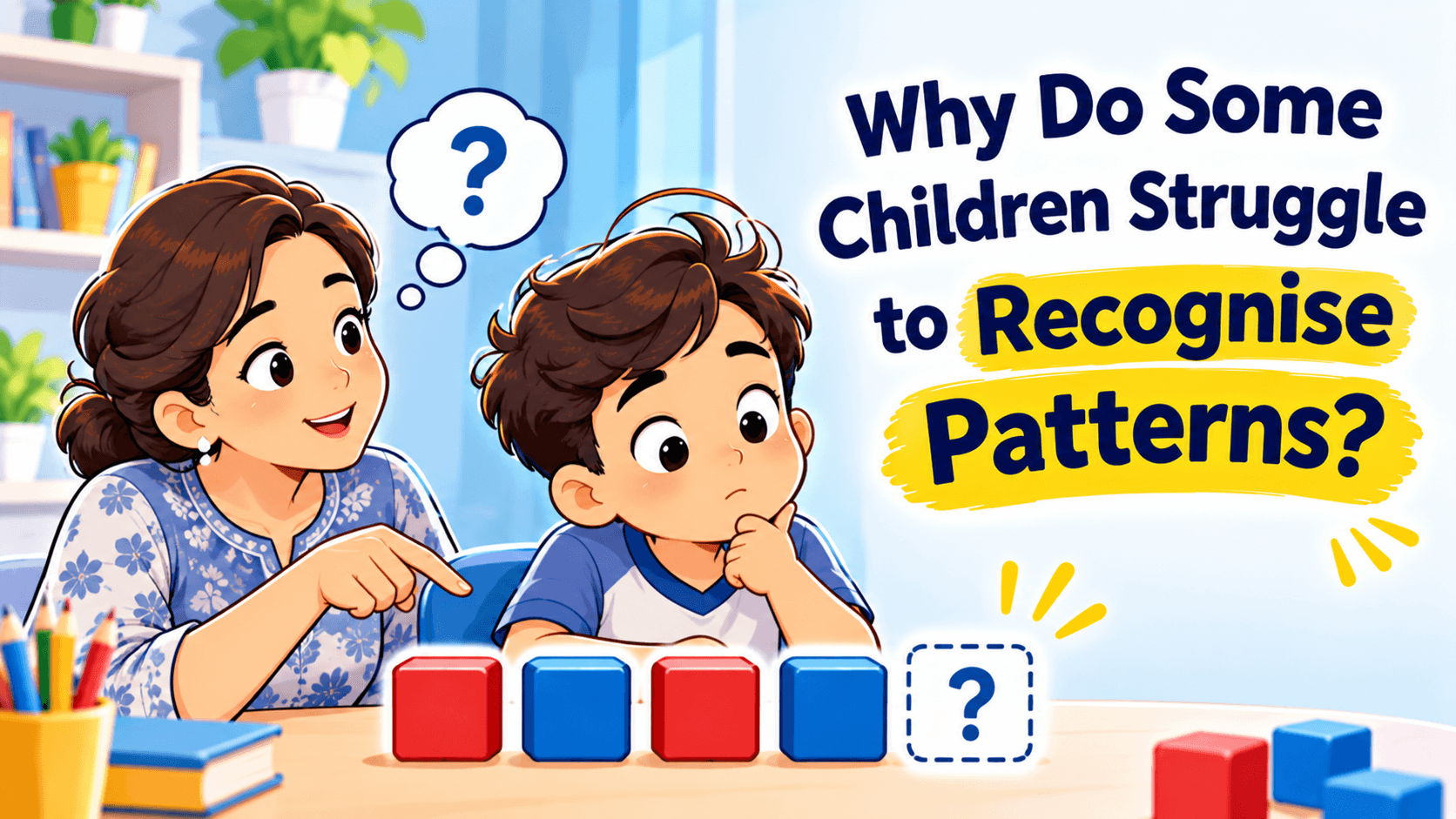

Your child can name colours and count objects, but when you arrange red, blue, red, blue blocks and ask what comes next, they hesitate. They may even choose a completely different colour.
Does this mean they are weak at maths? Not necessarily. Recognising patterns is a skill that develops gradually. Children must notice what repeats, work out the rule, and use that rule to predict what happens next.
Patterns appear in clothing designs, floor tiles, songs, daily routines, and numbers. Understanding how children recognise them can help parents make early mathematical learning more meaningful.
What Does Pattern Recognition Actually Involve?
A pattern is an arrangement that follows a rule. For example, spoon, fork, spoon, fork is a repeating pattern. Two blocks, then three blocks, then four blocks is a growing pattern.
Children need to do more than remember individual objects. They must identify what stays the same or changes.
India's National Curriculum Framework for the Foundational Stage includes identifying and extending patterns among expected mathematical skills for children aged three to eight. It recommends beginning with familiar objects, sounds, shapes, and movements before moving towards abstract numbers.
These abilities develop at different rates. A child might copy a coloured pattern successfully but struggle to explain its rule, especially when objects change in size and shape as well as colour.
Why Do Some Children Find Patterns Difficult?
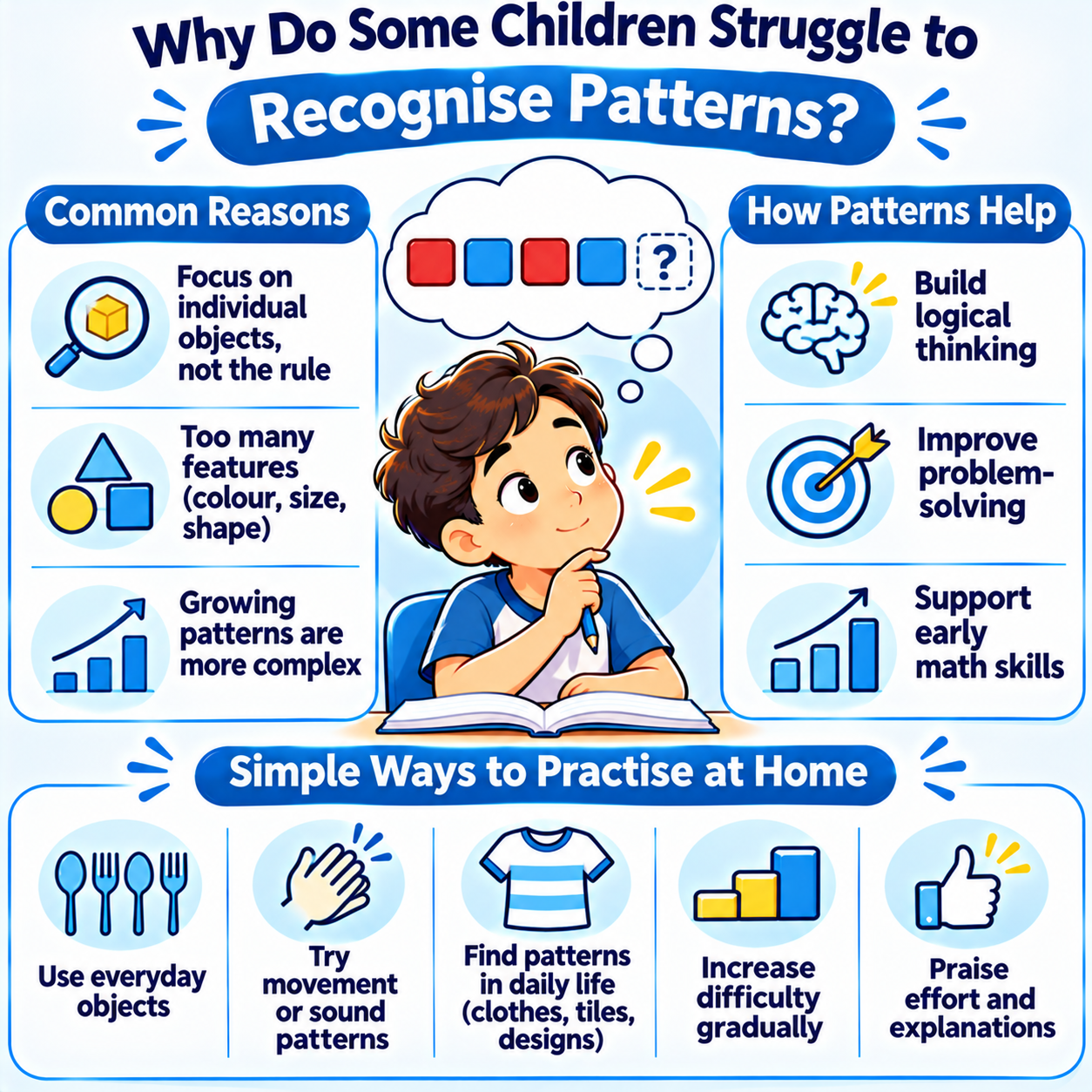
They Notice Individual Objects, Not the Rule
Imagine arranging a circle, square, circle, square. Your child may focus on which shape looks nicest rather than noticing the alternating order.
Start by asking, "What do you notice happening again?" Then show the same rule using familiar utensils or toys.
Too Many Features Compete for Attention
A sequence of big red circles and small blue triangles requires children to consider colour, size, and shape together.
A study in Early Childhood Research Quarterly examined how children approached repeating patterns. It found that success improved across ages four to six, and children's strategies often focused on one feature, such as shape or size.
This helps explain why reducing visual complexity can make a new pattern easier to understand.
Growing Patterns Require Different Thinking
In a repeating pattern, the same unit returns. In a growing pattern, something changes systematically: one bead, two beads, three beads.
Research published in Child Development found that repeating patterns were generally easier than growing patterns among the children studied. It also reported associations between pattern knowledge and arithmetic performance, without establishing that pattern practice alone causes better maths results.
How Do Patterns Support Early Mathematical Thinking?
Patterns encourage children to compare, predict, and explain relationships. These are useful habits when children later work with number sequences and mathematical rules.
For instance, noticing that every alternate number is even may be easier for a child who has practised identifying what repeats.
But pattern activities should not become speed tests. Correctly guessing the next item is less informative than understanding why it belongs there.
Ask your child to explain their choice in simple words. If they cannot, show the sequence again and let them rearrange the objects themselves.
The goal is to develop flexible reasoning rather than memorise answers to worksheets.
How Can Parents Practise Patterns at Home?
Use Household Objects
Arrange a spoon, cup, spoon, cup and ask your child to continue. Once they understand, try spoon, cup, plate, spoon, cup, plate.
Let them create a pattern for you to solve. This reveals whether they understand the rule rather than merely copying it.
Make Movement and Sound Patterns
Clap, tap, clap, tap. Ask your child to repeat the rhythm. Later, introduce clap, clap, tap.
Movement patterns can be especially useful when a child finds printed shapes confusing.
Look for Patterns During Everyday Activities
Notice stripes on clothing, repeated designs on gates, or alternating colours in decorations. Ask, "What repeats here?" or "What would come next?"
Some surroundings contain irregular designs, so do not force a rule where none exists.
Increase Difficulty Gradually
Begin with two-item repeating patterns. Move to three-item sequences, missing objects, and simple growing patterns only when your child feels ready.
Praise explanations and attempts rather than only correct answers. If difficulties persist across several early maths skills, speak with the child's teacher about age-appropriate support instead of drawing conclusions from one activity.
Connecting Early Pattern Learning With School Readiness
For parents researching Top schools in gurugram, it can be useful to ask how foundational numeracy is introduced through concrete materials and everyday observations. Vasant Valley School DLF City Campus, DLF Phase II, Gurgaon describes a planned early-years curriculum drawing on Montessori, Reggio Emilia, and Waldorf approaches, including exploration, play, and concept-based learning. Its DLF City primary campus is scheduled to open in April 2027. Families comparing Best Schools in gurugram can ask how teachers plan to move from hands-on patterns to mathematical symbols and how children's progress will be observed.

Conclusion
When children struggle to spot a pattern, they may need simpler examples, repeated opportunities, or time to notice the underlying rule.
Parents can help by using objects, movements, and familiar surroundings rather than relying only on worksheets. Ask children what they notice, encourage them to explain their thinking, and gradually introduce more complex sequences.
Recognising patterns is not about finding the correct answer quickly. It is about learning to notice relationships and make sense of them.
For more information on similar schools, check out this list of the best schools in Gurugram.












 as a preferred source on