




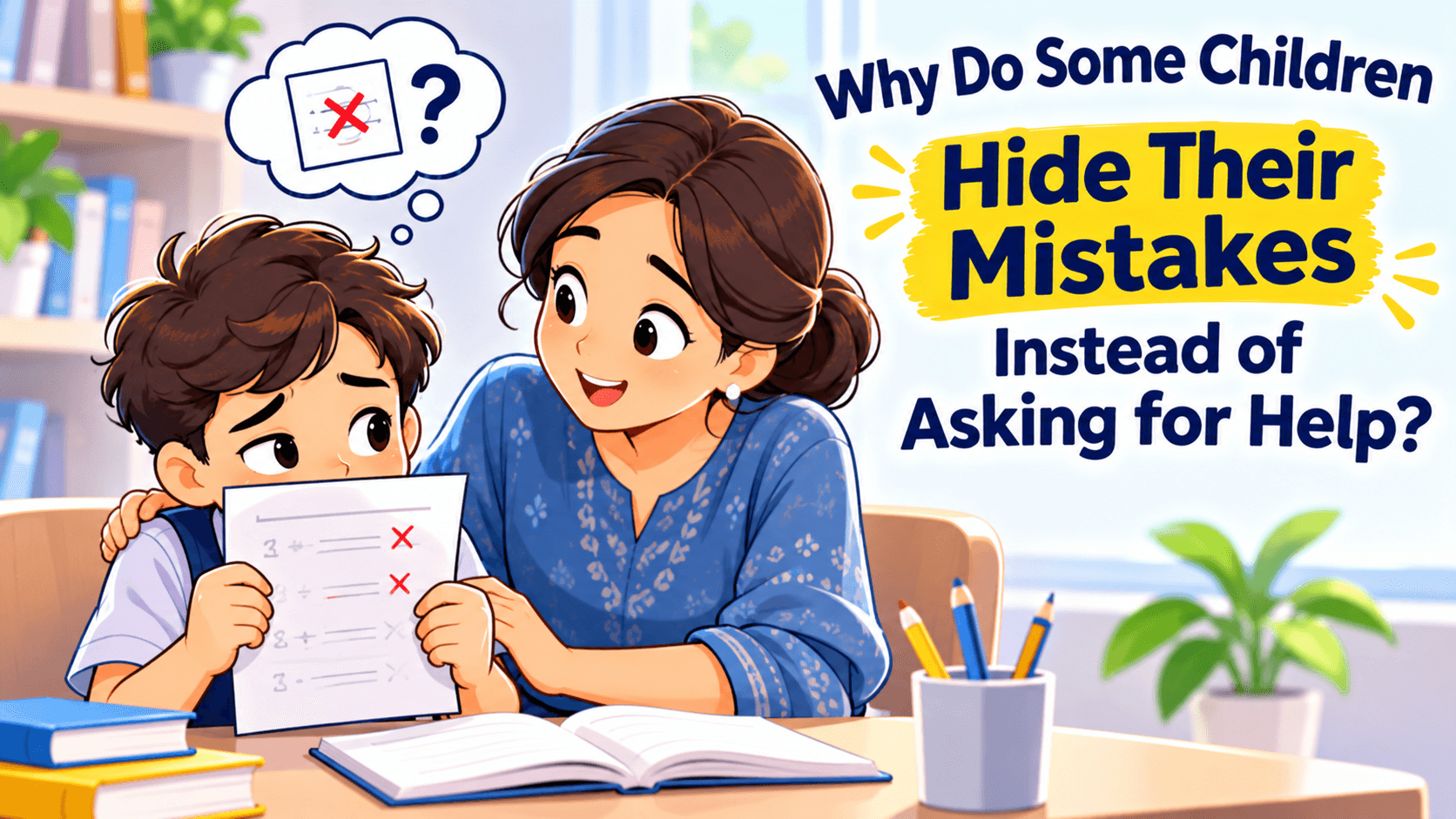

Your child returns home with a completed maths assignment. Everything looks fine until you notice that several answers have been erased and rewritten. When you ask what happened, your child quickly responds, "Nothing, I understood everything."
Later, you discover they were struggling but never asked their teacher for help.
Why would a child hide their mistakes instead of seeking support?
Sometimes, children worry about disappointing adults, appearing less capable than classmates, or being criticised for getting something wrong.
Understanding these concerns can help parents create an environment where children feel comfortable admitting mistakes and asking questions.
Why Are Some Children Afraid of Making Mistakes?
Making mistakes is a natural part of learning, but children do not always see it that way.
Their reactions often depend on previous experiences, expectations, and how adults respond when something goes wrong.
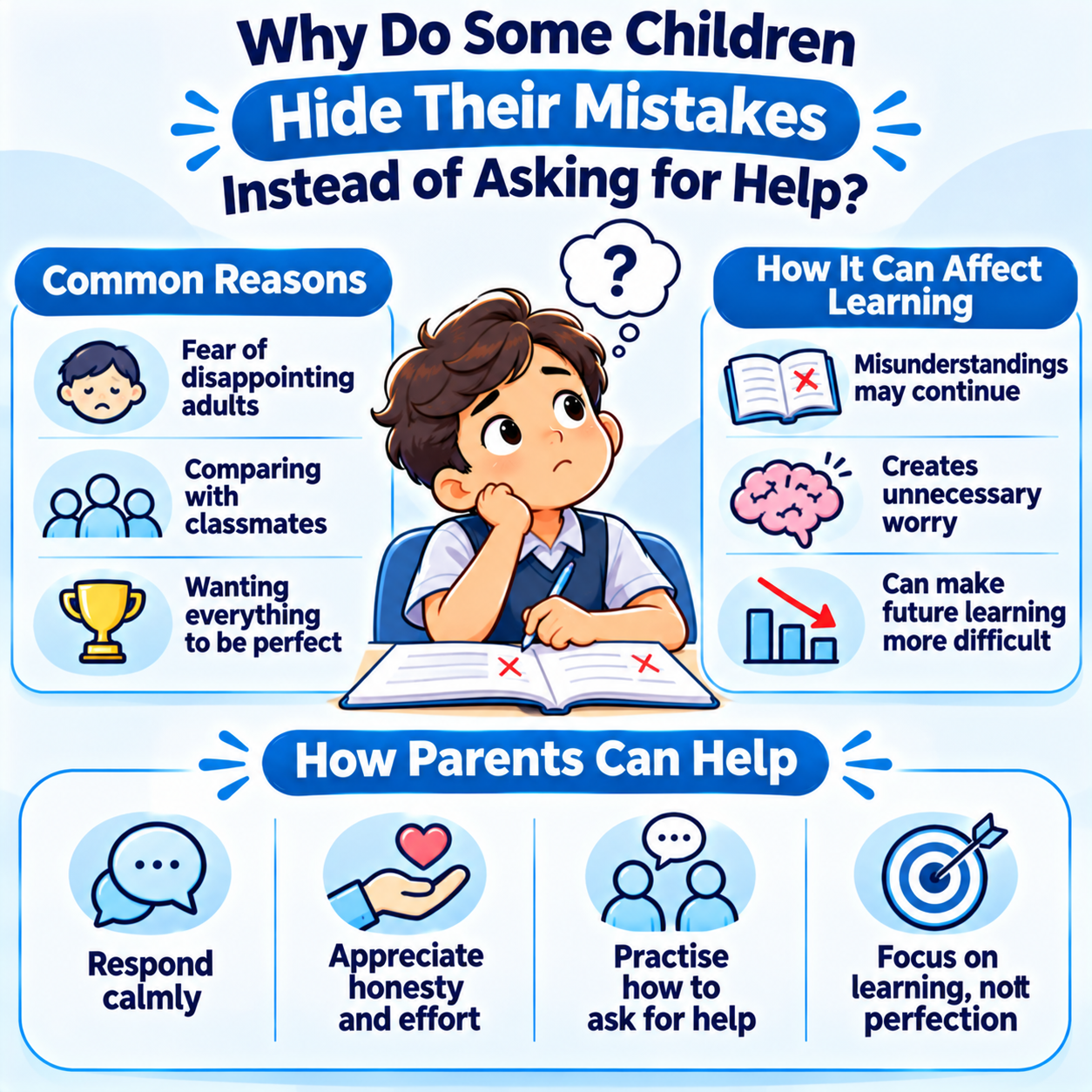
1. Fear of Disappointing Parents or Teachers
Imagine a child who usually scores well in mathematics but performs poorly on one test.
Instead of showing the result to their parents, they hide the paper because they worry about the reaction.
The child may begin associating mistakes with disappointment rather than opportunities to improve.
2. Comparing Themselves With Classmates
Children sometimes believe that capable students should understand everything immediately.
When classmates complete an assignment quickly, a child who needs additional explanation may feel embarrassed.
They might pretend to understand rather than risk appearing less knowledgeable.
3. Wanting Everything to Be Perfect
Some children set extremely high expectations for themselves.
According to the American Academy of Pediatrics, unhealthy perfectionism can make children interpret mistakes and constructive criticism as signs of personal failure.
Such thinking may discourage them from attempting unfamiliar tasks or seeking assistance.
How Does Hiding Mistakes Affect Children's Learning?
When children hide mistakes, teachers and parents may struggle to identify areas where additional support is needed.
For example, a child who repeatedly makes errors while dividing numbers might copy correct answers instead of asking for an explanation.
Although their notebook appears complete, the underlying misunderstanding remains.
Over time, this can make more advanced lessons difficult.
The Education Endowment Foundation (EEF) explains that effective feedback helps students recognise misunderstandings and identify specific ways to improve their work.
Its evidence review highlights the importance of feedback that focuses on learning strategies rather than personal characteristics.
However, children need opportunities to discuss their difficulties for adults to provide appropriate guidance.
Hiding mistakes may also create additional worry. A child might spend more time concealing an incorrect answer than understanding why it was wrong.
The goal should therefore be to help children view mistakes as useful information, not something embarrassing.
Why Do Children Hesitate to Ask for Help?
Asking questions requires children to acknowledge that they do not understand something.
For some, this feels uncomfortable, particularly in classrooms where they worry about being judged.
A child might think:
- What if everyone else already understands?
- Will my teacher think I wasn't listening?
- What if my friends laugh at my question?
- Should I solve everything without help?
These concerns can prevent children from seeking assistance even when they genuinely want to learn.
The Child Mind Institute explains that anxiety in school can sometimes appear as avoidance, excessive checking, or reluctance to participate.
However, hesitation does not automatically indicate an anxiety disorder. Children may also struggle to identify what they need help with.
Parents can encourage children to ask specific questions, such as, "Can you explain this step again?" rather than expecting them to understand everything immediately.
How Can Parents Help Children Feel Comfortable Admitting Mistakes?
Children gradually develop healthier attitudes towards mistakes when adults respond with patience and practical support.
Respond Calmly When Something Goes Wrong
If your child makes an incorrect calculation, avoid immediately asking, "How could you get something so simple wrong?"
Instead, say, "Let's find out which step was confusing."
This keeps the conversation focused on understanding the problem.
Share Your Own Mistakes
Children benefit from seeing adults acknowledge everyday errors.
For example, explain how you misunderstood instructions, made an incorrect calculation, or forgot something important.
Show how you corrected the situation rather than hiding it.
Appreciate Honesty and Effort
When children admit that they need help, acknowledge their honesty.
You might say, "I'm glad you told me which part was difficult."
The American Academy of Pediatrics recommends recognising effort and providing constructive feedback instead of making children feel defeated by mistakes.
Teach Children How to Seek Help
Practise simple conversations at home.
For example, encourage your child to say, "I tried solving this question, but I don't understand the second step."
This teaches children that asking for help is an important learning skill.
If fear of mistakes consistently causes distress, unfinished work, or school avoidance, parents should discuss the concern with teachers and consider professional guidance when appropriate.
Creating a Supportive Learning Environment at School
For parents exploring Top schools in Bangalore, understanding how teachers respond to mistakes and encourage questions can be an important consideration. The Paradise International School(TPI), Electronic City, Bangalore describes personalised attention, individual guidance, and inquiry-based learning as elements of its educational approach. Parents comparing the Best Schools in Bangalore can ask how teachers support students who hesitate to seek help, provide constructive feedback, and encourage children to discuss learning difficulties without embarrassment.

Conclusion
Children who hide their mistakes are not necessarily careless or unwilling to learn. Sometimes, they simply worry about how others will react.
Parents can help by responding calmly, encouraging honest conversations, and teaching children to ask for assistance when needed.
When mistakes become opportunities to understand and improve, children can gradually develop greater confidence in their ability to learn.
The important lesson is that asking for help does not mean a child has failed. It means they are taking another step towards understanding.
For more information on this and similar schools, check out this list of the best schools in Bangalore.
















 as a preferred source on