




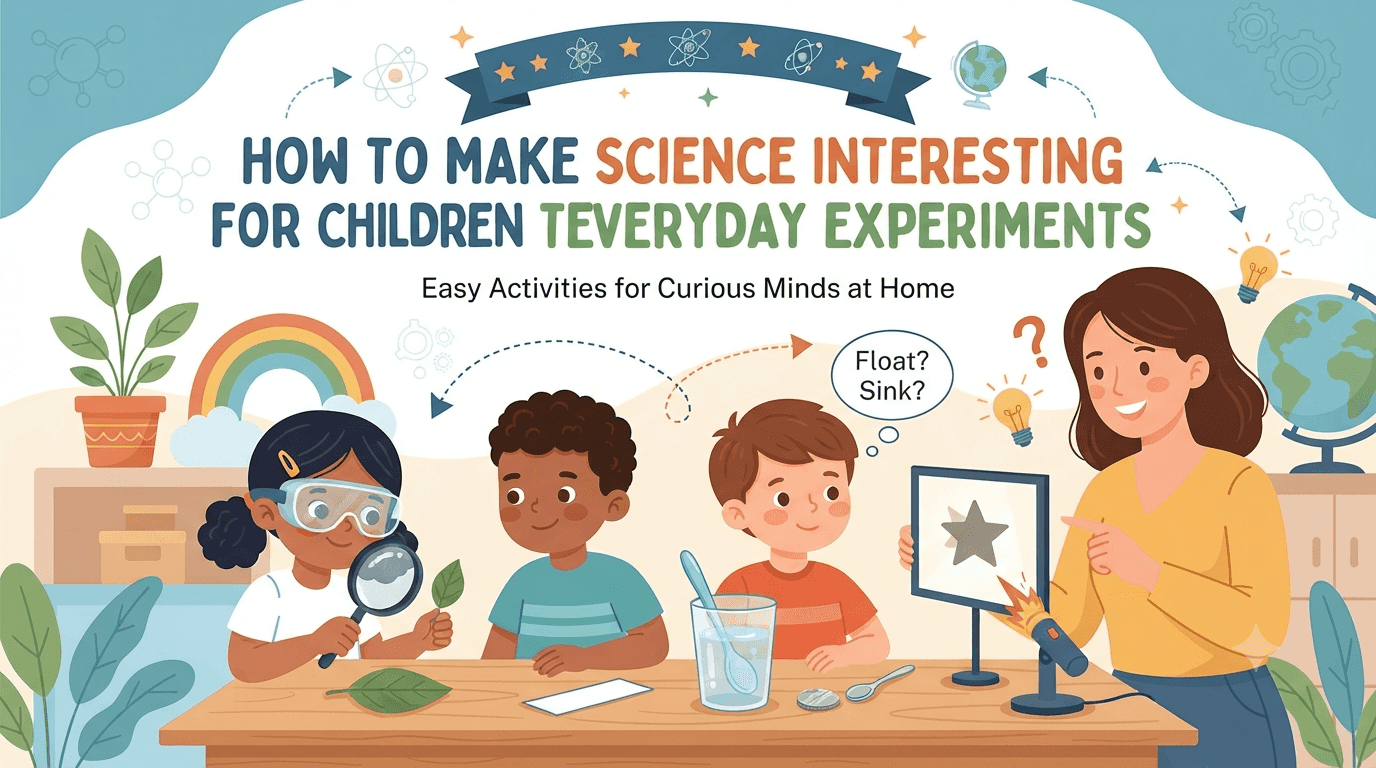

Children often ask questions that seem simple but lead to fascinating discoveries. Why does ice melt? Why does a shadow change during the day? Why do some objects float while others sink?
These questions are natural starting points for learning science. But textbook definitions alone may not help children connect science with the world around them.
Parents can make everyday experiences opportunities to explore. A glass of water, a torch, and a few household objects can introduce children to scientific ideas.
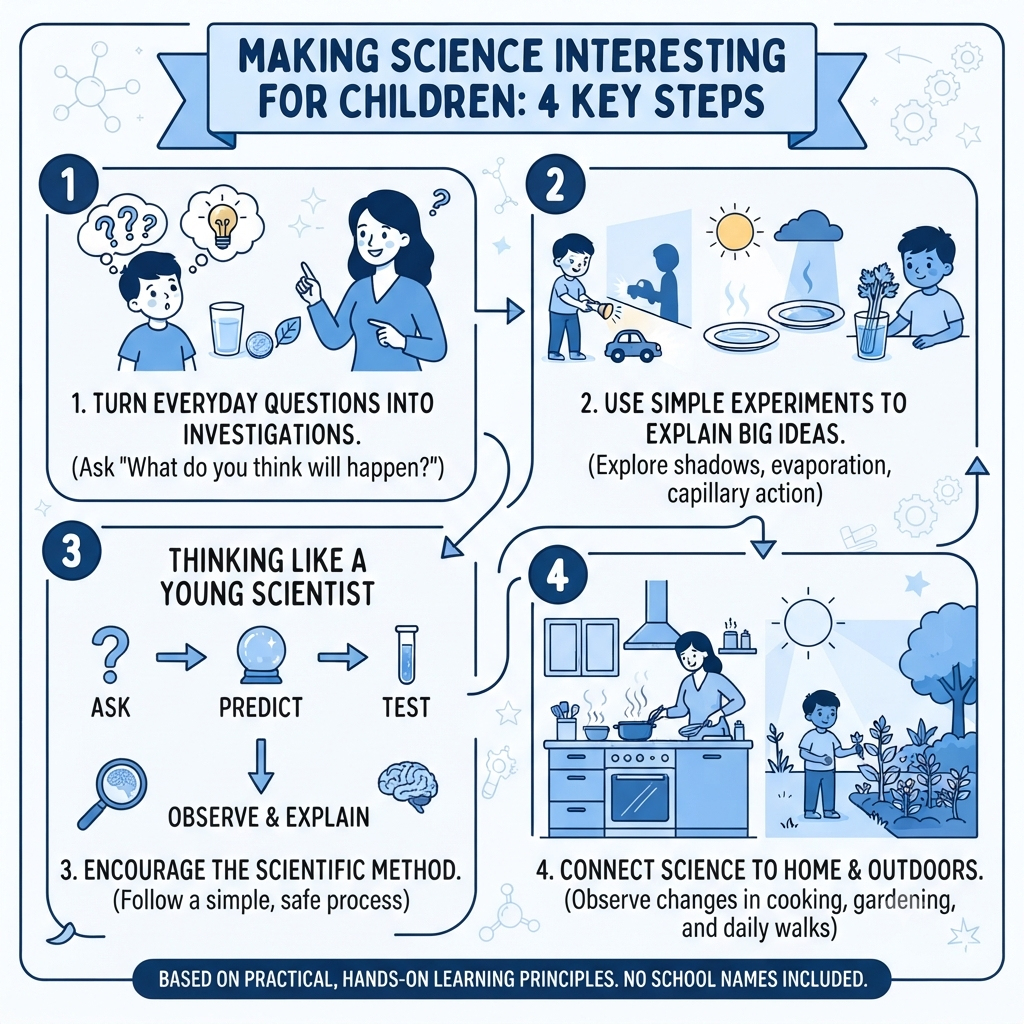
1. Turn Everyday Questions into Small Investigations
When your child asks a question, resist the urge to give the answer immediately. First, ask what they think might happen and why. This simple habit encourages them to make a prediction and explain their thinking.
For example, collect a few safe household objects such as a plastic spoon, a metal coin, a pencil, and a small piece of sponge. Ask your child to predict which ones will float in a bowl of water. Let them test each object and observe the result.
Explain that floating is linked to an object's density and the amount of water it displaces, not simply whether it is heavy or light. A large object can float, while a small object can sink. Ask your child whether the result matched their prediction.
The aim is to help children notice, compare, and ask questions.
2. Use Simple Experiments to Explain Big Ideas
Children often understand a concept better when they can see it happening. Try these simple activities:
Explore shadows: On a sunny day, place a toy or another object on the ground and observe its shadow in the morning. Check again around midday and later in the afternoon. Ask what has changed. Explain that a shadow forms when an object blocks light. Its length and position change as the Sun appears to move.
Watch water evaporate: Pour the same amount of water into two shallow plates. Keep one in a sunny, airy place and the other in a cooler shaded area. Check them after some time. Ask which plate has less water. Explain that evaporation is the change of liquid water into water vapour. Discuss how warmth and air movement affect it.
Make a simple colour investigation: Add a few drops of food colouring to two clear glasses of water. Place a white paper strip or a white flower stem in one glass and observe it over time. This introduces how water can travel through tiny spaces, a process called capillary action.
Use washable food colouring, protect surfaces, and do not let children drink the experiment mixtures. Keep activities age-appropriate and supervise them.
3. Encourage Children to Think Like Young Scientists
An experiment becomes more meaningful when children do more than watch it. Encourage them to follow a simple process:
- Ask: What do I want to find out?
- Predict: What do I think will happen?
- Test: How can I check my idea safely?
- Observe: What do I notice?
- Explain: What might the result mean?
Children can draw what they see or explain the result. Older children can compare results or repeat an activity while changing one condition.
If the result is different from what they expected, treat it as a chance to investigate. Ask whether something changed during the test. This shows them that science uses evidence, not just correct guesses.
4. Connect Science with Home and the Outdoors
A home is full of opportunities to notice science. While cooking with an adult, children can observe how heat changes the texture of food or how steam forms on a lid. While gardening, they can compare how plants grow in sunlight and shade, notice roots and leaves, or observe how soil feels when it is wet and dry.
On a walk, notice leaf shapes, listen to birds, or watch puddles disappear after rain. Ask, “What do you notice?” or “How could we find out?”
You do not need to know every answer. If a question is difficult, look it up together in a reliable book or learning resource. Showing children how to find and check information is also part of learning science.
How Schools Can Support Practical Science Learning
At Prestige International School (PIS), Rampura, Bangalore, the official school website describes a Science Zone with Physics, Chemistry, and Biology laboratories. It states that practical work gives students opportunities to collect information, discuss results, and develop scientific reasoning. For parents exploring the Best schools in Bangalore or Top schools in Bangalore, it is worth looking at how a school helps children connect classroom concepts with observation and practical investigation. A well-supported science experience can complement the questions and simple experiments children explore at home.

Conclusion
Children do not need complicated equipment to begin exploring science. Everyday objects and familiar experiences can help them ask questions, test ideas, and understand the world around them.
Make room for curiosity, allow children to make predictions and discuss what they observe. When parents treat questions as opportunities to explore rather than interruptions to answer quickly, science can become a natural and enjoyable part of everyday life.
For more information on this and similar schools, check out this list of the best schools in Bangalore.




 as a preferred source on