




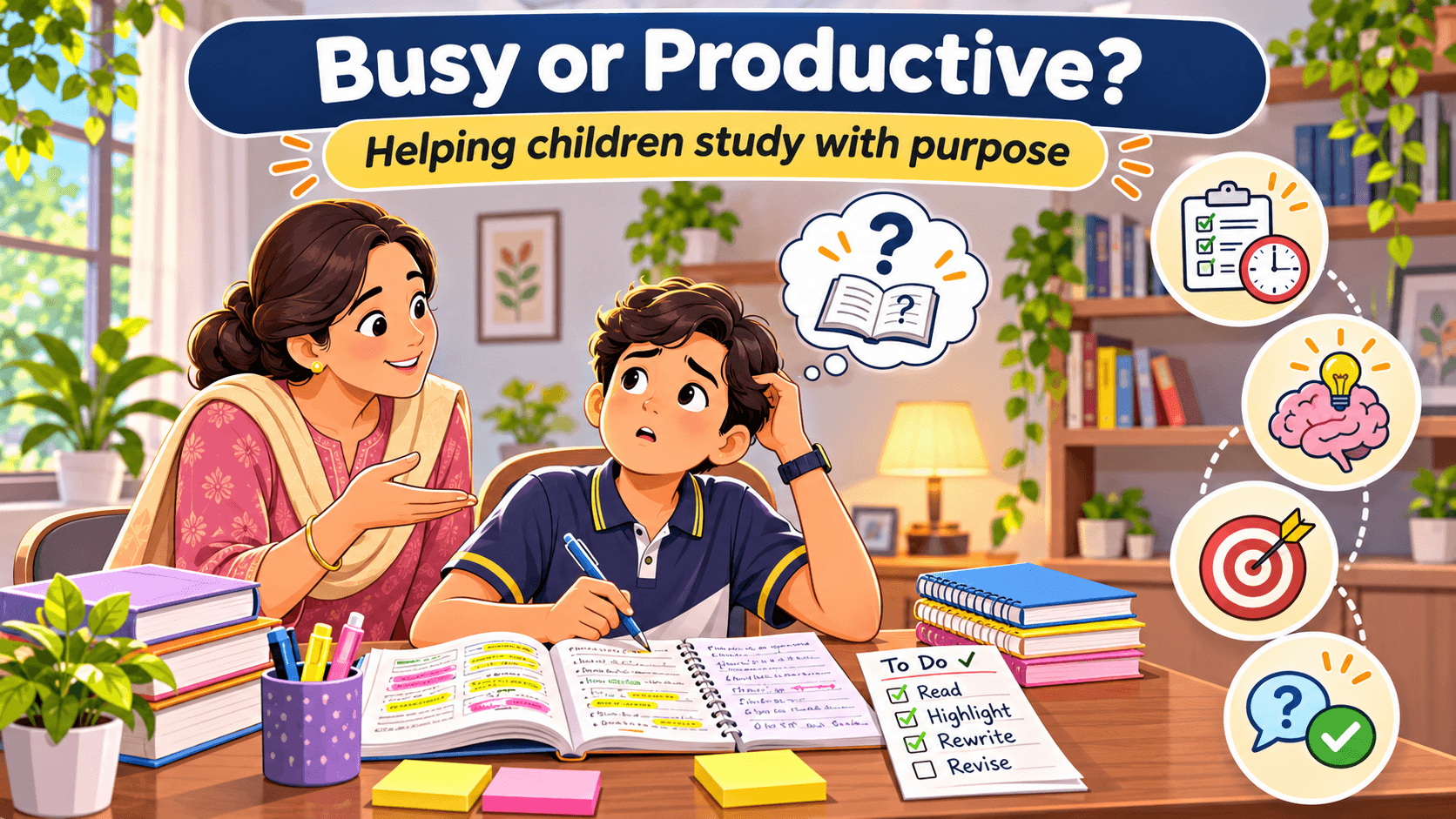

Your Class 7 child has been at their study desk for two hours. They have highlighted a science chapter, rewritten their notes, and arranged their notebooks neatly. But when you ask them to explain what they learned, they struggle to answer.
The effort is visible. The learning is harder to see.
For parents exploring Top Schools in Gurugram, including Gurugram Global Heights School (GGHS), Sector 102, Gurgaon, it is worth understanding the difference between keeping children occupied and helping them make meaningful progress.
Why Does Being Busy Feel Like Making Progress?
Being busy is easy to notice. A full notebook, a long checklist, or several completed worksheets can make a study session look successful.
But these are signs of activity, not necessarily understanding.
Imagine a child copying four pages about the water cycle. Yet, when asked why clouds form, they repeat a sentence without being able to explain it.
Copying may help organise information, but it does not automatically show that the child can recall or use it.
Colouring headings and rearranging study materials have clear endings. Working through a difficult question can feel uncertain and uncomfortable.
Parents should not dismiss the value of organised notes. Instead, ask what purpose each activity serves. Did it help the child understand something, practise a skill, or prepare to explain an idea?
Why Can Children Study for Hours but Remember So Little?
Reading something repeatedly makes it look familiar. That feeling can be mistaken for knowing it well.
Suppose one child reads a history chapter three times. Another reads a section, closes the book, and tries to describe the events in order. The second child may struggle more during the session, but that attempt reveals what they actually remember.
Research reviewed by psychologist John Dunlosky and colleagues identifies practice testing and spreading practice across different days as especially useful learning techniques. Rereading and highlighting alone are generally less reliable.
This does not mean children should stop taking notes. A useful approach is to read a short section, write a few key ideas, then put the book aside and explain those ideas without looking.
If they cannot recall something, they know what needs more attention.
Learning is not always comfortable. Sometimes the moment a child notices a gap in understanding is when meaningful progress begins.
How Can Parents Help Children Focus on Meaningful Progress?
Start by changing how study goals are discussed at home.
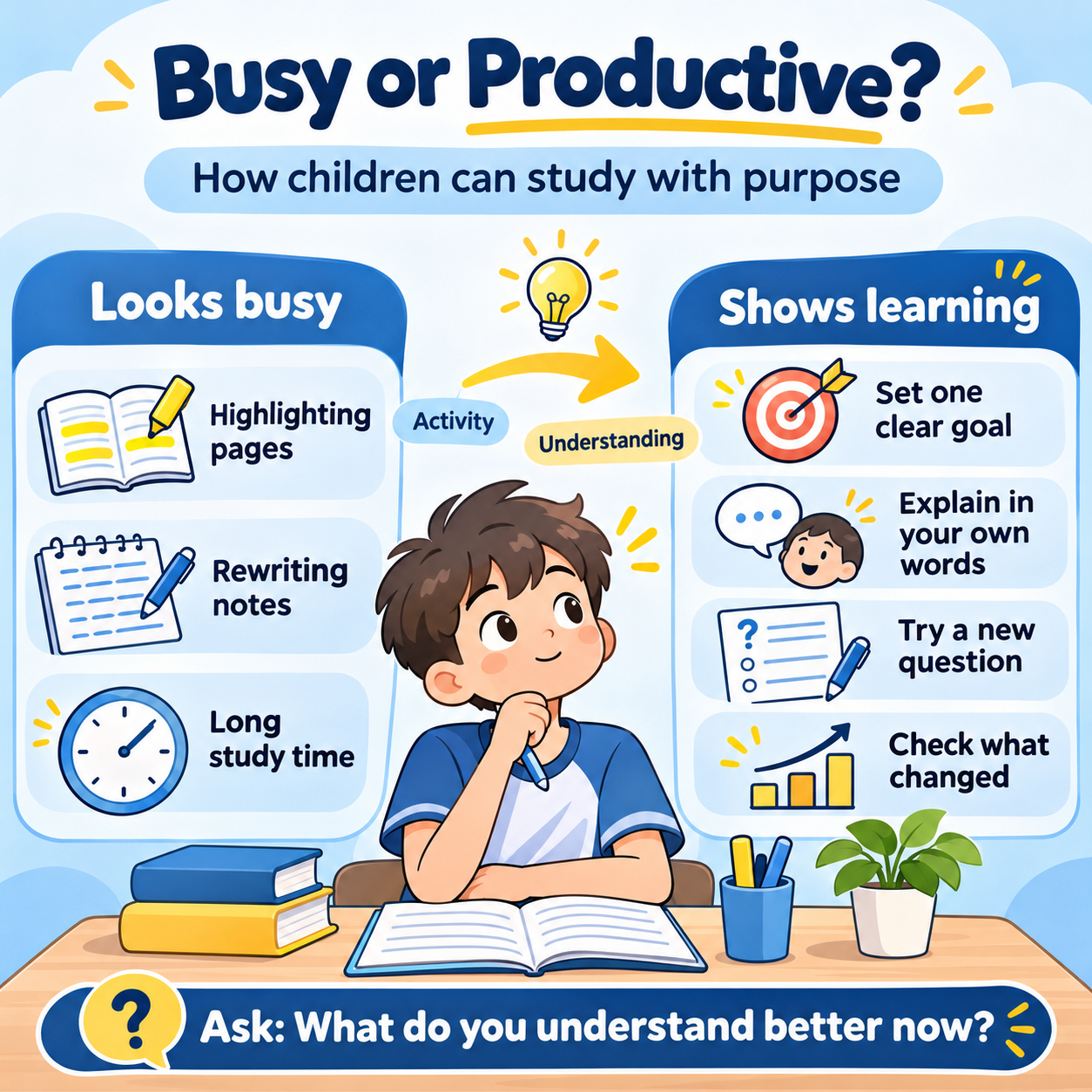
1. Set a specific goal. Instead of "Study maths for one hour," try "Learn to add unlike fractions and solve three questions independently." A clear goal gives the child something useful to work towards.
2. Choose the important task first. Ask which assignment is urgent or which concept is still confusing. Children sometimes finish easy tasks repeatedly because difficult work feels less rewarding.
3. Encourage active learning. After reading, invite your child to explain the concept, draw it from memory, or solve a fresh question. Asking "How do you know?" can reveal understanding better than asking "Have you finished?"
4. Make room for focused attention. Put distracting notifications aside during work that requires concentration. Breaks are welcome; constantly switching between homework and videos makes it harder to follow a train of thought.
5. Review what changed. At the end, ask: "What can you do now that was difficult before?" and "What do you still need help with?"
The Education Endowment Foundation recommends teaching children to plan, monitor and evaluate their learning. These questions help them develop those habits.
Keep goals realistic. If a child is struggling with a new concept, a short session that clears one misunderstanding may be more useful than finishing several pages quickly.
How Can Parents Tell Whether Their Child Is Actually Learning?
Look beyond time spent and the number of completed pages.
Can your child explain an idea in their own words? Can they use it in a slightly different question? Can they identify where they got stuck and ask for specific help?
For example, a student might complete only four fractions problems instead of twelve. But if they now understand why the denominators must be made equal before adding, the session may have achieved an important goal.
Illness, tiredness and genuinely challenging work can slow children down. Rest, exercise, play and time with friends are valuable, not wasted time.
The aim is not to turn every hour into measurable output. It is to help children recognise when their efforts are helping them learn.
Understanding Learning Progress at Gurugram Global Heights School
Gurugram Global Heights School (GGHS), Sector 102, Gurgaon, publishes 2026–27 assessment policies describing projects, oral assessments, individual and group work, and student portfolios. Parents comparing Best schools in Gurugram can use these published methods as a starting point to ask how teachers assess understanding and progress, rather than relying only on completed assignments. A written policy does not, by itself, verify how consistently each method is implemented.

Conclusion
A child can look busy without learning much, just as a child can make real progress without filling pages.
Instead of asking only, "How long did you study?", ask, "What do you understand better now?" That question keeps attention on learning while leaving room for the rest and balance children need.
For more information on similar schools, check out this list of the best schools in Gurugram.
















 as a preferred source on