




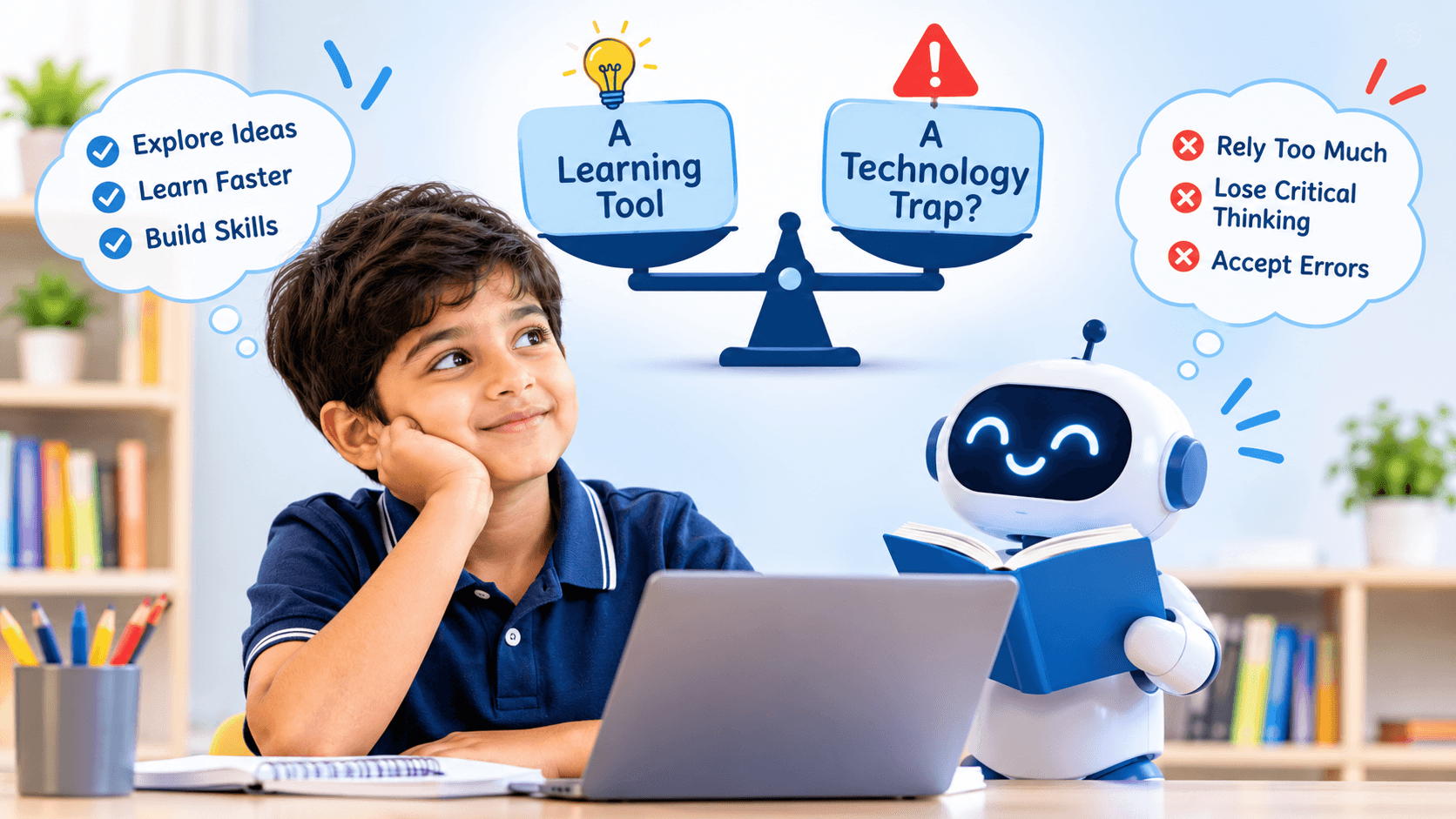

A child has a science assignment due tomorrow. Instead of trying the question, they copy an AI chatbot's answer. The work looks complete, but can the child explain it? Many parents face this concern as AI enters everyday learning.
AI can explain difficult ideas and support practice. But when it does the thinking, it becomes a shortcut. For parents exploring the Best schools in Ghaziabad, it is worth understanding how technology should support learning—not replace it.
When Can AI Actually Help Children Learn?
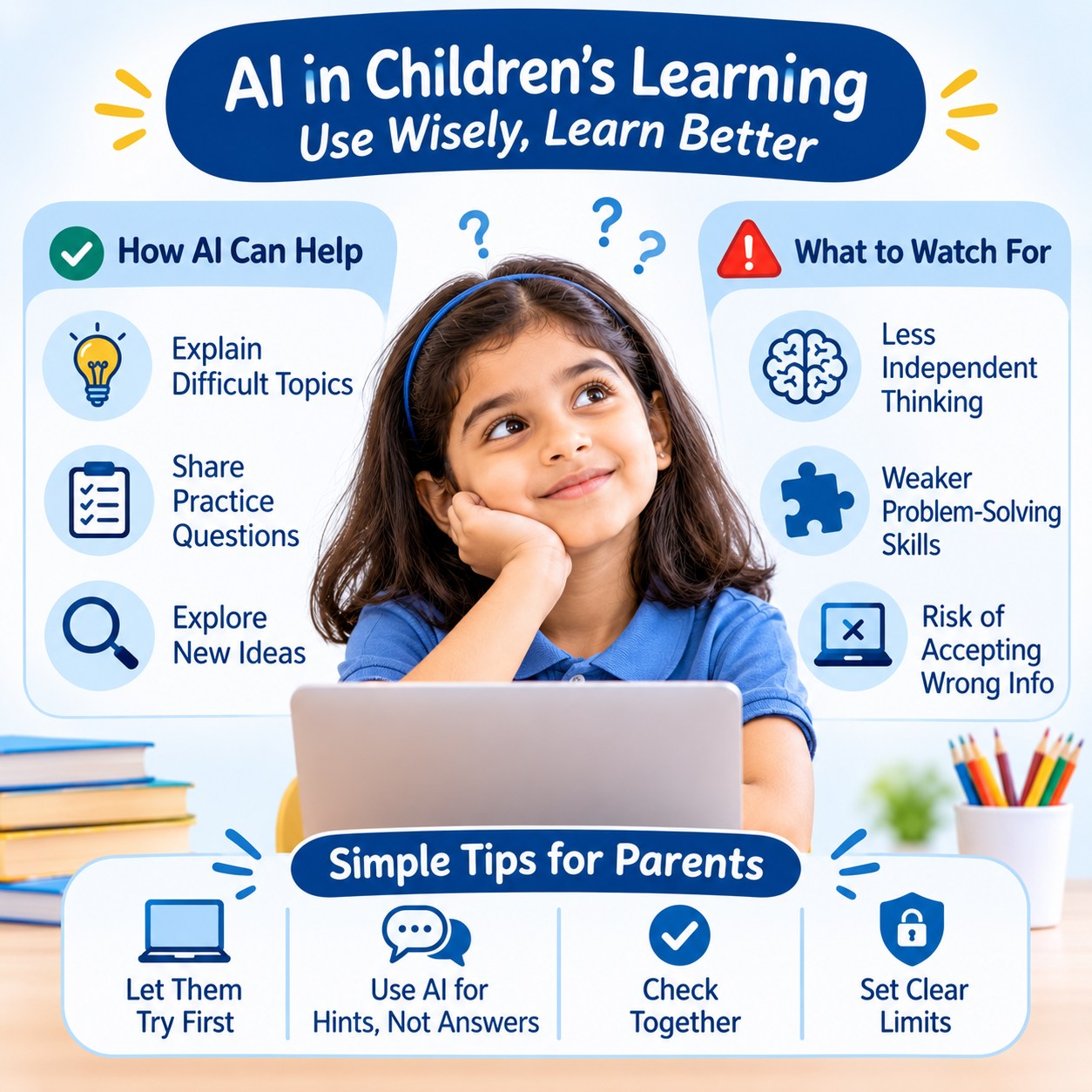
Used thoughtfully, AI can act like a study partner. A child who finds fractions difficult, for example, can ask it to explain the concept using a pizza example, then request practice questions to solve independently.
AI can break a complex topic into smaller steps, explain a difficult idea in another way, create revision questions and help children explore project ideas.
The child should remain involved. Asking for a hint encourages participation; asking AI to complete a worksheet removes the chance to practise.
The OECD's Digital Education Outlook 2026 makes this distinction. It explains that generative AI may improve the quality of a completed task without necessarily improving what a student has learned. Learning is more likely when AI supports the thinking process instead of simply providing finished answers.
How Can Too Much Dependence Affect Learning?
Children develop skills by trying, making mistakes and checking their work. If AI provides every answer, these steps can disappear.
1. Less independent thinking
A child who always asks AI for an answer gets fewer chances to understand a question, consider options and reach a conclusion. Unfamiliar problems may then feel harder to approach alone.
2. Weaker problem-solving habits
Working through a maths sum or planning a story takes patience. If a tool completes these tasks, children miss the practice of breaking a problem into smaller parts and testing solutions.
3. Difficulty spotting incorrect information
AI tools can produce confident-sounding answers that contain mistakes or made-up references. Children who accept every response without checking may learn incorrect information.
4. Less practice expressing ideas
If children ask AI to write every paragraph, story or project response, they may practise expressing their own ideas less often. The result may look polished but may not reflect their understanding.
These risks do not mean children should avoid AI. They show why guidance and limits matter.
How Can Parents Encourage Responsible AI Use?
Parents do not need to be technology experts. A few habits can keep learning at the centre.
- Ask children to try first: Encourage them to read the question, note what they know and attempt an answer before using AI.
- Use AI for hints, not finished work: Ask for a clue or explanation instead of a complete assignment.
- Check answers together: Compare important information with textbooks, class notes or trusted sources. Ask, "How do we know this is correct?"
- Invite children to explain: After using an AI explanation, ask them to describe the idea in their own words or solve a similar question without help.
- Protect personal information: Children should not share their address, phone number, passwords, photographs or private family information with AI tools.
- Set clear boundaries: Agree on when AI may be used, which tasks must be completed independently and how its help should be acknowledged.
The goal is to help children judge when a tool is useful and when to think for themselves.
What Should Schools Teach Children About AI?
Schools can teach students how AI works and where its limits lie. Children need to check AI-generated information, recognise that not every task requires a digital tool and value their own reasoning.
UNESCO's AI Competency Framework for Students recommends learning built around a human-centred mindset, AI ethics, knowledge of AI techniques and an understanding of AI system design. In simple terms, students should not only learn to use AI; they should learn to question it, use it safely and understand its impact.
Teachers can ask students to compare AI explanations with textbooks, identify errors or explain which parts of a project came from their own research. Assessment can include discussions and reflections, not just final answers.
Building a Balanced Approach at Sapphire International School, Crossings Republik
At Sapphire International School (SIS), Crossings Republik, Ghaziabad, the published curriculum includes Artificial Intelligence as a skill subject in the Preparatory Stage and IT/AI in the secondary curriculum. Its learning information also refers to inquiry, critical thinking, digital research and technology-supported learning. A report published in October 2026 described 19 Sapphire learners visiting ISRO's Mission Operations Complex in Bengaluru, accompanied by the Head of School at Crossings Republik and a teacher. This kind of exposure can help students connect classroom learning with real scientific work. Parents comparing the Top schools in Ghaziabad can consider how schools balance digital skills with independent thinking.

Let Technology Support Thinking, Not Replace It
AI is not automatically making children better learners or more dependent. The difference lies in how it is used. When children ask questions, check information and apply what they learn, AI can support their progress. When they copy answers without understanding, it can get in the way. Parents and schools can help children use technology with curiosity and responsibility while continuing to build the skills no tool should do for them: thinking, questioning and learning independently.
To know more about other schools in Ghaziabad, click on the link below




 as a preferred source on