




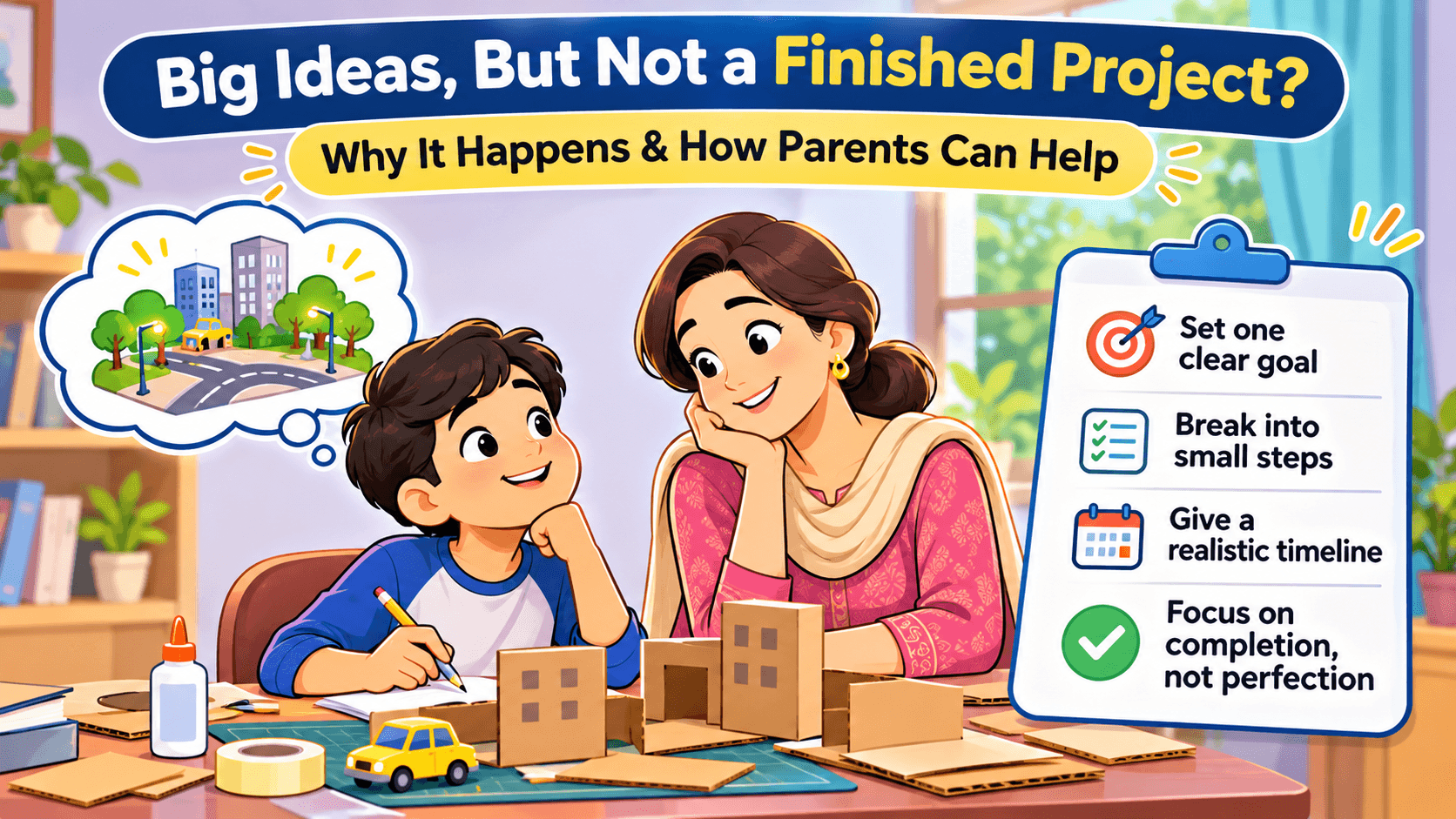

Your child has an exciting plan for a school exhibition: a miniature city with roads, parks, lights, and moving vehicles. They spend an evening sketching it and collecting cardboard boxes. A week later, the materials are still scattered across the table, and very little has been built.
You wonder why someone with so many ideas finds it difficult to finish even one.
For parents exploring Top Schools in Faridabad, including Grand Columbus International School (GCIS), Sector 16A, Faridabad, this raises a useful question: what helps children turn imagination into completed work?
Why Is Coming Up With an Idea Easier Than Completing It?
Imagining a finished project is exciting. The difficult part often begins when children have to decide what to do first.
Suppose a Class 6 student wants to build a robot that sorts household waste. They can describe exactly what it should do, but they do not know which parts to buy, how to connect them, or what to test first.
Turning an idea into reality requires planning, attention, remembering instructions, and changing direction when something fails. These are linked to executive function skills, which develop throughout childhood and adolescence.
Harvard University's Center on the Developing Child explains that children strengthen these skills through practice and supportive experiences.
A creative child may therefore need help organising a project without needing someone else to supply the idea.
Before beginning, ask: "What is the simplest version of this project we could make?" That question can turn an overwhelming ambition into a realistic starting point.
Why Do Children Lose Interest Halfway Through Projects?
Sometimes the first stage is more enjoyable than the work that follows.
A child may love designing a miniature garden but feel less excited when they have to prepare pots, arrange soil, and water the plants regularly.
Other obstacles can include missing materials, unfamiliar techniques, distractions, or the fear that the result will not look as impressive as imagined.
An unfinished project does not always mean the child is lazy. The original plan may simply be too large for the time and skills available.
Ask what changed: "Did you lose interest, get stuck, or realise you need something you don't have?"
The answer matters. A child who needs to learn a new skill requires different support from one who has genuinely decided to pursue another interest.
Not every personal experiment must become a finished product. But when a school assignment has a deadline, children benefit from learning how to adjust their plans and complete a manageable version.
How Can Parents Help Children Finish Their Creative Projects?
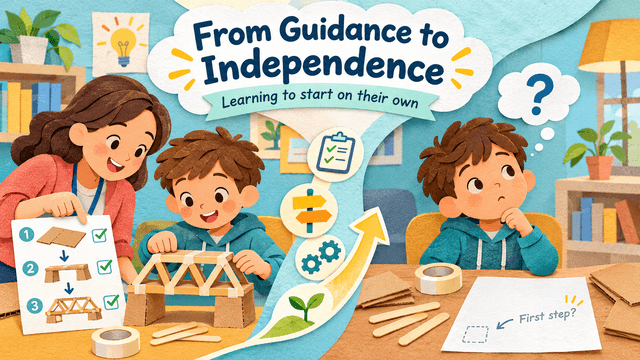
Parents can guide the process without taking ownership of the finished work.
1. Choose one achievable goal. Help your child decide what the project must demonstrate. A model city may need roads, buildings, and one working streetlight, not every feature they imagined.
2. Break the goal into small steps. Write a short list: gather materials, build the base, add structures, and test the light. Let the child choose which step to tackle first.
3. Give each stage a realistic time. Instead of saying "Finish the model this weekend," agree on a smaller target, such as completing the base on Saturday.
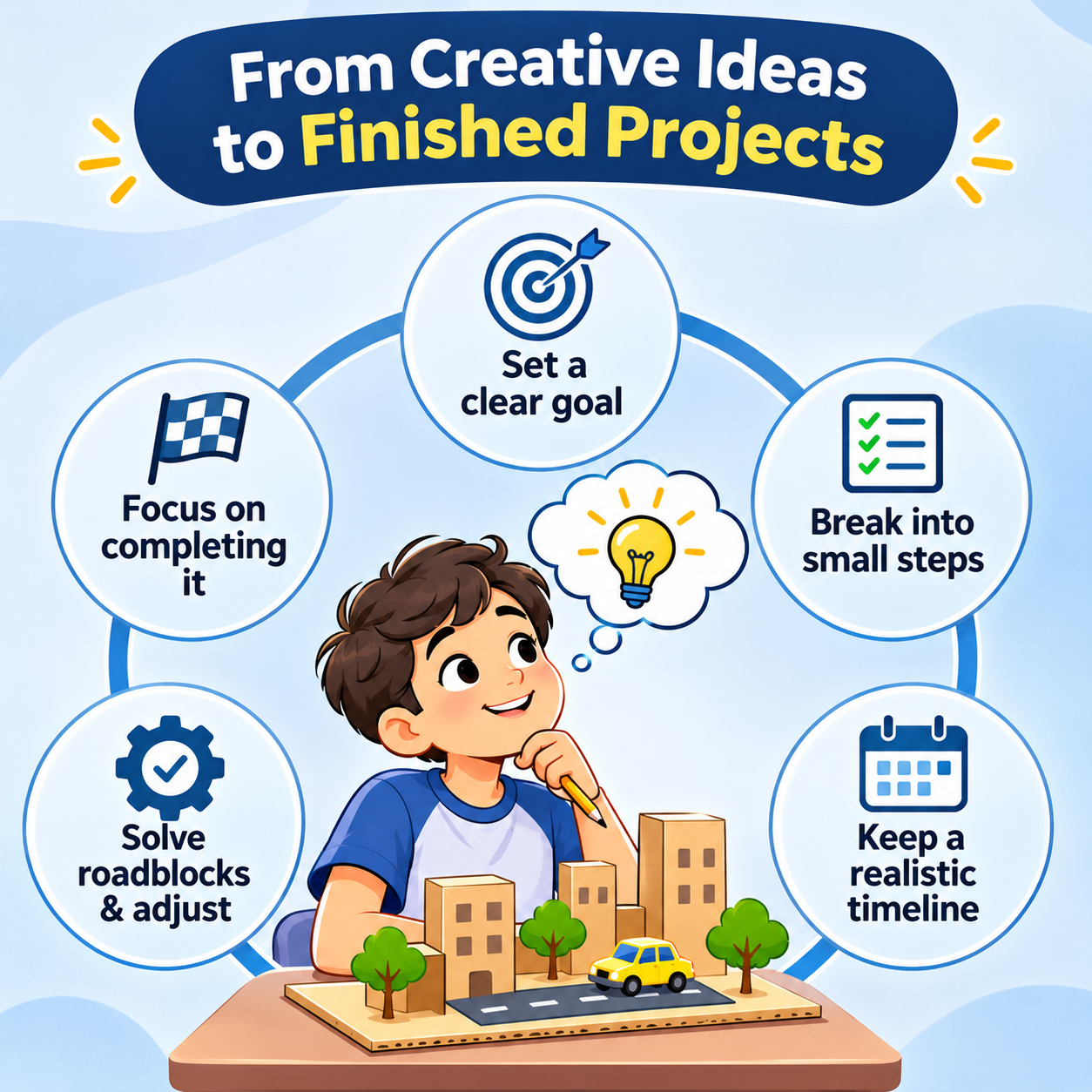
4. Make progress visible. A simple checklist helps children see what they have finished and what remains. It also makes restarting after a break easier.
5. Help without taking over. If the light does not work, ask what they could check first rather than rewiring the model yourself.
6. Decide what finished means. Agree on a point at which the project meets its purpose.
The Education Endowment Foundation's guidance on self-regulated learning recommends teaching children to plan, monitor and evaluate their work. Parents can model those habits through questions such as "What is working?" and "What should we change?"
The aim is to give enough support to keep progress possible while leaving meaningful decisions to the child.
Should Parents Value a Perfect Project or a Finished One?
A simple project that a child plans, tests, and completes can be more educational than an elaborate model mostly assembled by adults.
Imagine two cardboard bridges. One has decorative lights and intricate features but was largely built by a parent. The other is plain, yet the child tested several shapes before making it stable.
Avoid comparing your child's work with highly polished projects online. Instead, ask what they learned and what they would change next time.
Finishing does not require perfection. Sometimes reducing an unrealistic design is itself an important planning decision.
Creative Projects at Grand Columbus International School, Faridabad
Grand Columbus International School (GCIS), Sector 16A, Faridabad, lists an Atal Tinkering Lab, LEGO Robo Lab and robotics-related opportunities in its published school information. Families comparing Best schools in Faridabad can ask how students are supported in planning, testing, and completing their own projects. The availability of these facilities does not, by itself, establish particular teaching methods or student outcomes.

Conclusion
Children may have imaginative ideas long before they develop the planning skills to complete them. Small goals, realistic timelines and thoughtful adult guidance can help bridge that gap.
The aim is not a flawless project. It is helping children make choices, work through difficulties, and experience the satisfaction of finishing something they genuinely helped create.
For more information on Grand Columbus International School and similar schools, check out this list of the best schools in Faridabad.

 as a preferred source on