




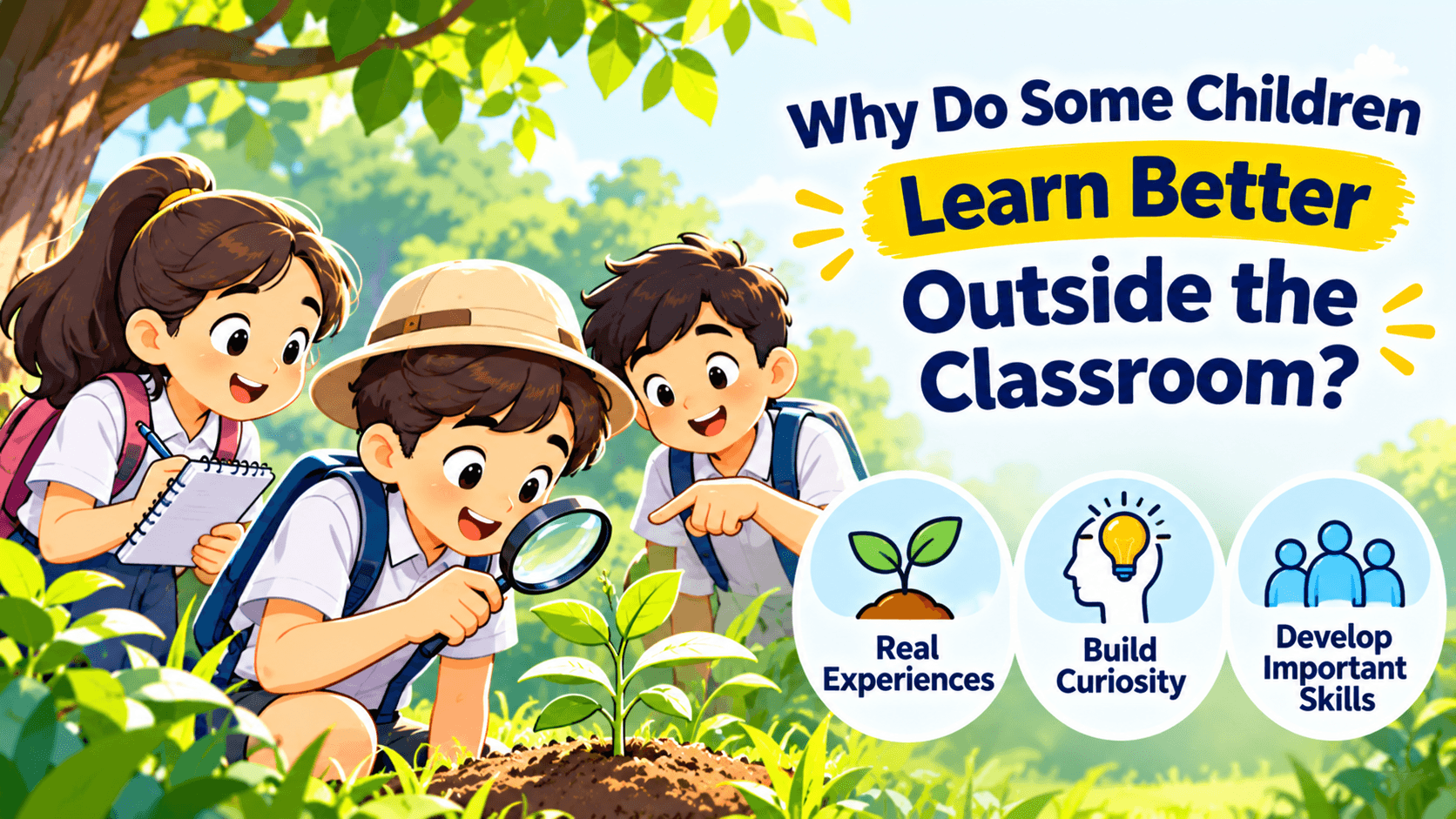

Have you ever noticed that your child struggles to remember a science lesson from their textbook but can explain everything they saw during a visit to a zoo or museum?
Perhaps they find fractions confusing in class but understand them easily while dividing a pizza among family members.
Such experiences raise an interesting question: Why do some children understand concepts better when they experience them in real life?
The answer often lies in how children connect information with practical experiences. While classroom teaching builds essential knowledge, learning beyond the classroom can help children understand how that knowledge works in everyday situations.
Why Does Learning Through Real Experiences Make Concepts Easier?
Children sometimes struggle with concepts because they cannot connect them to anything familiar.
Imagine a child learning about plant growth. Reading about sunlight, soil, and water provides important information. However, planting seeds and observing their growth allows the child to see these concepts in action.
This approach is called experiential learning, where children develop understanding through experiences, observation, and reflection.
India's National Education Policy (NEP) 2020 encourages experiential learning, including hands-on activities, arts-integrated education, and practical applications across subjects.
A 2022 systematic review of nature-based outdoor learning also found promising evidence of improvements in student engagement and motivation, although academic outcomes varied between studies.
The important point is that practical experiences do not automatically replace textbooks. They become valuable when children connect what they observe with what they have already learned.
How Does Learning Outside the Classroom Develop Important Skills?
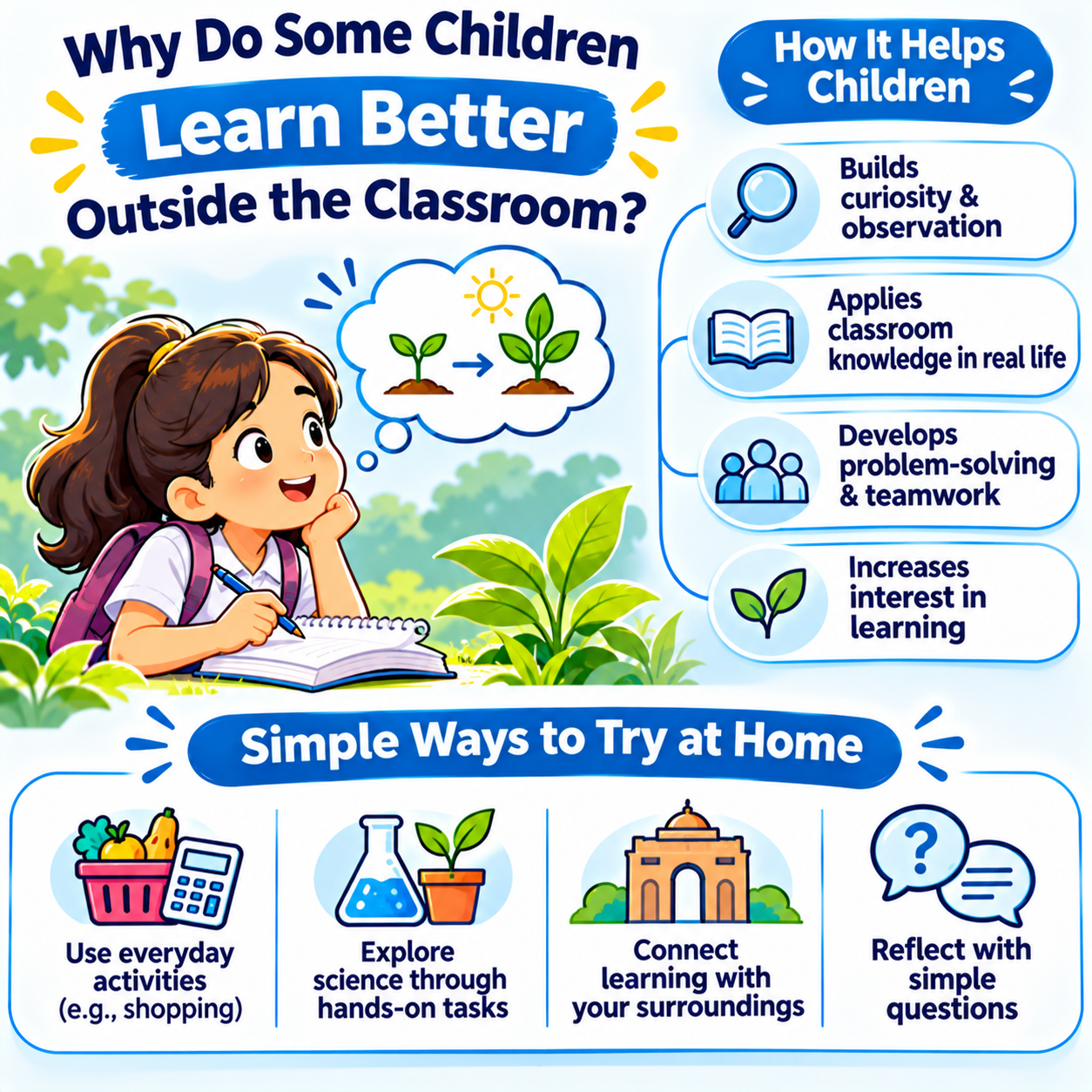
Learning beyond classroom walls can encourage children to observe, question, collaborate, and solve problems.
These abilities develop through everyday experiences rather than memorising information alone.
1. Encourages Curiosity and Observation
During a visit to a garden, a child might notice that some plants grow in sunlight while others grow in shaded areas.
They may begin asking questions:
- Why do certain plants need more sunlight?
- Why do some leaves have different shapes?
- What happens when plants receive too little water?
Such questions encourage children to investigate instead of accepting information without understanding it.
2. Helps Children Apply Academic Knowledge
Imagine children learning measurements while helping their parents prepare a recipe.
They measure ingredients, compare quantities, and adjust portions for additional family members.
Suddenly, mathematics becomes something useful rather than a collection of calculations.
Similarly, visiting a historical monument can help children connect textbook lessons with architecture, geography, and cultural heritage.
3. Builds Problem-Solving and Social Skills
Practical activities often involve unexpected challenges.
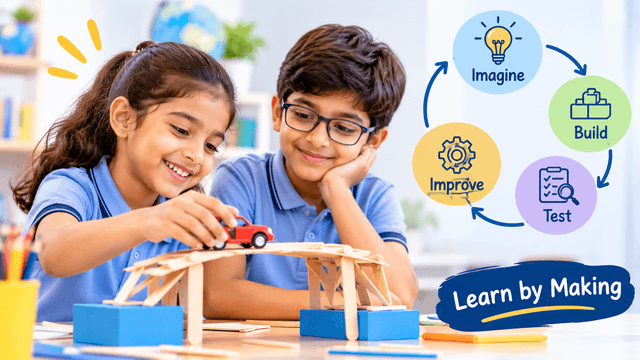
For example, children working together to build a small model bridge might discover that their structure cannot support enough weight.
They must identify the problem, discuss possible solutions, and try again.
Such experiences provide opportunities to practise teamwork, patience, and decision-making.
However, benefits depend on how activities are designed and whether children receive appropriate guidance.
Can Outdoor Experiences Improve Children's Interest in Learning?
Some children become more interested in a subject when they can explore it through movement, observation, and direct participation.
A lesson about insects might feel difficult when children only memorise their characteristics. Observing insects in a garden can make the same subject more engaging.
A 2022 systematic review published in Frontiers in Psychology examined nature-based outdoor learning among schoolchildren. Several studies reported improvements in engagement, motivation, and wellbeing.
However, the review did not establish that outdoor learning consistently produces better academic results than classroom teaching.
This distinction matters.
The Education Endowment Foundation also notes that evidence for improved academic attainment through outdoor adventure learning remains limited.
Therefore, parents should view learning outside the classroom as an additional educational opportunity, not necessarily a superior replacement for structured teaching.
How Can Parents Encourage Experiential Learning at Home?
Parents do not need expensive educational trips or specialised equipment to make everyday experiences meaningful.
Simple activities can help children connect academic concepts with their surroundings.
Turn grocery shopping into a maths activity.
Ask your child to compare product prices, calculate the total bill, or estimate how much change you should receive.
Explore science through household activities.
Let children observe melting ice, growing seeds, or objects that float and sink. Encourage them to predict what might happen before observing the results.
Connect history with local surroundings.
During visits to monuments or museums, discuss how people lived in earlier times and how their surroundings influenced their lives.
Encourage reflection after every activity.
Ask questions such as, "What surprised you?" or "How does this connect with something you learned at school?"
These conversations help children organise their observations and develop a clearer understanding.
Most importantly, allow children to explore without turning every experience into a test.
Connecting Classroom Knowledge With Real-World Experiences
For parents exploring Top schools in Greater Noida West, understanding how schools connect academic concepts with practical experiences can be useful. The Modern Scholar International School(TMSIS), Knowledge Park V, Greater Noida West, describes experiential education as part of its curriculum. Its official website highlights hands-on projects, real-life applications, and trips and excursions, including nature trails and visits to heritage sites. Parents considering the Best Schools in Greater Noida West can ask how such activities connect with classroom lessons and how students reflect on their experiences afterward.

Conclusion
Children do not always learn best by listening, reading, or memorising alone. Sometimes, experiencing a concept helps them understand something that previously seemed confusing.
Classroom teaching provides structure and essential knowledge, while practical experiences create opportunities to apply that knowledge.
For parents, the goal should not be to choose between classroom learning and real-world experiences, but to help children benefit from both.
Even ordinary activities can become meaningful learning opportunities when children are encouraged to observe, question, experiment, and reflect.
To know more about other schools in Greater Noida West, click on the link below







 as a preferred source on