




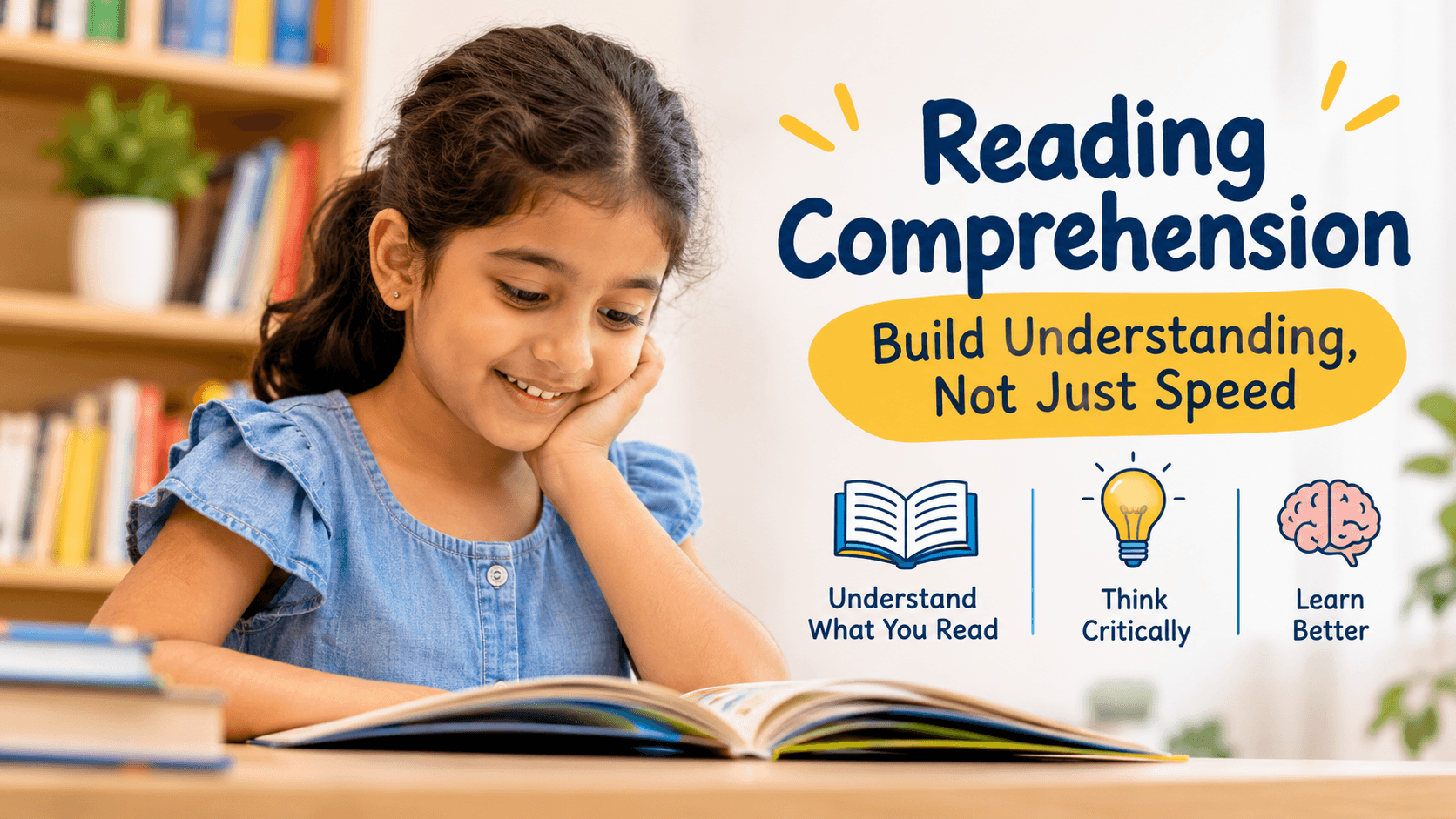

Your child finishes reading a storybook in ten minutes. They read every sentence aloud without much difficulty. But when you ask what the story was about, they struggle to explain it. Does this mean they are becoming good readers?
Not necessarily. Reading is not just about recognising words or finishing a book quickly. Children also need to understand what they read, connect ideas, and explain information in their own words. For parents exploring Top schools in Bangalore, understanding how children develop reading comprehension can help them support their child's overall learning.
1. Reading Fluency and Reading Comprehension Are Not the Same
Reading fluency and reading comprehension are connected, but they are not the same skill. Fluency refers to reading words accurately, smoothly, and with appropriate expression. Comprehension means understanding the meaning of those words and the message they convey.
For example, imagine a child reading a paragraph about how plants grow. They may pronounce every word correctly but still struggle to explain why plants need sunlight, water and nutrients. This shows that reading the paragraph and understanding its meaning are two different things.
Fluent reading helps children recognise words without spending too much effort on each one. This allows them to focus on the meaning of the text. However, reading quickly does not automatically mean that a child understands everything.
The goal should be to help children read accurately, develop a comfortable pace, and understand what they are reading rather than rush through pages.
2. Why Reading Comprehension Is Important for a Child's Overall Learning
Reading comprehension supports learning across different subjects. It helps children understand information, follow instructions, and make sense of new ideas.
Here are four important ways it contributes to their development:
1. Helps with academic understanding
Children encounter written information in almost every subject. In Mathematics, they need to understand word problems before solving them. In Science, they must understand explanations of concepts and processes. Good comprehension helps them understand what a question is asking instead of simply memorising an answer.
2. Develops vocabulary
Books introduce children to unfamiliar words, expressions, and sentence structures. When children understand these words through context, they gradually build a stronger vocabulary. This also helps them express their thoughts more clearly.
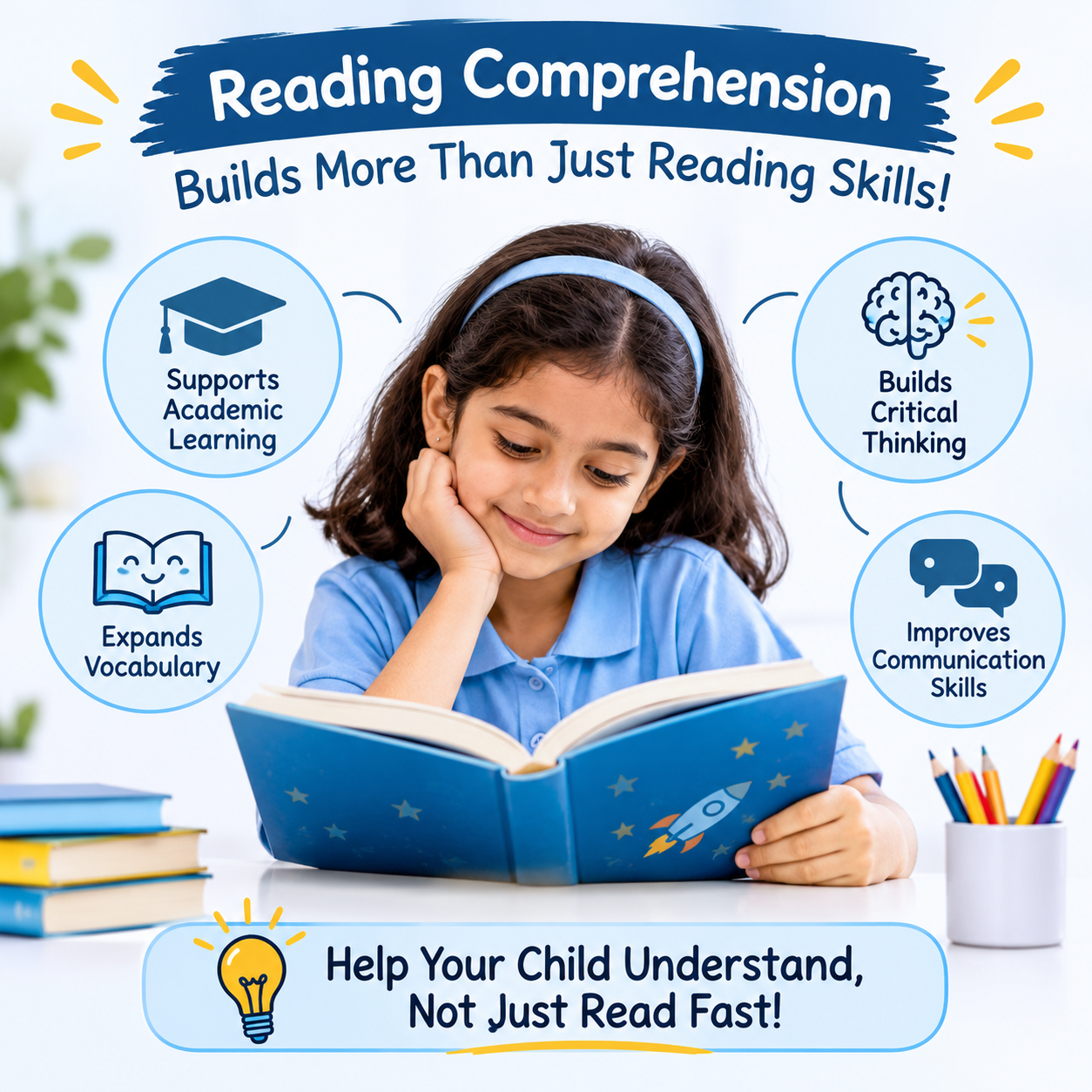
3. Encourages critical thinking
Understanding a story or passage involves more than remembering information. Children learn to identify the main idea, make predictions, compare events, and draw conclusions. These abilities encourage them to think independently rather than accept every piece of information without questioning it.
4. Improves communication skills
Children who understand what they read often find it easier to discuss stories, explain ideas, and participate in conversations. They learn to organise their thoughts and communicate them meaningfully.
Reading comprehension, therefore, is not limited to language classes. It supports a child's learning and communication in everyday situations.
3. How Parents Can Help Children Become Better Readers
Parents do not need complicated teaching methods to improve their child's reading comprehension. Small activities at home can make reading more meaningful and enjoyable.
Ask questions after reading.
After your child finishes a story, ask simple questions such as, "What happened in the story?" or "Why do you think the character did that?" These questions encourage children to think about the meaning instead of simply remembering the words.
Encourage predictions
Pause while reading a story and ask your child what they think might happen next. This encourages them to pay attention to details and connect different events.
Discuss unfamiliar words
Children will come across words they do not understand. Instead of asking them to memorise every definition, explain the meaning through simple examples. You can also encourage them to guess the meaning from the surrounding sentences.
Let children retell stories.
Ask your child to explain a story in their own words. They can describe what happened at the beginning, what changed in the middle, and how the story ended. This helps you understand whether they have followed the main events.
Connect reading with everyday life
Reading does not have to be limited to storybooks. You can read recipes, simple instructions, signs, short news reports, and age-appropriate informational texts together. Discussing these materials helps children understand how reading is useful in everyday situations.
Even spending 10–15 minutes discussing a story together can make reading a more engaging experience. The aim is not to test children but to make them comfortable sharing what they understand.
4. How to Recognise Whether Your Child Understands What They Read
Parents can observe a few simple signs to understand whether their child is developing good reading comprehension.
- Explains the main idea: The child can describe what a passage or story is about without repeating every sentence.
- Answers questions independently: They can answer questions about the text using their own understanding.
- Connects ideas: They relate something they have read to their own experiences or other things they know.
- Understands characters and events: They can explain why a character behaved in a certain way or why something happened.
- Shares personal opinions: They can talk about what they liked, disliked, or found interesting in a story and explain why.
Remember that children develop reading skills at different rates. Some may need more time, practice, or support with unfamiliar words. Instead of comparing your child's reading speed with that of other children, focus on their understanding and gradual progress.
Creating a Reading-Friendly Learning Environment
At New Oxford International School (NOIS), Anekal, Bangalore, learning resources and language-development activities provide opportunities for children to engage with words and ideas. The school has a library with books, magazines, and journals across different subjects, along with a Communication Lab that focuses on vocabulary, pronunciation, speaking, and listening activities. For parents exploring Top schools in Bangalore and Best schools in Bangalore, such learning resources are worth considering when looking at how a school supports children's language development.

Conclusion
The purpose of reading is not simply to finish a book or read a certain number of pages every day. It is to understand ideas, learn new things, and develop the ability to think independently. Parents can support this journey by making reading enjoyable and encouraging children to discuss what they read. A child who understands a story today is gradually learning how to understand the world around them tomorrow.
For more information on this and similar schools, check out this list of the best schools in Bangalore.



 as a preferred source on