






Your child confidently solves percentage questions in their mathematics notebook. But when you ask them to calculate a 20% discount while shopping, they look confused.
"You learned this last week. Why can't you do it now?" you wonder.
For parents exploring Top schools in Bangalore, including Navkis Educational Centre, Kogilu, Bangalore, understanding how children connect classroom knowledge with everyday situations is an important consideration.
A child may understand a lesson but struggle to recognise when or how to use it. This gap between learning something and applying it elsewhere is more common than parents might expect.
Why Do Children Struggle to Apply What They Learn?
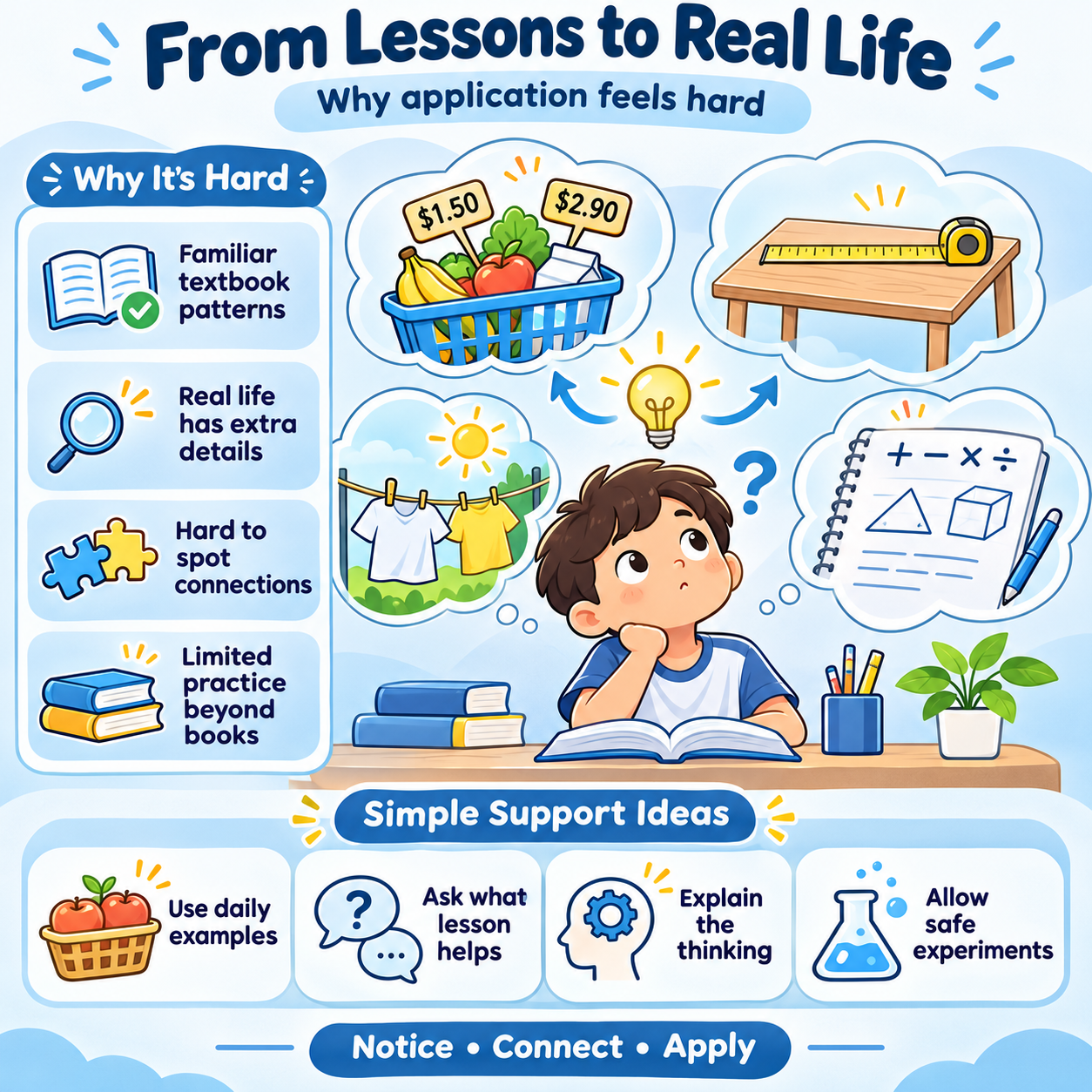
Children often practise concepts in familiar textbook formats. However, everyday situations rarely provide clear instructions or ready-made formulas.
Several factors can make applying knowledge difficult.
1. Textbook questions follow familiar patterns.
A child may solve ten multiplication problems correctly because each question follows the same format.
But when asked to calculate the cost of several identical items at a shop, they might not immediately recognise that multiplication can help.
2. Real-life problems contain extra information.
Textbook questions usually provide the necessary details. Everyday problems require children to identify what matters.
For example, measuring a room for a carpet involves deciding what to measure before calculating the area.
3. Children may not recognise connections.
A student might explain evaporation in science class but struggle to connect it with why wet clothes dry faster on a windy day.
4. They may have limited practice outside textbooks.
Understanding a concept does not automatically mean children can use it independently in unfamiliar situations.
The National Academies' How People Learn explains that knowledge learned in different contexts is more likely to support flexible application.
This means difficulty with practical questions does not necessarily indicate that a child has learned nothing.
How Does Connecting Lessons to Everyday Situations Help?
Children can develop more flexible understanding when they encounter familiar concepts in different situations.
Consider these everyday examples:
Mathematics: While grocery shopping, ask your child to compare the prices of two rice packets of different sizes.
Science: When drying clothes, discuss how moving air, temperature, and humidity can affect evaporation.
Language: Encourage your child to explain directions to a visitor or write a clear message about a family event.
These activities give children opportunities to recognise where classroom knowledge may be useful.
India's National Curriculum Framework for School Education 2023 also emphasises connecting learning with children's experiences and surroundings.
However, parents should avoid turning every household activity into a test.
A casual conversation about why something happens can encourage curiosity without making children feel constantly evaluated.
What Can Parents Do to Help Children Apply Their Knowledge?
Parents don't need expensive educational kits or complicated experiments. Ordinary household situations can provide meaningful learning opportunities.
1. Ask children to identify familiar concepts.
While preparing a recipe, ask, "If we're cooking for twice as many people, how should we change the ingredients?"
Allow your child to recognise that multiplication or proportion might help.
If they struggle, provide a small hint instead of immediately explaining everything.
2. Give children manageable problems to solve.
Suppose your child has ₹200 to purchase notebooks and stationery.
Ask them to compare prices, estimate the total, and decide which items fit the budget.
This encourages them to use arithmetic while considering practical limitations.
3. Encourage children to explain their reasoning.
Rather than focusing only on correct answers, ask:
- "What information do we need?"
- "Which lesson could help us solve this?"
- "How can we check whether the answer makes sense?"
The Education Endowment Foundation recommends helping students plan, monitor, and evaluate their learning.
These questions can encourage children to think about their approach instead of simply remembering a formula.
4. Allow safe mistakes and experiments.
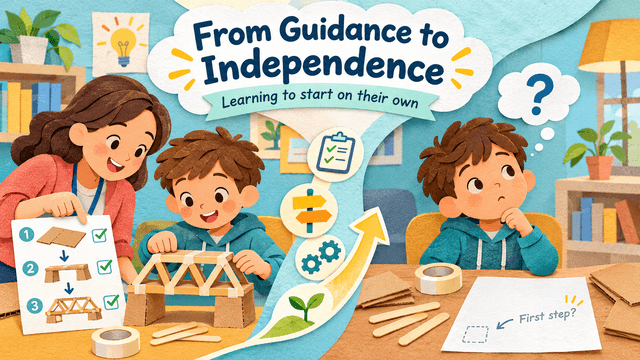
Imagine your child building a paper bridge using folded sheets.
If the bridge collapses, avoid immediately showing them the correct design.
Ask what might happen if they change the folds or add support.
Let them test different ideas safely and observe the results.
5. Discuss what they discovered afterward.
After completing an activity, ask where the same idea might be useful again.
For example, measuring a table may help children understand how similar measurements are used when choosing a tablecloth.
The purpose is not to create more homework. It is to help children notice how knowledge connects with daily life.
How Can Parents Tell Whether Their Child Truly Understands a Concept?
Getting the correct answer is useful, but it does not reveal everything about a child's understanding.
Look for whether your child can explain an idea in their own words, recognise when it might help, and check their reasoning.
For example, a child who understands division may explain why it helps when sharing twelve biscuits equally among four friends.
They might still need guidance when the situation becomes more complicated.
Rather than judging understanding through one unfamiliar question, observe how your child approaches different problems over time.
If difficulties continue across both familiar and new tasks, discussing them with the teacher may help identify where additional support is needed.
Connecting Classroom Learning With Practical Experiences
Navkis Educational Centre, Kogilu, Bangalore describes its Navkis Wheel initiative as an approach that connects academic concepts with practical situations through hands-on experiences. Its official website also discusses interdisciplinary STEAMED education involving design thinking and innovation. For parents comparing the Best schools in Bangalore, these descriptions provide a starting point for asking how classroom concepts are connected to everyday applications, while recognising that learning outcomes depend on individual experiences and teaching practices.

Conclusion
Children may know a concept without immediately recognising where to use it.
Parents can support this connection through everyday conversations, manageable challenges, and opportunities to explain their thinking.
The next time your child learns something new, ask them to find one place where that knowledge might be useful outside the classroom.
For more information on this and similar schools, check out this list of the best schools in Bangalore.













 as a preferred source on