




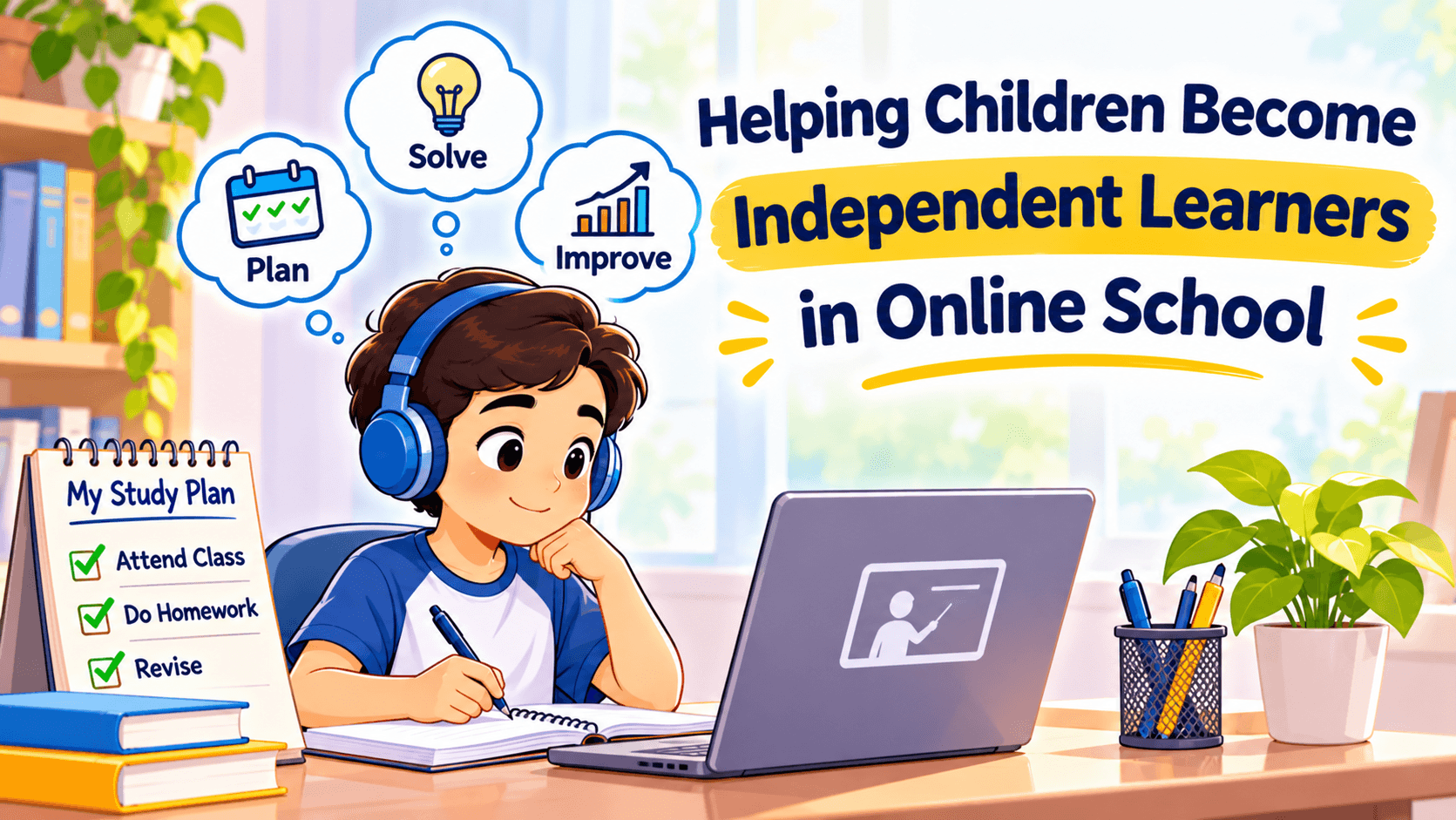

Your child attends online classes regularly, listens to teachers, and completes assignments. But the moment you stop reminding them about homework or checking their timetable, everything seems to come to a halt.
Many parents face this situation. They want their children to take responsibility for studying but worry that giving them too much freedom might affect their learning.
The good news is that independent learning is a skill children can develop gradually. With the right guidance, online schooling can provide opportunities to practise managing time, solving problems, and taking responsibility for schoolwork.
What Does Independent Learning Actually Mean for Children?
Independent learning does not mean leaving children to study without help. It means teaching them to understand what they need to learn, organise their tasks, and recognise when they need support.
For example, imagine a child struggling with a mathematics question. Instead of immediately asking a parent for the answer, they review their notes, try another method, or ask their teacher for clarification.
These small decisions help children become more confident in managing their education.
According to the Education Endowment Foundation (EEF), teaching children to plan, monitor, and evaluate their learning can improve academic performance. Its research identifies these self-regulation strategies as effective ways to support learning.
However, independence develops through practice and guidance, not simply by expecting children to manage everything themselves.
How Can Parents Help Children Manage Their Study Time?
One of the biggest challenges in online education is managing time without constant reminders.
Children may know their class timings but still struggle to organise homework, revision, and breaks.
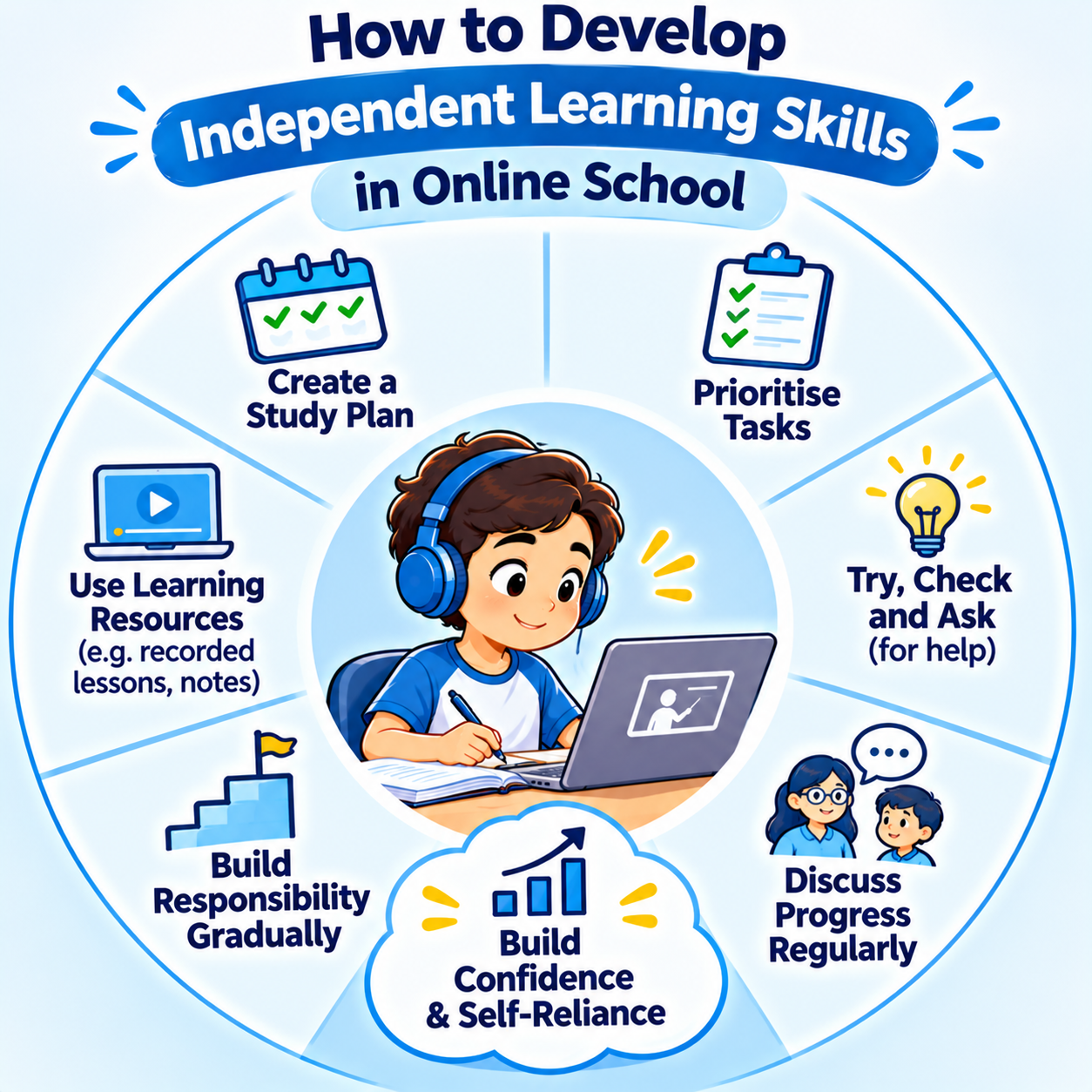
1. Create a Simple Daily Study Plan
Instead of preparing a strict timetable for your child, involve them in making one.
Ask questions such as:
- Which assignments need to be completed today?
- Which subject requires extra practice?
- When would you prefer to revise yesterday's lesson?
- How much time should you keep for breaks?
Younger children may need a visual timetable, while older students can maintain their own planners.
For example, a Class 5 student could list three daily tasks: completing mathematics homework, reading one chapter, and revising science.
Start with manageable goals. Completing a few tasks independently is more useful than creating an unrealistic schedule.
2. Teach Children to Prioritise Tasks
Not every assignment requires immediate attention.
Help children distinguish between urgent homework, upcoming assessments, and subjects needing additional practice.
Initially, parents can guide these decisions. Gradually, children should begin choosing their own priorities.
This approach encourages responsibility without overwhelming them.
How Can Children Learn to Solve Problems Without Depending on Parents?
When children encounter difficult questions, their first reaction may be to ask someone for help.
While asking questions is important, immediately providing answers can reduce opportunities for independent thinking.
Encourage the Try, Check, Ask Approach
Teach children a simple three-step process:
- Try: Attempt the question using existing knowledge.
- Check: Review notes, textbooks, or previous examples.
- Ask: Seek help from a teacher or parent if the difficulty remains.
For instance, if a child cannot understand a science concept, they could revisit the explanation and write down exactly what they find confusing.
This makes their questions more specific and meaningful.
Research from the US Institute of Education Sciences also supports techniques such as practice quizzes and explanatory questions to strengthen learning.
Children can use these strategies to check their understanding rather than relying only on repeated reading.
How Can Parents Encourage Independence Without Removing Support?
A common misunderstanding is that independent learners should complete everything without assistance.
In reality, children need different levels of guidance depending on their age, confidence, and learning needs.
A Class 2 student may require help opening assignments and following instructions. A Class 8 student may be ready to manage deadlines but still need support with difficult subjects.
Parents can gradually reduce assistance as children demonstrate greater responsibility.
Instead of asking, "Have you finished everything?" every hour, try discussing progress at the end of the day.
Ask what they completed, what they found difficult, and what they plan to do differently tomorrow.
These conversations encourage children to reflect on their learning.
It is also important to appreciate effort, improvement, and problem-solving rather than focusing entirely on marks.
If a child misses a deadline, help them understand what went wrong and make a better plan. Treating mistakes as learning opportunities can support confidence and responsibility.
How Sunbeam World School Supports Online Learning
For parents exploring the Top online schools in India, understanding how schools organise independent study and provide academic support is important. Sunbeam World School (SWS), Online School describes a learning model combining live teacher-led classes, recorded lessons, and a learning management system. According to its official website, students can revisit recorded sessions for revision, while parents can access information about assignments, attendance, grades, and teacher feedback. These features can provide opportunities for children to manage revision and monitor schoolwork with appropriate guidance. Families comparing the Best Online schools in India should also consider how effectively each school's learning structure supports their child's individual needs.

Conclusion
Independent learning develops through small, consistent habits rather than sudden changes in responsibility.
When children learn to organise tasks, attempt problems independently, and evaluate their progress, they gradually become more confident learners.
Parents play an important role by offering guidance while allowing children to make age-appropriate decisions.
The goal is not to make children study alone, but to help them become capable of taking responsibility for their learning, whether they attend school online or in a physical classroom.
To know more about other Online Schools, click on the link below





 as a preferred source on