





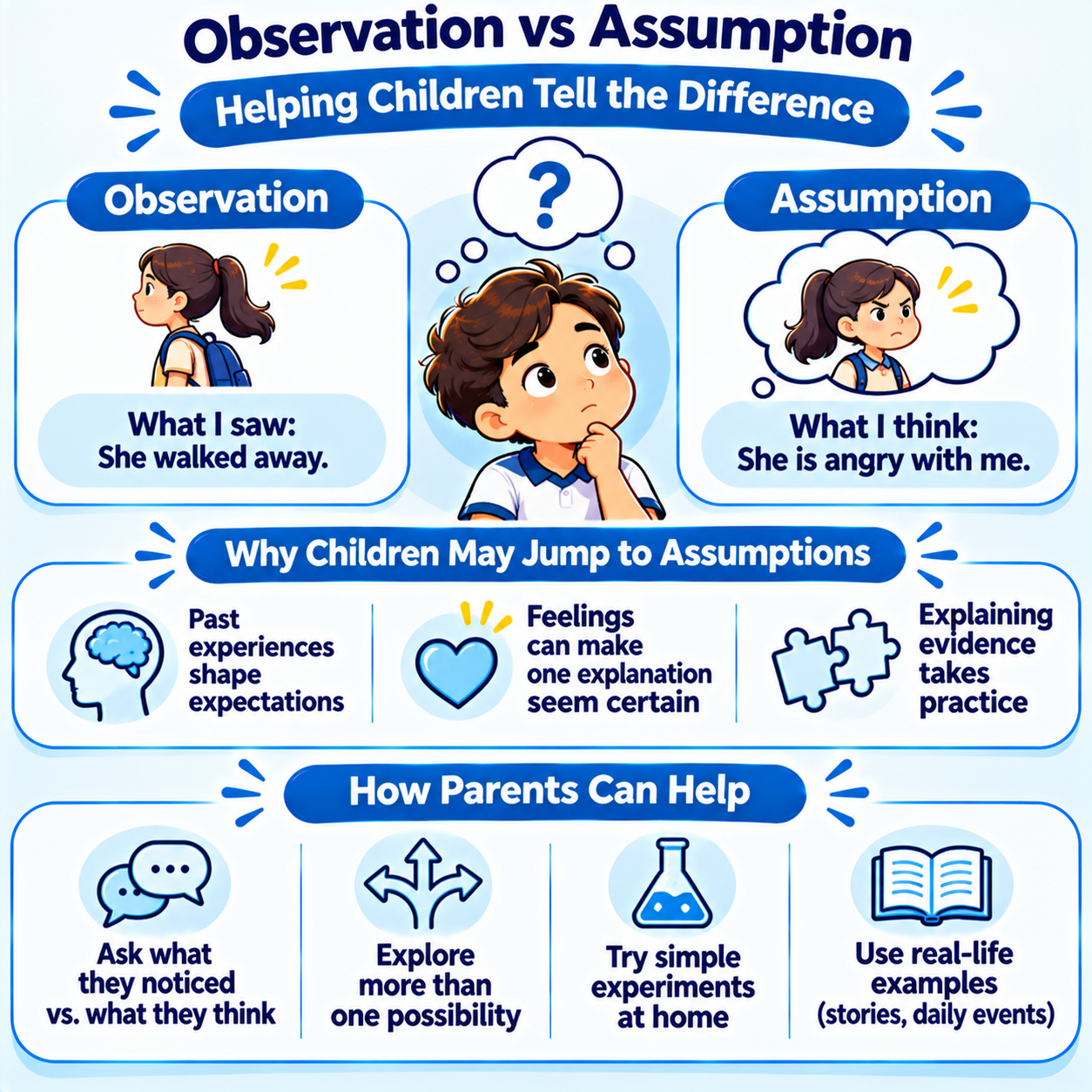
Your child comes home upset because a classmate walked past without saying hello. "She is angry with me," they insist. But when you ask what happened, the only thing they actually saw was their classmate walking away.
Walking away is an observation; believing someone is angry is an interpretation. Children often combine the two without noticing. This can cause misunderstandings in friendships and science lessons.
Helping children separate what they know from what they think happened strengthens their reasoning without making them doubt every experience.
What Is the Difference Between an Observation and an Assumption?
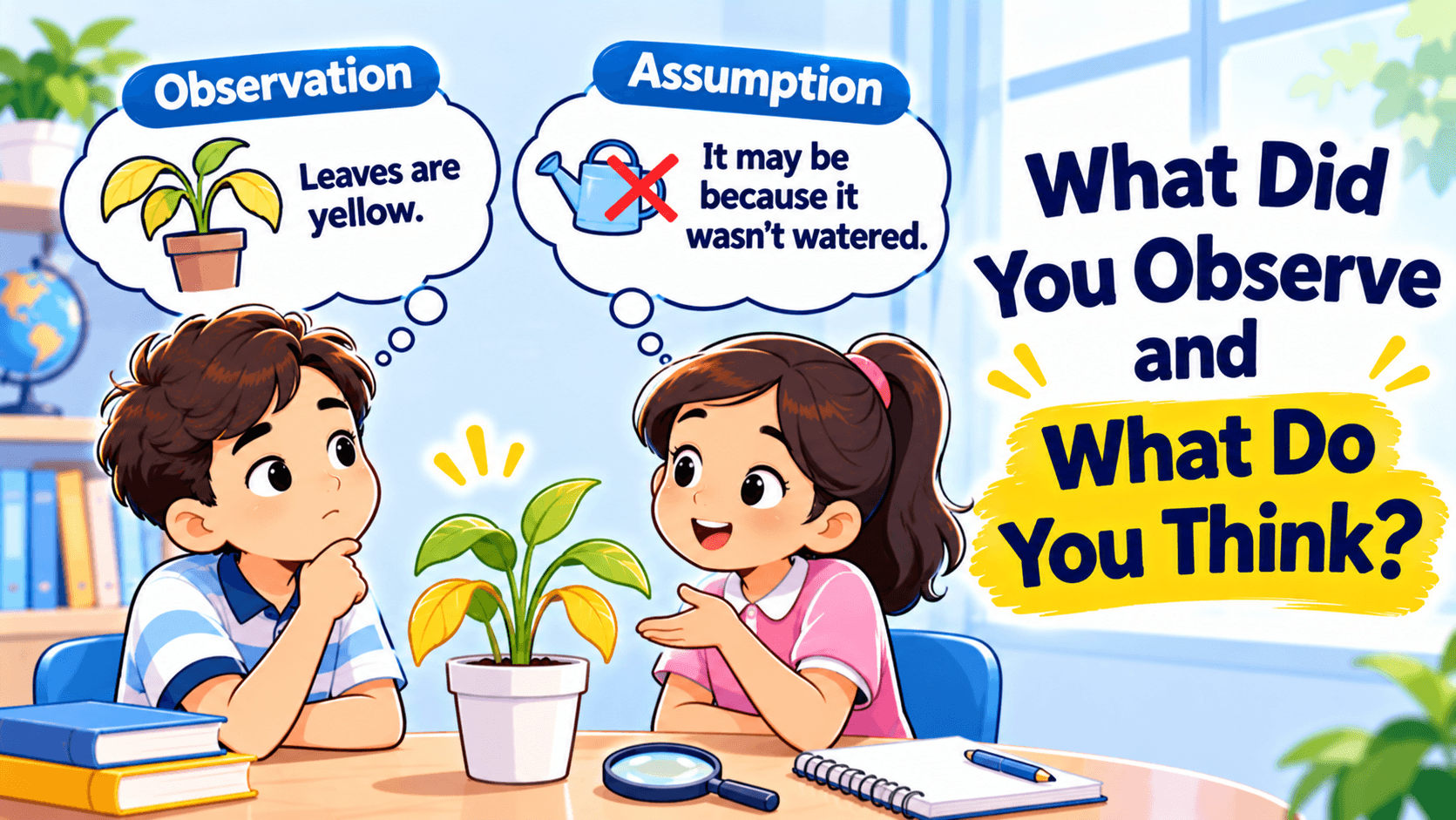
An observation describes information we notice or measure. For example, "The plant's leaves are yellow" is an observation. Saying, "The plant is dying because nobody watered it" is an explanation that needs more evidence.
In science, an explanation based on observations is often called an inference. Inferences can be reasonable and useful, but they are not automatically facts. A plant's leaves might turn yellow for several reasons.
The Royal Society of Chemistry recommends helping students distinguish observations from inferences and checking whether conclusions fit the available evidence.
Parents can introduce a simple distinction: "What did you notice?" followed by "What do you think it means?"
Why Do Children Jump From What They See to What They Believe?
1. Previous Experiences Shape Expectations
If a friend ignored your child's greeting once before, your child may expect the same thing to happen again. They might overlook other explanations, such as noise, distraction, or the friend being in a hurry.
A UNICEF Innocenti research review explains that children's previous knowledge and expectations influence what they notice. They may focus on details that fit an existing idea while missing other information.
2. Feelings Can Make One Explanation Seem Certain
Imagine a child seeing two classmates whispering. If they already feel excluded, they may conclude, "They are talking about me."
Whispering alone does not establish that. Parents can acknowledge the child's hurt feelings while exploring other explanations instead of immediately agreeing or dismissing the concern.
3. Explaining Evidence Takes Practice
In a 2024 study of 192 Japanese elementary-school students, researchers found that children could often distinguish observations from inferences in simple statements. Yet many struggled to connect an explanation clearly to the observations supporting it.
Making a claim, identifying evidence, and explaining the connection are skills that need guidance.
How Does This Skill Help With Schoolwork and Friendships?
In science, children may observe that an ice cube melts faster on one plate than another. Saying that sunlight caused the difference might be reasonable, but the plates could also differ in temperature or material. Testing one factor at a time helps investigate the explanation.
In reading, a character may leave a room quietly. Children might assume the character is upset, although the story has not yet revealed why. Asking them to point to a sentence that supports their answer develops careful interpretation.
In friendships, separating an event from its meaning may prevent unnecessary arguments. "My friend did not invite me today" is different from "My friend never wants me around."
Guesses are useful ideas that can be checked.
How Can Parents Teach Children to Check Their Assumptions?
1. Play "What I Saw, What I Think"
Show your child a picture of a wet road. Ask them to describe what is visible, then suggest possible reasons: rain, a leaking pipe, or someone washing the street.
Explain that a sensible explanation still needs supporting evidence.
2. Ask for More Than One Possibility
When your child makes a quick judgement, ask, "What else might explain this?"
Avoid turning the conversation into an interrogation. Two possible explanations are enough to begin practising flexible thinking.
3. Use Small Experiments
Put two similar plants in different locations and record changes while keeping other conditions as similar as possible.
Discuss what you measured, what you predicted, and what remains uncertain.
4. Model Uncertainty Without Dismissing Feelings
Try saying, "I can see why that bothered you. We know your friend walked away, but we don't know why yet."
If your child reports repeated exclusion, bullying, or unsafe behaviour, take the concern seriously and seek information from a responsible adult. Considering alternatives should never become a reason to ignore a real problem.
Connecting Observation and Inquiry at School
For families exploring Top schools in bangalore, it is useful to ask how teachers help children explain conclusions using evidence. WisdomWood High(WWH), Begur Lake, Bangalore describes inquiry-led CBSE learning, hands-on projects, and weekly agriculture and STEM experiences on its official website. Such settings offer relevant opportunities for observing changes, asking questions, and testing ideas, although the school has not published evidence that a specific programme improves children's ability to distinguish assumptions from observations. Parents comparing Best Schools in Bangalore can ask how students record findings and discuss different explanations.

Conclusion
Children naturally use experience and emotions to make sense of events. Sometimes important details are missing.
Parents can help by asking what was actually observed, what is being inferred, and what could confirm the explanation.
Through ordinary conversations, stories, and simple experiments, children can learn to think carefully without losing their curiosity or confidence.
For more information on this and similar schools, check out this list of the best boarding schools in India.









 as a preferred source on