







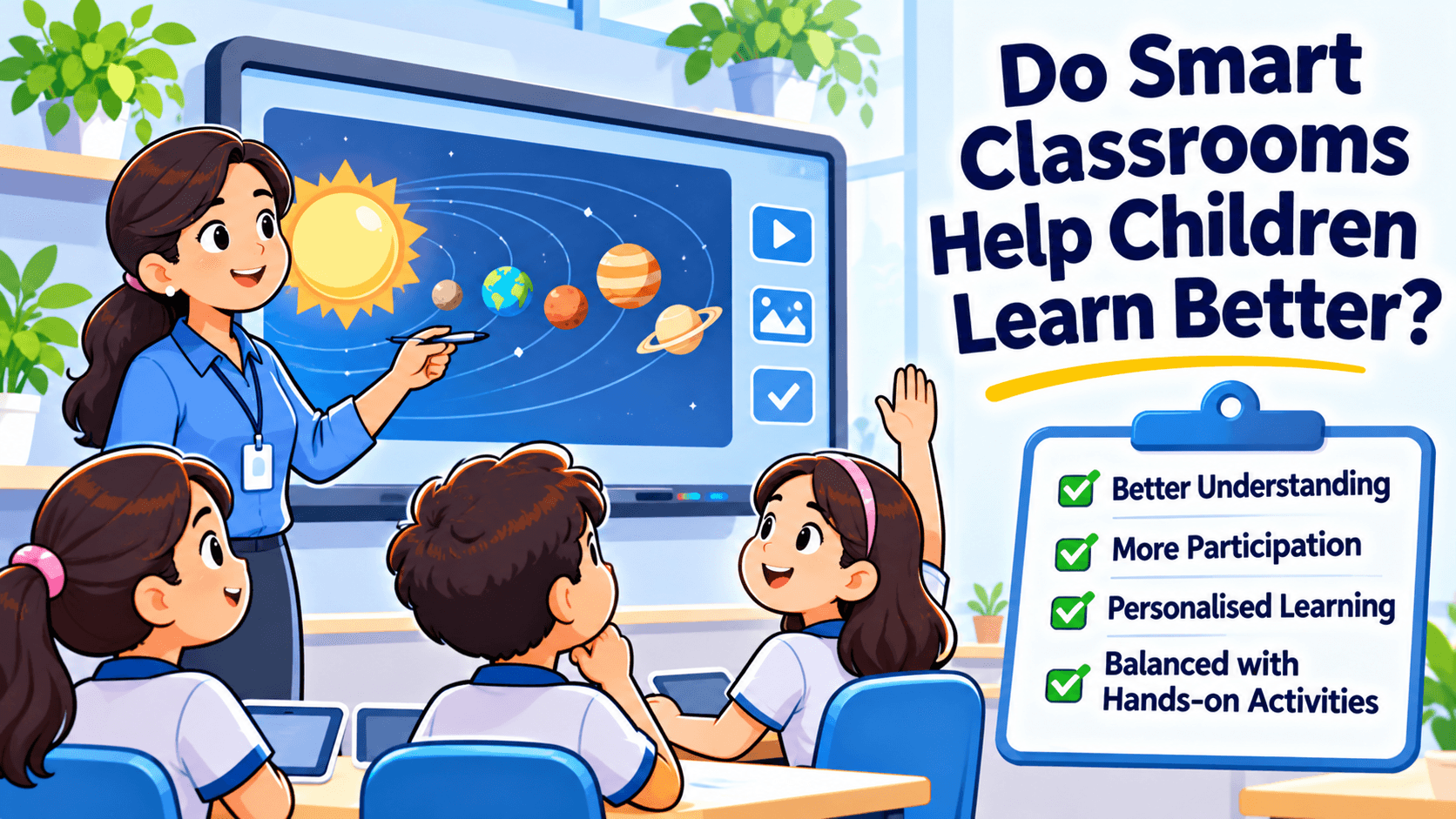

Imagine visiting a school where classrooms have large digital screens, animated lessons, and interactive learning tools. Everything looks modern and exciting. Your child might even say that studying there would be more fun.
But as a parent, you may have an important question: Do smart classrooms actually help children understand lessons better, or do they simply make learning more entertaining?
For parents exploring the Top schools in bangalore, technology-enabled classrooms are often an important consideration. However, the presence of digital equipment does not automatically guarantee better learning.
Understanding how technology supports teaching can help parents make more informed decisions.
1. What Makes a Classroom Truly Smart?
A smart classroom uses digital tools such as interactive boards, educational videos, animations, and learning applications to support regular teaching.
Consider a science lesson about the human heart. A textbook provides diagrams and explanations. A digital animation can show how blood moves through the heart, making the process easier to visualise.
However, watching an animation is only one part of learning.
A teacher might ask students to explain the process in their own words, draw a diagram, or discuss what happens when the heart beats faster.
These activities help children apply what they have seen.
According to UNESCO's 2023 Global Education Monitoring Report, educational technology can improve certain learning experiences, but its effectiveness depends on how it is used and whether teachers provide proper guidance.
The real value of a smart classroom lies in how technology strengthens understanding, not how impressive the equipment looks.
2. How Can Digital Tools Improve Children's Learning?
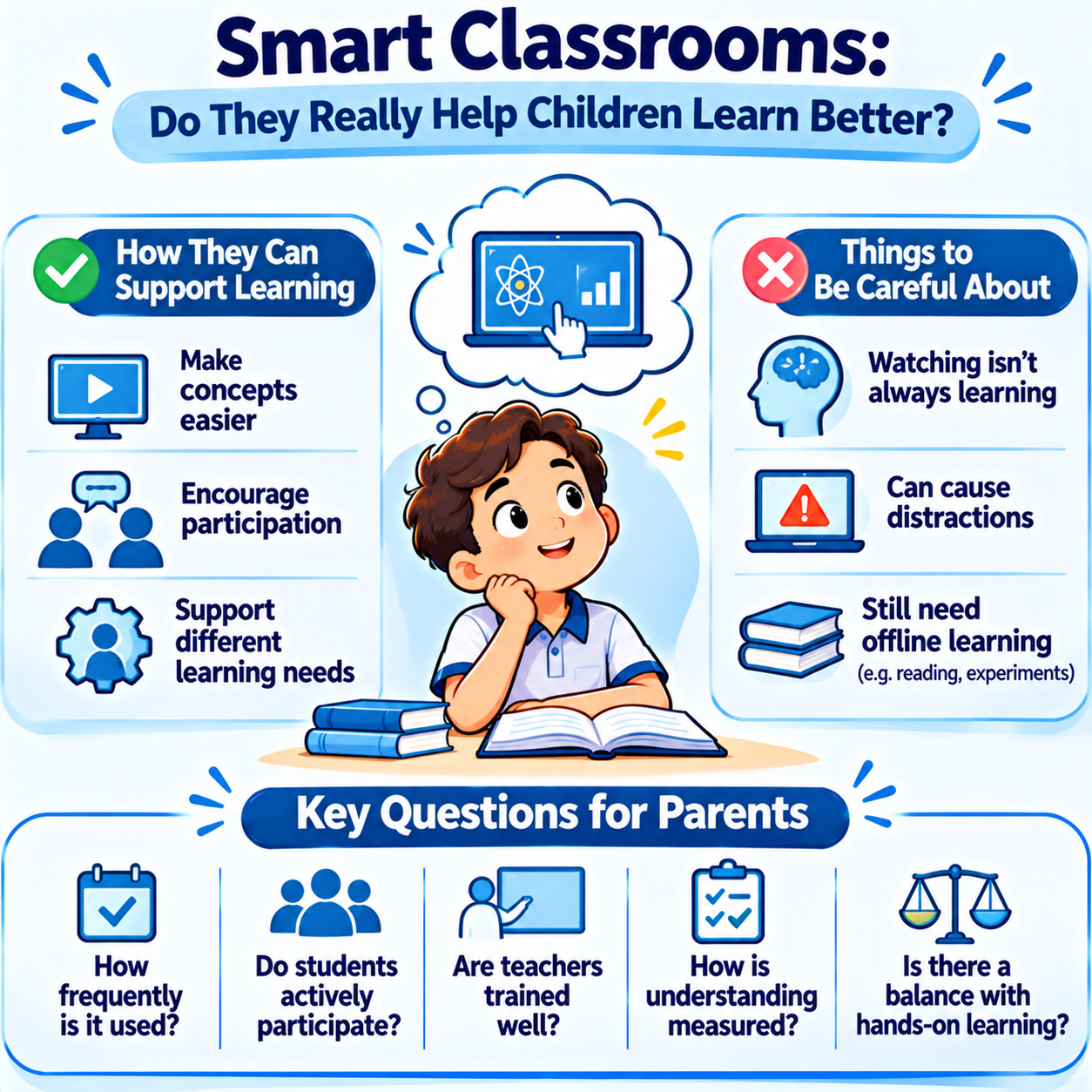
When used thoughtfully, digital resources can make difficult concepts easier to explore.
Making Abstract Concepts Easier to Understand
Some subjects involve ideas that children cannot easily observe.
For example, students learning about the solar system may struggle to understand planetary movement through textbook illustrations alone.
An interactive simulation can demonstrate how planets orbit the Sun while allowing the teacher to explain their movements.
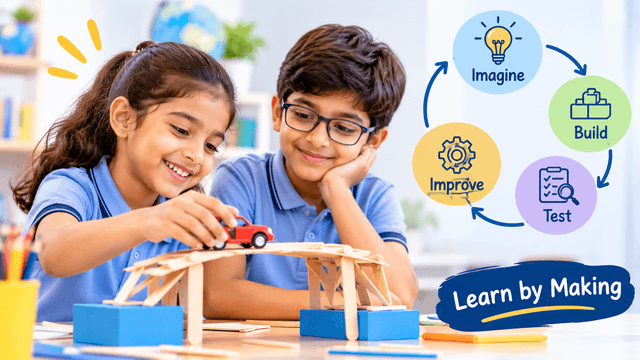
Children can then build a simple model or answer questions about what they observed.
Combining visual explanations with practical activities gives students different ways to understand a concept.
Encouraging Active Participation
Digital quizzes and interactive exercises can encourage students to participate during lessons.
Imagine a mathematics teacher asking students to solve fractions using an interactive board.
Children can attempt solutions, compare approaches, and discuss mistakes.
However, participation should involve thinking rather than simply selecting answers.
A useful follow-up question is: "Can you explain why you chose that answer?"
This helps teachers understand whether students have genuinely understood the lesson.
Supporting Different Learning Needs
Children do not always learn at the same pace.
Some benefit from diagrams, while others need repeated explanations or hands-on activities.
Digital resources can offer additional practice and alternative explanations.
However, technology should complement teacher support rather than replace personal attention.
India's National Education Policy 2020 encourages the thoughtful integration of digital resources into education while recognising the importance of effective teaching practices.
3. Can Too Much Classroom Technology Affect Learning?
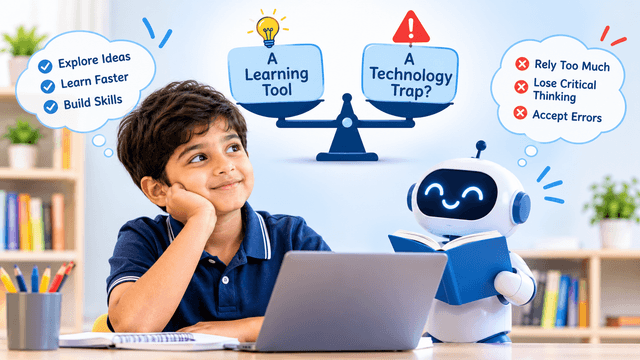
Although technology offers educational benefits, excessive or poorly planned use can create problems.
Watching Is Not the Same as Learning
A child may enjoy an educational video without remembering its main message.
For example, watching a colourful animation about plants does not necessarily mean the child understands photosynthesis.
Teachers need to encourage questioning, discussion, and practical application after digital activities.
Otherwise, learning may remain passive.
Digital Distractions Can Reduce Attention
Frequent animations, notifications, or unrelated digital activities can distract students from the lesson.
UNESCO's research also warns that excessive technology use may reduce educational benefits.
This does not mean schools should avoid technology entirely.
Instead, teachers should select digital activities according to the lesson's learning objectives.
Children Still Need Offline Experiences
Reading physical books, writing, drawing, conducting experiments, and playing with classmates remain valuable parts of education.
For younger children especially, real-world exploration and personal interaction are important.
A balanced classroom allows technology and traditional learning methods to support each other.
4. What Should Parents Look for When Visiting Smart Classrooms?
While comparing the Best Schools in Bangalore, parents should look beyond digital screens and ask how technology contributes to everyday learning.
Here are five useful questions:
1. How frequently are smart classroom tools used?
Ask whether technology supports specific lessons or replaces most classroom activities.
2. Do students actively participate?
Look for opportunities where children solve problems, answer questions, and discuss ideas rather than simply watch presentations.
3. Are teachers trained to use digital tools effectively?
Teachers should understand when technology improves a lesson and when another teaching method works better.
4. How does the school measure understanding?
Ask whether students demonstrate learning through explanations, discussions, assignments, and practical activities.
5. Is there a balance between screen-based and hands-on learning?
A healthy learning environment should include reading, writing, experiments, creative activities, and peer interaction.
Parents can also ask children what they learned during a digital lesson and encourage them to explain it without looking at a screen.
Their responses may reveal more than the technology itself.
Understanding Technology-Supported Learning at Kesar The International School
Kesar The International School (KTIS), Bagalur, Bangalore, describes technology-supported classrooms and a hybrid learning model in its official preparatory-stage curriculum for Grades 3–5. The school also highlights activity-based learning, classroom interaction, and experiential approaches within this stage. For parents evaluating digital learning environments, these stated approaches provide a starting point for asking how technology is combined with teacher guidance and practical classroom experiences. Observing lessons and discussing teaching practices with school representatives can help families understand how these approaches work in practice.

Conclusion
Smart classrooms can make education more engaging, but technology alone cannot guarantee meaningful learning.
What matters is whether children understand concepts, ask questions, develop reasoning skills, and apply knowledge beyond the screen.
When choosing a school, parents should focus less on the number of digital devices and more on how teachers use them.
The smartest classroom is not necessarily the one with the most technology, but the one where children learn to think independently.
For more information on this and similar schools, check out this list of the best schools in Bangalore.










 as a preferred source on