




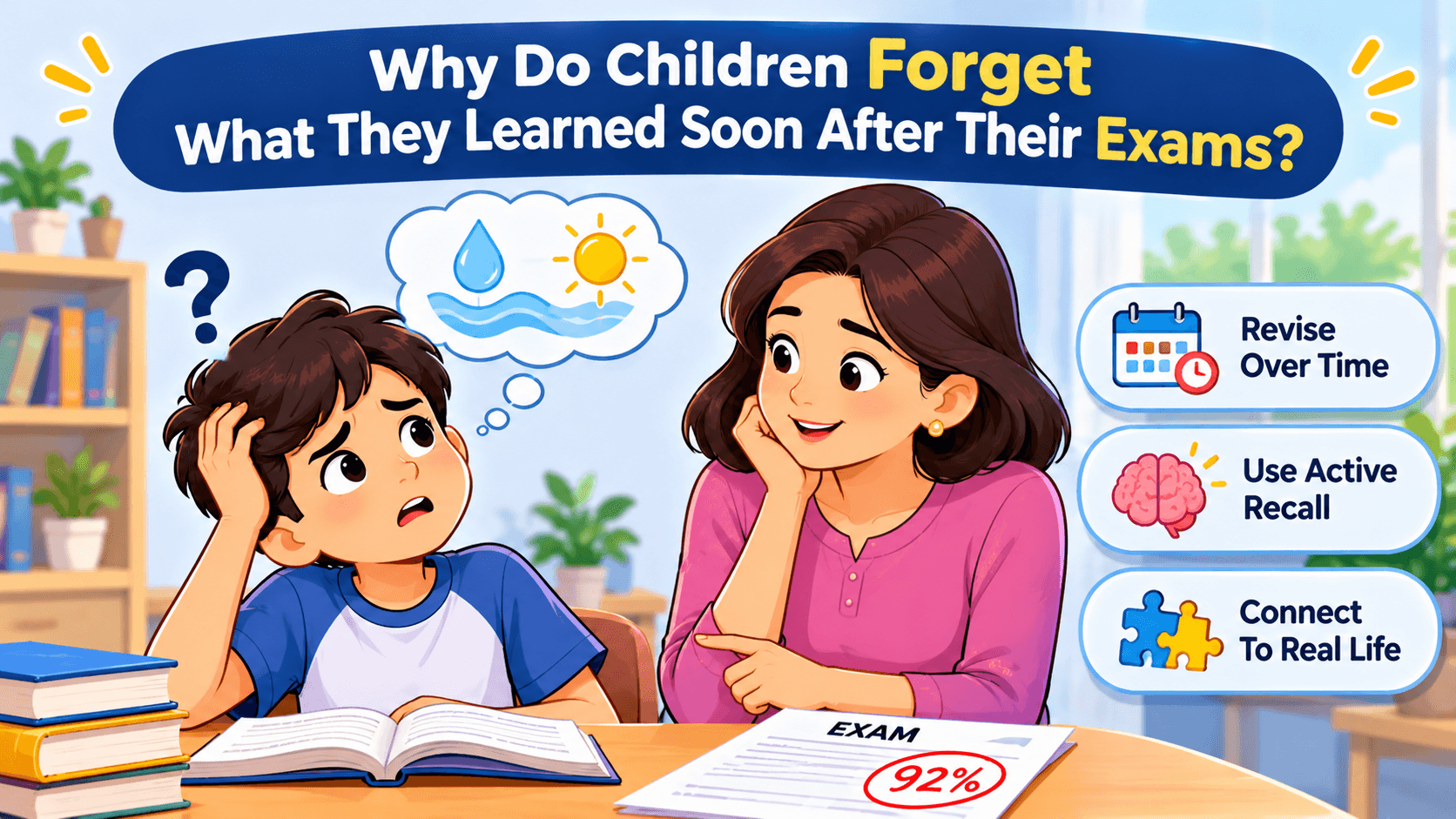

Your child scores 92% in a science exam, to everyone's delight. Three weeks later, you ask why wet clothes dry faster in sunlight. They hesitate, even though they answered a similar question correctly in the test.
Does that mean they never understood the chapter?
For parents exploring Top Schools in Greater Noida West, including The Infinity School (TIS), Tech Zone VII, Greater Noida West, this raises a question about learning beyond marks.
Forgetting some information is normal. What matters is how children study, revisit and use what they have learned.
Why Do Children Remember Answers During Exams but Forget Them Later?
In the days before an exam, children often spend extra time with their textbooks. Definitions, diagrams and answers become familiar through repetition.
During the test, questions may also provide clues that help them remember the information. Weeks later, without those clues or recent revision, remembering the same answer can be harder.
Consider a child who memorises the definition of evaporation. They reproduce it accurately in an exam but cannot explain why a puddle disappears after a sunny afternoon.
The difficulty may involve recall, understanding or application.
Research on learning techniques shows that studying repeatedly in a short period is not always the most effective way to remember information over time.
Still, forgetting does not prove that the child only memorised. Even well-understood lessons can become harder to recall when they are not used.
Why Doesn't Rereading a Chapter Always Help Children Remember?
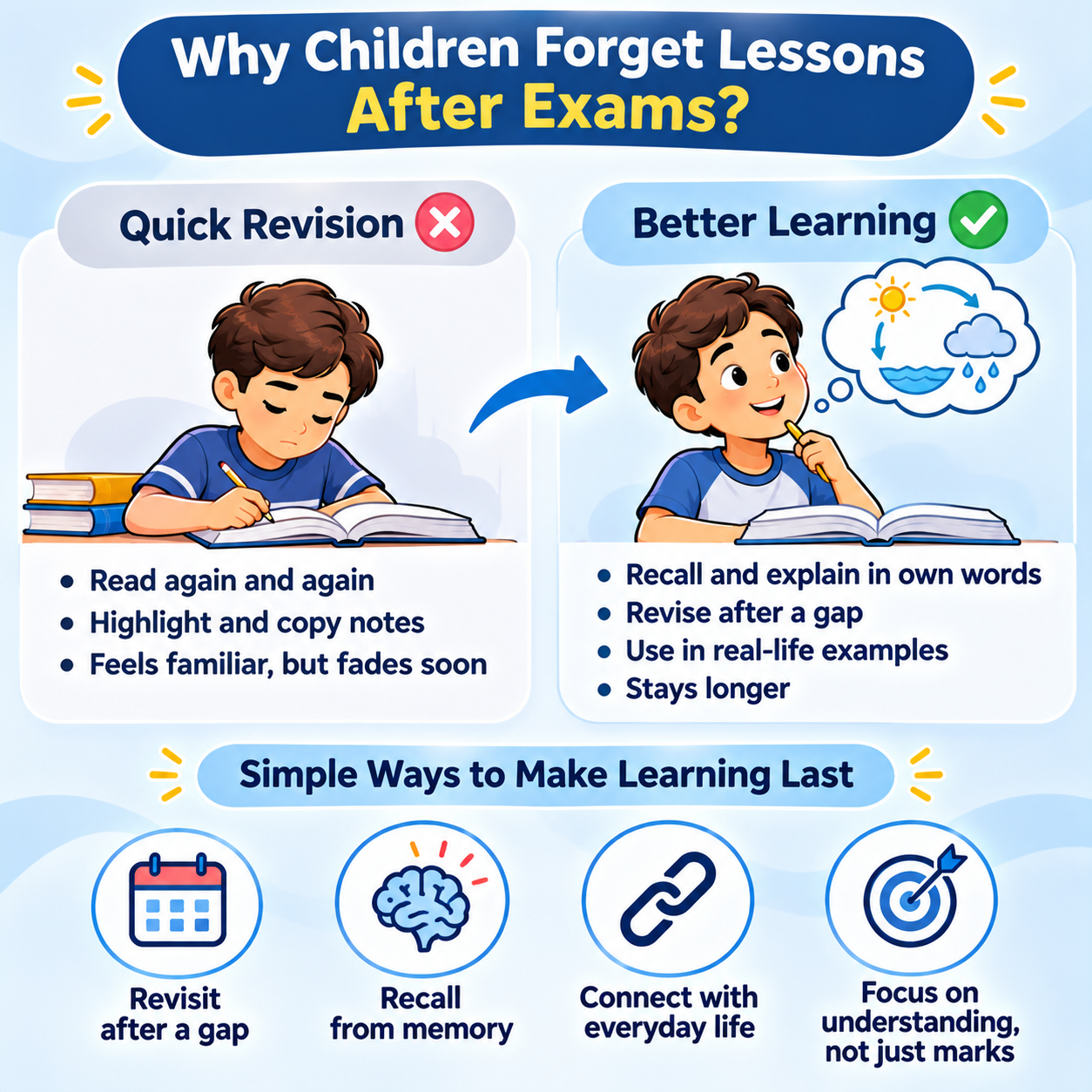
Reading a chapter several times can create a feeling of confidence. When children recognise every sentence, they may assume they know the material.
But recognising an explanation on a page is easier than producing it from memory.
Imagine two students preparing for a history test. One reads the chapter four times. The other reads it once, closes the book and tries to explain the events in order.
The second student may forget a date or mix up two events. That struggle identifies what needs another look.
This approach is called retrieval practice: trying to remember information before checking the answer.
Research reviewed by psychologist John Dunlosky and colleagues identifies practice testing and spreading study across different days as useful learning techniques.
Retrieval should not become a punishment. If a child cannot remember something, let them check the explanation, discuss it and try again. The goal is learning, not catching mistakes.
How Can Parents Help Children Remember Lessons for Longer?
Children do not necessarily need longer study hours. They often benefit from using their study time differently.
1. Revisit a topic after a gap. Instead of studying fractions only the night before an exam, return to the concept a few days later and again the following week.
2. Ask for explanations without the textbook. After a science lesson, invite your child to describe the water cycle in their own words. Then check the book together for missing steps.
3. Connect lessons with everyday life. Fractions can appear while sharing a pizza. Evaporation can be discussed while drying clothes.
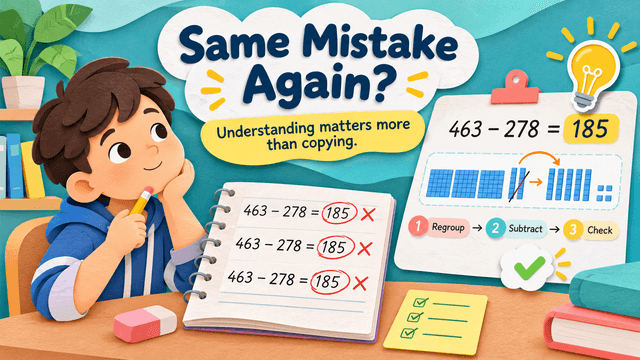
4. Use different questions. A child who has solved ten similar multiplication problems can try a word problem that requires deciding when multiplication is useful.
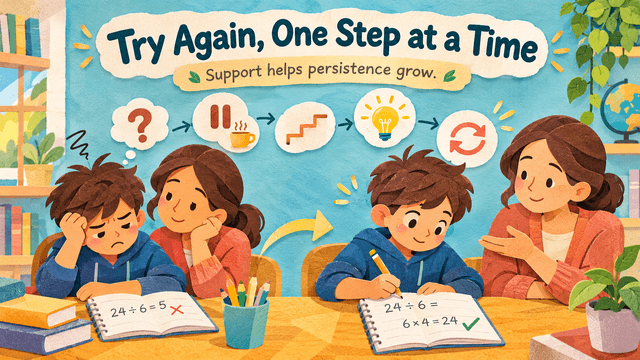
5. Return to forgotten information calmly. Ask what they remember, clarify what is missing and give them another chance to explain.
Evidence on spacing and retrieval supports revisiting and recalling information across time. Educational guidance on self-regulated learning also encourages children to notice what they know and what still needs work.
Keep these activities short and age-appropriate. Revision should support sleep, play and family time, not replace them.
How Can Parents Tell Whether Learning Is Lasting Beyond the Exam?
Marks show how a child performed on particular questions on exam day. To explore lasting learning, look for what they can explain and use later.
A child might connect a new lesson about plant growth to an earlier explanation of photosynthesis. Another might recognise when a fraction method applies to a cooking problem.
Parents can occasionally ask, “What do you remember from the chapter we studied last month?” or “Where could we use this idea?”
Avoid turning every conversation into a surprise test. Children may need a hint, and perfect recall is not the goal.
Look for growing understanding, willingness to review mistakes and the ability to apply familiar ideas in new situations.
Learning Beyond Exams at The Infinity School
The Infinity School (TIS), Tech Zone VII, Greater Noida West, describes mastery-based learning and deliberate practice in its published curriculum. These provide a relevant starting point for parents to ask how earlier concepts are revisited and how understanding is assessed over time. The curriculum description does not establish that the school follows a particular spaced-revision or retrieval-practice schedule, or that students achieve specific memory outcomes.

Conclusion
Forgetting after an exam is not automatically a sign that learning failed. But it can reveal which ideas need to be recalled, revisited, or explained differently.
Rather than focusing only on how many times children read a chapter, help them return to its key ideas and use them in everyday situations. That is how exam preparation can become part of longer-lasting learning.
To know more about other schools in Greater Noida West, click on the link below










 as a preferred source on