






Your child practises for weeks for a school dance competition. On the final day, they forget a few steps and return home upset. Instead of talking about everything they learned, they say, "I'm terrible at dancing. I never want to perform again."
For parents exploring Top Boarding schools in India, including Mody School Lakshmangarh, Sikar, understanding how children respond to disappointing results is an important part of supporting their emotional development.
One bad performance does not define a child's abilities. However, understanding why it feels so significant can help parents respond more effectively.
Why Can One Bad Performance Affect a Child's Confidence So Much?
Children sometimes judge their abilities based on their most recent experience. When something goes wrong, they may overlook previous improvements and focus entirely on the mistake.
Imagine a child who enjoys drawing but does not receive a prize in an art competition. Instead of thinking that another participant performed better that day, they conclude that they are not creative.
This happens partly because children may connect their performance with their personal worth.
They may also worry about how classmates, teachers, or parents will react. For a child who usually performs well, an unexpected setback can feel particularly uncomfortable.
The American Psychological Association (APA) explains that believing abilities are fixed can make students more likely to withdraw when they encounter difficulties.
However, disappointment does not always indicate low confidence. Sometimes, children are simply upset because something mattered deeply to them.
What matters is helping them understand the difference between making a mistake and being incapable.
How Can Parents Accidentally Make Disappointment Feel Worse?
Parents usually want to motivate their children after a disappointing result. However, their immediate reactions can sometimes add pressure.
Consider a child who loses a badminton match. Before asking how the child feels, a parent begins explaining everything they should have done differently.
Although the advice may be useful, the timing can make the child feel judged.
Comparisons can create similar problems.
Statements such as "Your friend won because she practised harder" may cause children to focus on how they measure up against others rather than what they can improve.
Even dismissing disappointment can be unhelpful. Saying "It's just a competition, stop crying" might make children feel that their emotions are unreasonable.
The American Academy of Pediatrics advises parents to value effort, improvement, and sportsmanship rather than judging young athletes only by winning.
This does not mean parents should avoid discussing mistakes. It means children may respond better to constructive feedback after they have had time to process their feelings.
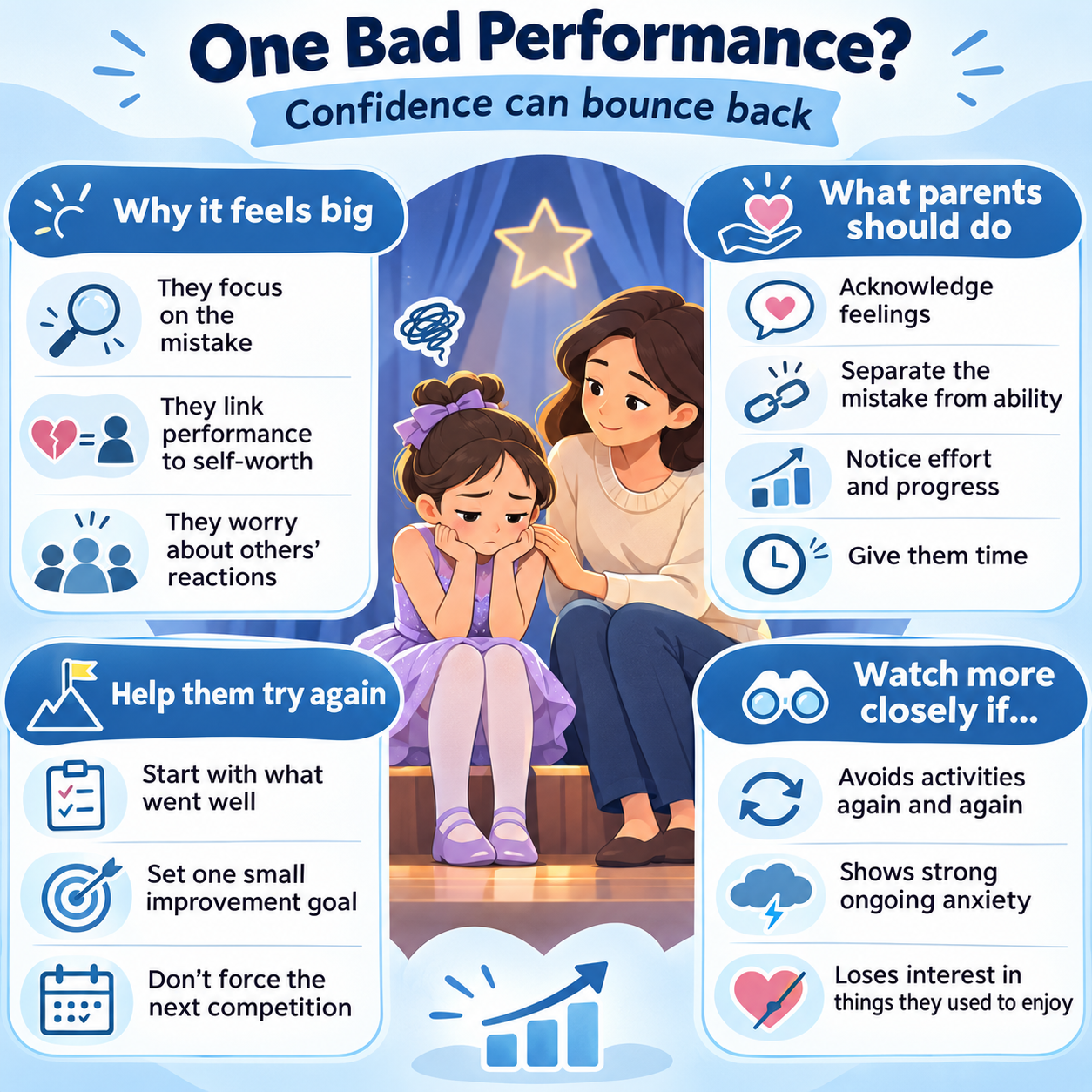
What Should Parents Do Immediately After a Disappointing Performance?
Children often need emotional support before they are ready to discuss what went wrong.
Parents can help through four simple approaches.
1. Acknowledge their disappointment
Instead of immediately saying, "You'll win next time," try, "I know you're disappointed because you worked hard for this."
This allows children to express their feelings without believing they must quickly become cheerful.
2. Separate performance from personal ability
Remind children that a single result reflects one performance, not everything they know or can achieve.
A child who forgets part of a speech has made a mistake during that speech. It does not mean they are incapable of public speaking.
3. Recognise specific preparation
Rather than offering exaggerated praise, notice something meaningful.
For example, "You remembered the difficult section you struggled with during practice" acknowledges genuine progress.
APA research supports feedback that focuses on effective strategies, effort, and improvement instead of fixed labels such as naturally talented.
4. Give children time
Not every disappointing experience needs an immediate discussion.
Some children want to talk straightaway. Others need a little space before they can reflect calmly.
UNICEF recommends acknowledging disappointment rather than ignoring it and helping adolescents consider what they can learn once they are ready.
How Can Children Learn From a Setback Without Becoming Afraid to Try Again?
Once children feel calmer, parents can encourage reflection without turning the experience into another examination.
Start by asking what went well.
A child who struggled during a debate might still have researched the topic carefully or explained one argument clearly.
Then discuss one area for improvement.
Instead of saying, "You need to become more confident," suggest practising the opening lines of the next speech or organising ideas into three clear points.
Small, specific goals make improvement easier to understand.
Children should also have some choice about participating again. Immediately enrolling them in another competition may increase pressure rather than rebuild confidence.
If a child experiences persistent sadness, severe anxiety, or ongoing avoidance of activities they previously enjoyed, parents should consider additional support from a qualified professional.
The aim is not to eliminate disappointment. It is to help children recognise that setbacks can be understood, managed, and learned from.
Learning Through Performance at Mody School Lakshmangarh, Sikar
Parents comparing the Best Boarding schools in india may also consider opportunities for cultural and sporting participation. Mody School Lakshmangarh, Sikar, reports that its students participated in the IPSC Dance Fest in May 2026, receiving awards for choreography theme representation and Bharatanatyam costume design. Such events provide a relevant context for discussing preparation, performance, and competition results. However, participation or awards alone do not establish how individual students respond emotionally to success or disappointment.

Conclusion
A disappointing performance can affect children deeply, especially when they have invested time and effort. Parents can help by recognising their feelings, avoiding unnecessary comparisons, and discussing improvement without pressure.
Confidence does not mean never feeling disappointed. It means gradually learning that one difficult experience does not determine what a child can achieve next.
For more information on this and similar schools, check out this list of the best boarding schools in India.









 as a preferred source on