




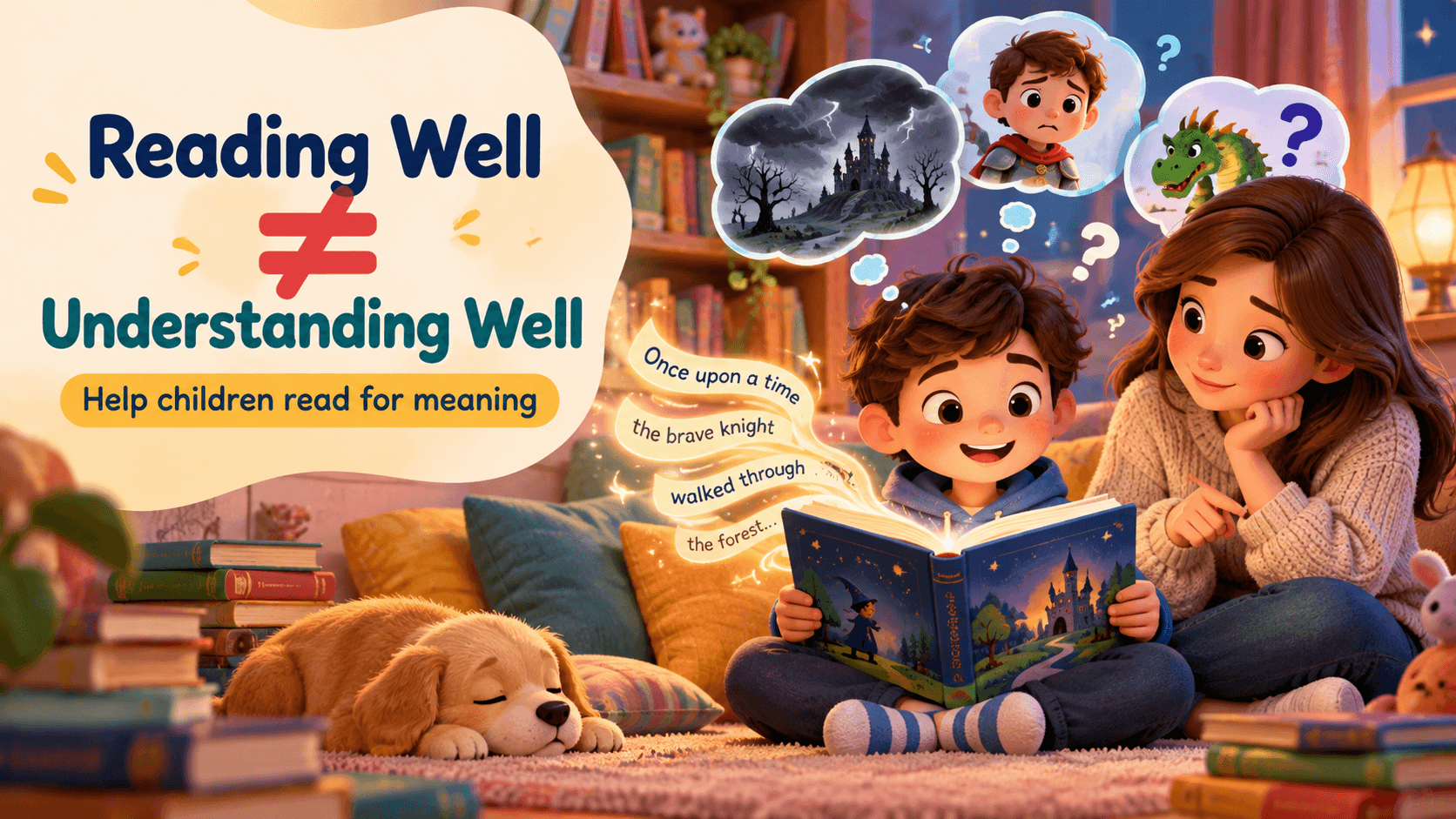

Your eight-year-old reads an entire page from a storybook without stumbling over a single word. You feel pleased with their progress. But when you ask, "Why was the main character upset?" your child looks confused and cannot explain what happened.
For parents exploring Top Schools in Bangalore, including Prestige International School(PIS), Rampura, Bangalore, this raises an important question: why can some children read confidently but struggle to understand the meaning of a passage?
The answer lies in understanding that reading words and understanding ideas are connected but different skills. Both need attention as children develop their reading abilities.
Why Doesn't Fluent Reading Always Mean Good Comprehension?
Reading fluency involves recognising words accurately and reading them with appropriate speed and expression. Reading comprehension involves understanding the ideas, events, and information those words communicate.
A child might read the sentence, "Riya hurried home as dark clouds gathered," without difficulty. However, they may not understand that Riya was probably worried about getting caught in the rain.
The sentence does not directly explain her feelings. The reader must connect the information and draw a conclusion.
This ability is called making an inference, and it is an important part of reading comprehension.
Educational guidance from the Institute of Education Sciences recognises that understanding language, vocabulary, and meaning is essential alongside foundational reading skills.
Fluent reading creates a useful foundation, but it does not automatically ensure understanding.
Parents should therefore pay attention not only to how smoothly children read but also to whether they can explain what they have read.
What Makes Understanding a Story Difficult for Some Children?
Several factors can affect how well children understand written material.
Unfamiliar vocabulary: A child may pronounce a word correctly without knowing what it means. For example, recognising the word "reluctant" is different from understanding why a character feels unwilling to do something.
Limited background knowledge: Imagine a child reading about farming in a snowy mountain village. If they have never encountered that environment, certain descriptions may be difficult to imagine.
Difficulty connecting events: Understanding a story requires remembering earlier information and recognising how events influence one another.
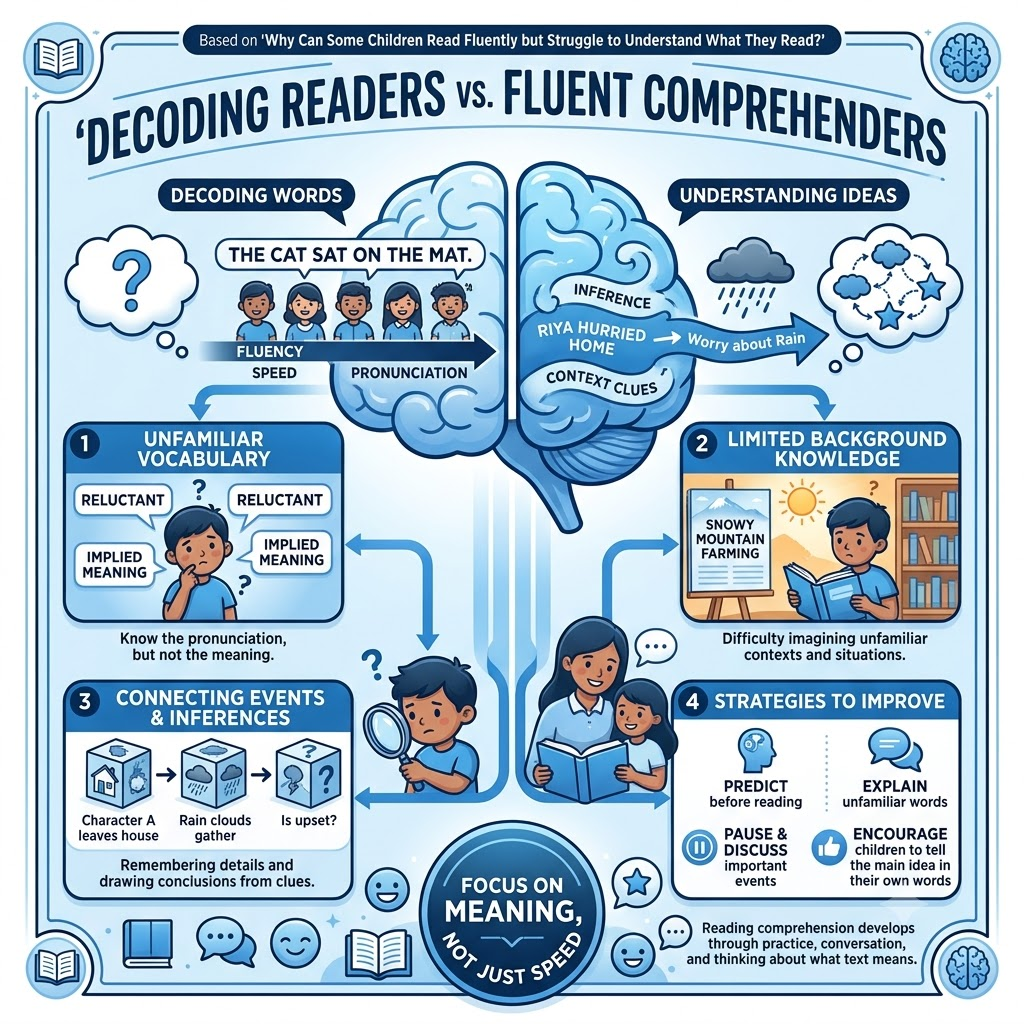
Trouble understanding implied meaning: Sometimes writers communicate feelings or intentions without stating them directly. Children may need practice using clues to understand these ideas.
Reading without checking understanding: A child may continue turning pages even after losing track of the story.
These difficulties do not necessarily mean a child lacks concentration or intelligence.
Sometimes the reading material is unfamiliar, the vocabulary is challenging, or the child needs more experience discussing ideas.
Understanding the reason behind the difficulty helps parents offer useful support instead of simply asking children to read the passage again.
How Can Parents Improve Reading Comprehension at Home?
Reading comprehension develops through practice, conversation, and opportunities to think about what a text means.
The Education Endowment Foundation identifies strategies such as predicting, questioning, summarising, and making connections as useful approaches to developing reading comprehension.
Parents can introduce these habits through simple activities.
Talk before reading. Look at the title and illustrations together. Ask, "What do you think this story might be about?" This helps children connect the reading material with things they already know.
Explain unfamiliar words naturally. If your child encounters a difficult word, explain it using a familiar example rather than expecting them to memorise a dictionary definition.
Pause to discuss important events. After a few paragraphs, ask, "What has happened so far?" or "Why do you think the character made that choice?"
Encourage predictions. Before turning the page, ask what might happen next. Children can use clues from the story to support their guesses.
Invite children to explain the story. Instead of asking them to repeat every detail, encourage them to describe the main idea in their own words.
Show them how to notice confusion. If something does not make sense, demonstrate how to reread a sentence or look for clues in the surrounding text.
These activities should feel like shared conversations, not examinations.
Avoid interrupting after every sentence or correcting every response immediately. Allow children time to think and explain their ideas.
The aim is to make reading meaningful and enjoyable while gradually helping children become more independent readers.
How Can Parents Recognise Improvement in Reading Comprehension?
Progress is not always reflected in reading speed or examination marks.
A child who previously struggled to explain a story may gradually become better at identifying its main events, describing characters' feelings, or explaining why something happened.
Another encouraging sign is when children begin noticing confusion themselves.
For example, a child might say, "I don't understand why he left the house," and return to an earlier paragraph for clues.
Parents can also observe whether children connect stories with personal experiences or ask thoughtful questions about what they read.
One difficult passage does not indicate a lasting comprehension problem. However, if difficulties continue across age-appropriate texts, discuss them with the child's teacher. This can help identify whether vocabulary, language understanding, or another reading skill needs additional support.
Encouraging Meaningful Reading Experiences
For families comparing the Best Schools in Bangalore, access to reading materials and opportunities to engage with books are worth considering. Prestige International School(PIS), Rampura, Bangalore provides a school library with reading periods, book-borrowing opportunities, and reference materials.

Such resources give students opportunities to explore stories and informational texts beyond their regular lessons. Parents can also consider how schools encourage children to discuss what they read, ask questions, and develop an understanding of different ideas rather than focusing only on completing books.
Helping Children Read for Meaning, Not Just Words
Reading fluently is an important achievement, but understanding gives reading its real purpose.
Through patient conversations, suitable books, and opportunities to ask questions, parents can help children move beyond recognising words towards understanding ideas.
The goal is not simply to finish more pages, but to enjoy and learn from what is written.
For more information on this and similar schools, check out this list of the best schools in Bangalore.











 as a preferred source on