




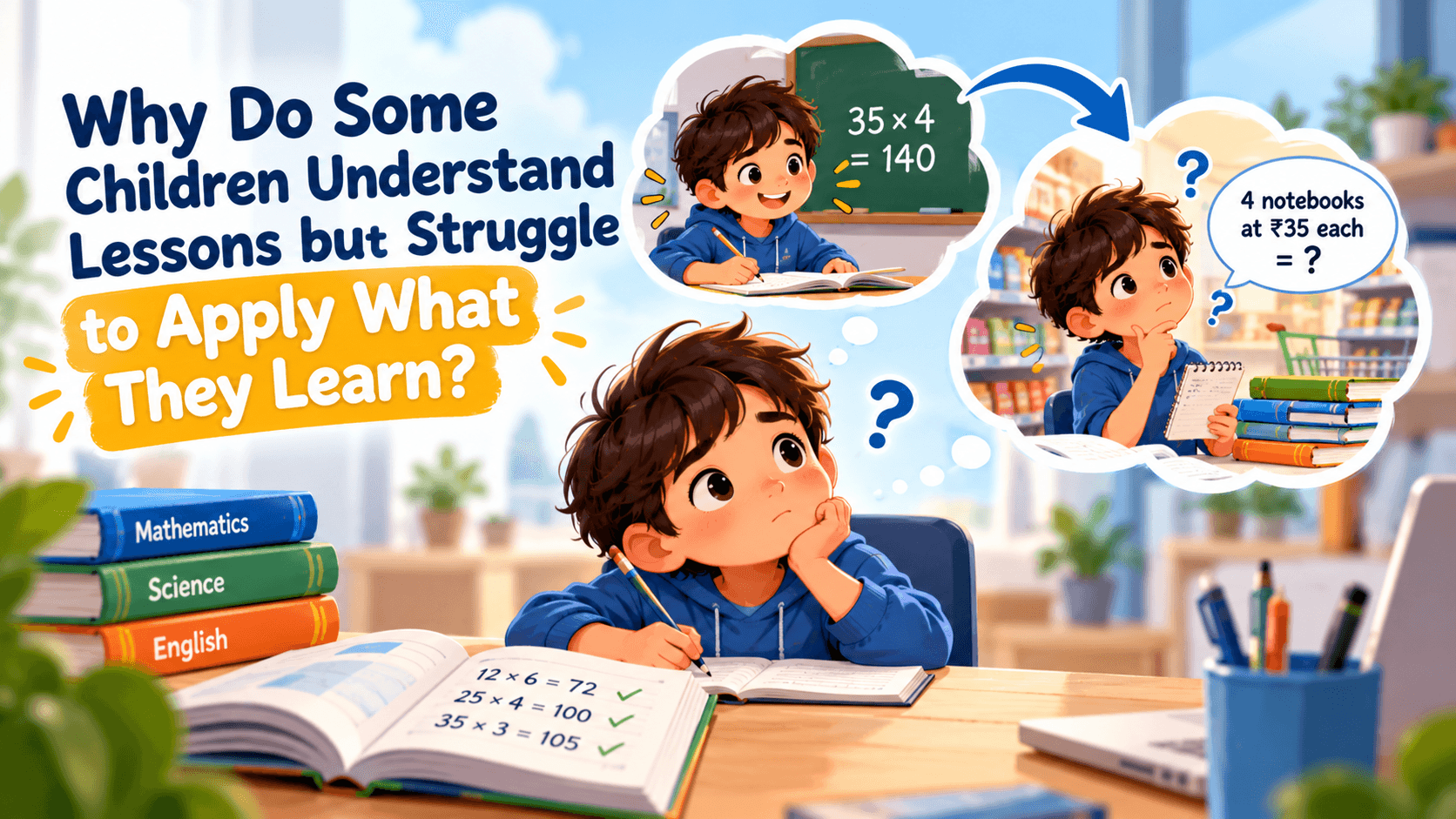

Your child solves multiplication questions correctly in their mathematics notebook. But when you ask them to calculate the cost of four notebooks priced at ₹35 each, they struggle to find the answer. You wonder why they cannot use something they have already learned.
This is a common concern among parents exploring Top schools in Greater Noida West, including The Wisdom Tree School (TWT). Children may remember formulas, definitions, and textbook answers but find it difficult to apply the same knowledge in unfamiliar situations.
Understanding why this happens can help parents support their children without putting unnecessary pressure on them.
Why Does Knowing an Answer Not Always Mean Understanding It?
Remembering information and applying it are related but different learning skills.
A child might memorise the formula for calculating the area of a rectangle and use it correctly in textbook exercises. However, when asked how much carpet is needed to cover a rectangular room, they may struggle to recognise that the same formula applies.
This happens because familiar textbook questions often provide clues about which method to use. Real-life situations require children to identify the problem, select relevant information, and decide how to solve it.
CBSE's competency-based education approach emphasises applying knowledge to practical situations rather than relying only on memorised answers.
This does not mean memorisation is unnecessary. Children need to remember basic facts and procedures before they can apply them confidently.
The goal is to help children move beyond knowing an answer to understanding when and why that knowledge is useful.
What Makes It Difficult for Children to Apply Classroom Knowledge?
Several factors can explain why a child understands a lesson but struggles with practical questions.
Limited exposure to different examples: Children who repeatedly solve similar textbook problems may become comfortable with familiar patterns. When the question changes, they might not recognise the underlying concept.
Difficulty connecting different situations: A child may understand fractions in mathematics but struggle to use them while measuring half a cup of flour or dividing food equally.
Uncertainty about choosing the right method: Some problems require children to combine different skills. For example, planning a small birthday party within a budget involves addition, multiplication, comparison, and decision-making.
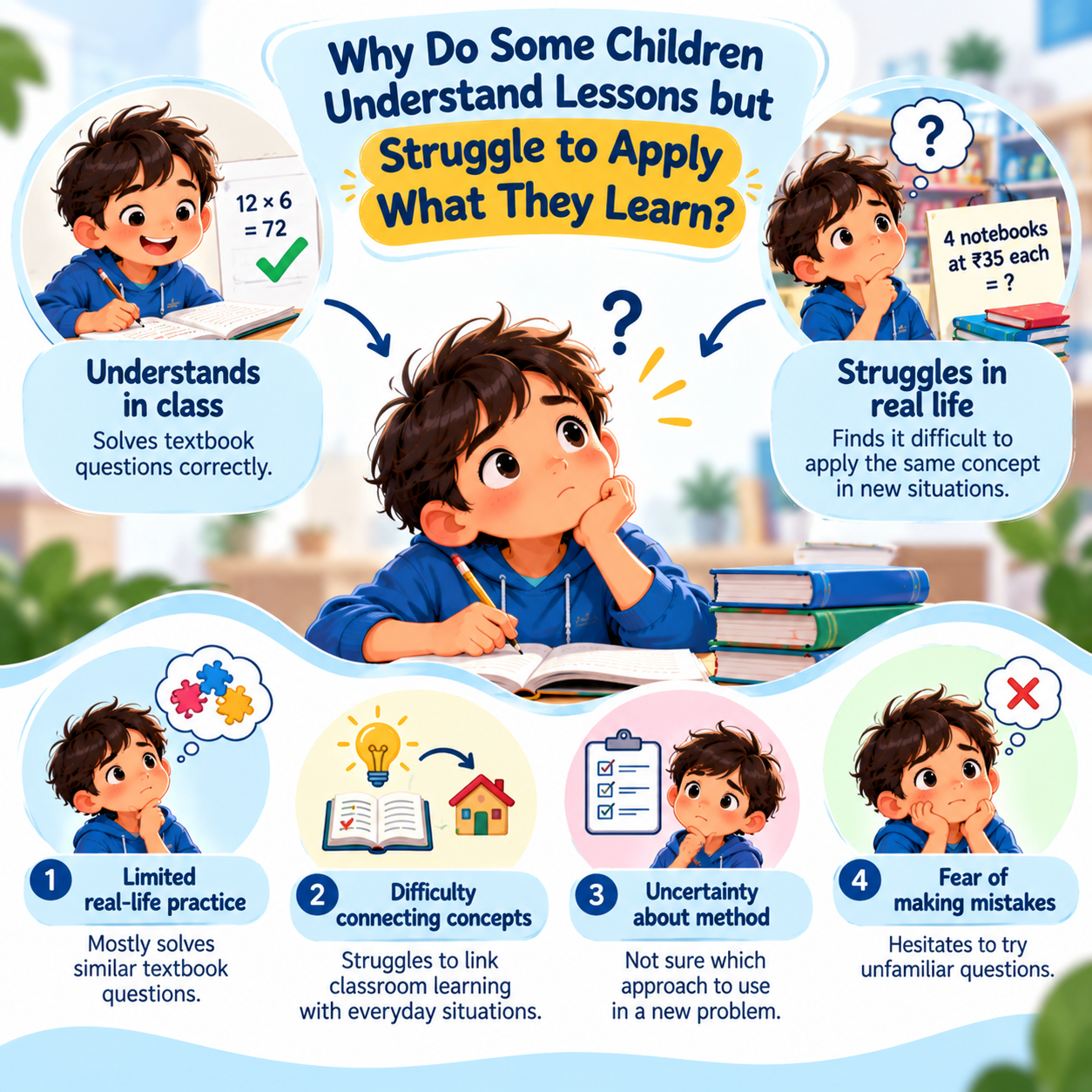
Fear of making mistakes: Children who worry about giving incorrect answers may hesitate to try unfamiliar methods, even when they understand the basic concept.
These difficulties do not necessarily indicate poor intelligence or a lack of effort.
Sometimes, children simply need more opportunities to practise applying familiar knowledge in different situations.
Instead of immediately correcting every mistake, parents can encourage children to explain their thinking. This helps identify whether the difficulty comes from misunderstanding the concept or recognising how to use it.
How Can Parents Help Children Apply What They Learn in Everyday Life?
Children encounter learning opportunities throughout the day. Parents can use ordinary activities to help them connect classroom concepts with real situations.
Use shopping to practise mathematics. Ask your child to calculate the cost of several items, compare prices, or estimate the amount of change they should receive. These activities can make addition, multiplication, and percentages more meaningful.
Connect science with everyday observations. If your child has learned about evaporation, ask why wet clothes dry faster on a sunny day. Encourage them to consider how sunlight, temperature, and moving air might affect drying.
Introduce measurement through cooking. While preparing a recipe, let your child measure ingredients or adjust quantities. For example, ask how much milk would be needed if a recipe is doubled.
Encourage explanations instead of quick answers. When children solve a problem, ask how they reached their answer and whether another method could work.
The Education Endowment Foundation highlights the importance of helping students plan, monitor, and evaluate their learning.
Parents can support this process through questions such as:
- What information do you already have?
- Have you solved a similar problem before?
- Which method might help you?
- Does your answer make sense?
If children struggle, demonstrate one example before encouraging them to try independently.
The purpose is not to turn every household activity into a lesson. It is to help children recognise that classroom knowledge has uses beyond examinations.
How Can Parents Tell Whether Their Child Can Apply a Concept?
Good examination marks can indicate progress, but they do not always reveal how confidently children use knowledge in unfamiliar situations.
Parents can observe understanding by asking children to explain concepts in their own words or solve slightly different versions of familiar problems.
For example, after learning percentages, a child could calculate a discount while shopping. After studying plant growth, they could explain why sunlight and water matter to plants.
Notice whether your child can identify relevant information, choose an approach, and explain their reasoning.
If difficulties continue, discuss them with teachers. Understanding where a child needs support is more useful than simply asking them to practise additional questions.
Connecting Classroom Learning With Practical Understanding
For parents comparing the Best schools in Greater Noida West, opportunities to connect academic concepts with practical experiences are worth considering. The Wisdom Tree School (TWT), located in Sector 16B, Greater Noida West, follows a CBSE curriculum and describes experiential learning as part of its educational approach.

This approach focuses on connecting learning with experiences and meaningful activities. Such connections are relevant to helping children understand how classroom knowledge relates to everyday situations. Parents can also explore how schools encourage questioning, practical activities, and independent problem-solving.
Helping Children Move From Knowing to Doing
Applying knowledge is a skill that develops through practice, reflection, and experience. Children may need guidance before they can confidently solve unfamiliar problems.
By encouraging questions, exploring everyday examples, and allowing children to learn from mistakes, parents can help them see that learning is not only about remembering answers but also understanding how to use them.
To know more about other schools in Greater Noida West, click on the link below













 as a preferred source on