





Your child comes home upset because they could not understand a maths problem. When you ask why they didn't seek help, they quietly reply, "I was scared to ask the teacher."
Many parents recognise this situation. Children may speak freely at home but struggle to express themselves in classrooms or unfamiliar situations. Learning to speak up is not about becoming the loudest person in the room. It is about knowing when and how to communicate needs respectfully.
This important life skill is called self-advocacy, and parents can help children develop it through everyday conversations and small opportunities to make decisions.
What Does Self-Advocacy Really Mean for Children?
Self-advocacy means recognising your needs, expressing your thoughts and asking for support when necessary.
For a younger child, it might mean telling a teacher they cannot see the board. For an older child, it could mean explaining why they feel uncomfortable during a group activity.
Self-advocacy involves three important abilities:
- Speaking up: Sharing thoughts, opinions, or concerns clearly.
- Asking for help: Recognising when support is needed.
- Setting boundaries: Saying no to situations that feel uncomfortable or unfair.
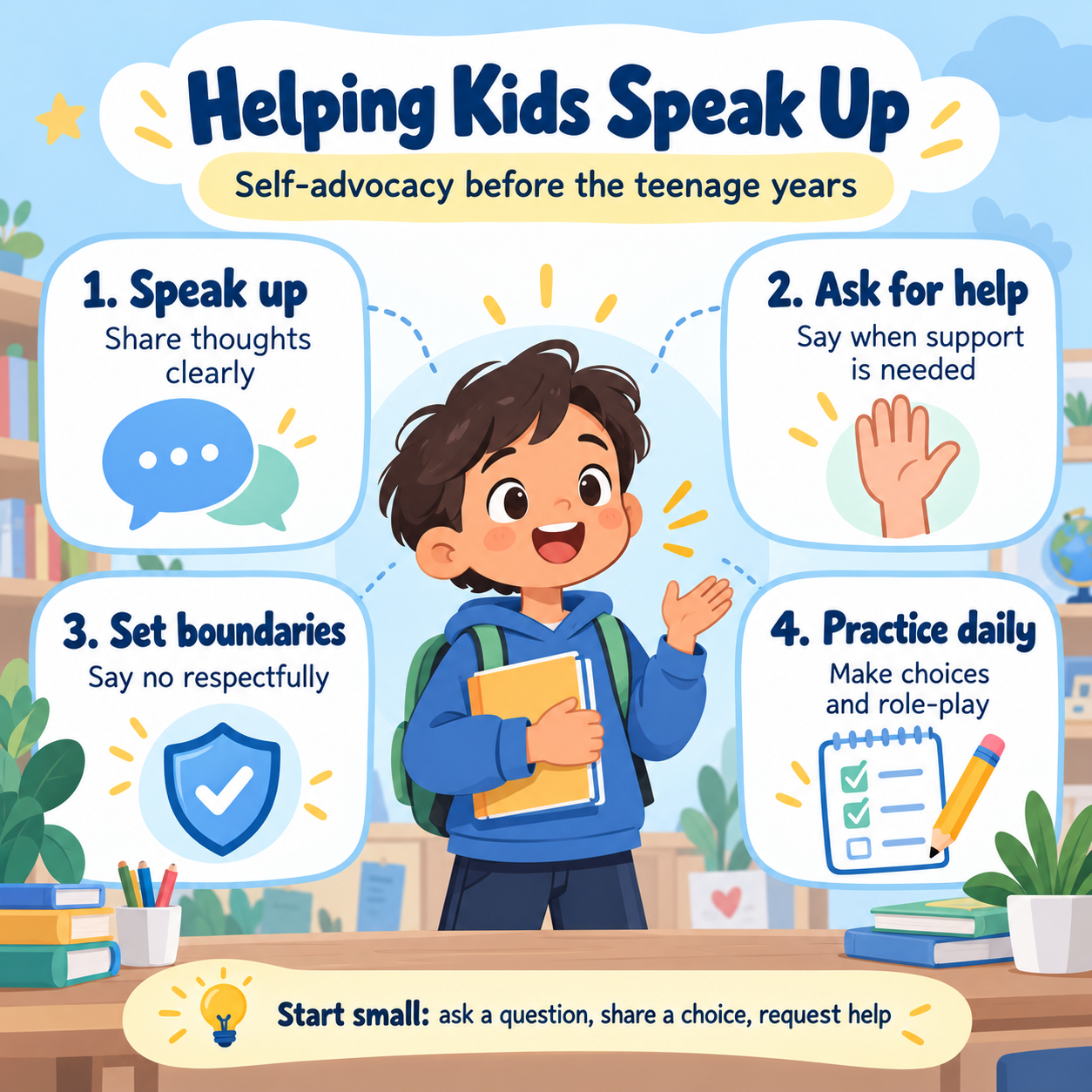
The Illinois Early Learning Project identifies these as important self-advocacy skills that children can practise.
Importantly, self-advocacy does not require children to be naturally outgoing. A quiet child can communicate confidently through thoughtful words, writing or other suitable methods.
Why Do Some Children Struggle to Speak Up?
Children may hesitate to express themselves for several reasons. Understanding these challenges helps parents respond with patience rather than pressure.
Fear of Making Mistakes
Some children worry about giving the wrong answer or being laughed at. They may remain silent even when they have something important to say.
Parents can help by treating mistakes as normal learning experiences rather than failures.
Adults Often Speak for Them
Imagine a shopkeeper asking your child what they would like. Before the child responds, you answer for them.
Although well-intentioned, repeatedly doing this can reduce opportunities for independent communication.
Give children a little time to respond before stepping in.
Difficulty Finding the Right Words
Sometimes children understand their feelings but cannot explain them clearly.
Instead of insisting that they speak immediately, help them identify the problem.
Ask, "Are you feeling confused, worried or uncomfortable?"
Children who experience communication or learning difficulties may also benefit from additional support and alternative ways to express themselves.
Four Simple Ways to Teach Children Self-Advocacy
Self-advocacy grows through practice. Parents can introduce these habits without turning every conversation into a lesson.
1. Encourage Small, Everyday Decisions
Let children make age-appropriate choices, such as selecting a weekend activity or deciding which homework task to complete first.
Ask them to explain their preferences.
This helps children practise making decisions and communicating their reasoning.
2. Practise Asking for Help
Role-playing can make unfamiliar conversations less intimidating.
Pretend to be a teacher while your child practises saying:
"I understand the first part, but could you explain the next step again?"
Praise their willingness to ask rather than expecting perfect words.
The Child Mind Institute recommends practising conversations to help children recognise and communicate their needs.
3. Teach Children to Set Respectful Boundaries
Children should understand that expressing discomfort is acceptable.
Practise simple statements such as:
- "Please ask before borrowing my things."
- "I don't feel comfortable doing that."
- "I would like a turn to speak."
Explain that being respectful does not mean agreeing with everyone.
Also remind children that they should seek adult help if someone repeatedly ignores their boundaries or makes them feel unsafe.
4. Listen Before Offering Solutions
When children describe a problem, parents often immediately suggest what to do.
Instead, ask, "What do you think could help?"
Listen to their ideas and discuss possible solutions together.
You can guide children without taking control of every situation. However, serious bullying, threats or safety concerns require adult intervention.
How Can Parents and Schools Encourage Student Voice?
Children need opportunities to express themselves both at home and in school.
Classroom discussions, group activities and opportunities to ask questions can help children practise communication. Equally important is an environment where children feel comfortable admitting confusion.
UNICEF's Convention on the Rights of the Child recognises children's right to express views on matters affecting them, with appropriate consideration given to their age and maturity.
Parents can support this principle by asking teachers practical questions:
- Can children ask questions privately if they feel nervous?
- How are quieter students encouraged to participate?
- What support is available when children struggle to express concerns?
The goal is not to make every child a public speaker. It is to ensure children know their voices matter.
Student Participation at Ramagya School, Greater Noida West
For parents comparing the Best School in Greater Noida West or searching for a Top school in Greater Noida West, opportunities for student participation are worth exploring. Ramagya School, Knowledge Park V, Greater Noida West, located in Noida Extension, follows the CBSE curriculum and lists debate among its extracurricular activities.

The campus also held a student council investiture ceremony in July 2025, highlighting responsibility and student leadership. These activities provide opportunities for participation, although they do not establish individual learning outcomes. Parents can ask how the school encourages all children, including quieter students, to express their opinions and seek support.
Conclusion: Give Your Child Space to Find Their Voice
Teaching self-advocacy does not mean expecting children to handle every difficulty alone. It means giving them the confidence, language and support to communicate their needs.
Start this week with one small challenge: encourage your child to ask a question, express a preference or request help independently.
With patience and regular practice, children can gradually learn that speaking up is not something to fear. It is a valuable part of growing up.
To know more about other schools in Greater Noida West, click on the link below












 as a preferred source on