








Every parent knows that feeling of picking up their kid late from school, even by ten minutes. Now imagine that ten minutes stretching into two hours, every single day, because both parents are still stuck at work. The child stands near the gate, watching everyone else leave until someone finally comes for them. Maybe it's a relative, maybe it's the school ayah waiting with them, maybe it's just them alone with their bag on the steps.
This is happening in more homes across India than ever before, and there's a simple reason why. More women are working full-time jobs now, families have moved away from their hometowns for work, and the joint family setup that once had a grandparent or aunt around to help just isn't there anymore for most people living in cities. Both parents are clocking in nine- to ten-hour days, and school hours don't match office hours, not even close. So the gap in between has to be filled by someone, or something.
This is part of why daycare is no longer seen as just "babysitting" anymore. Parents looking at the best schools in Bangalore today are asking different questions than before; they want to know what happens after 3 pm, not just what happens in the classroom. That's where places like Aadya Academy come in, trying to make sure the hours after school aren't just filler time but time that actually helps a child grow.
Also Read: Does Day Care Also Play a Role in Your Child's Education?
Why Daycare Is Growing in India
Think about how things used to work maybe fifteen, twenty years back. The mother stayed home, more often than not. She'd be the one picking the kids up from school, feeding them lunch, sitting with them while they did homework, and just being there through the day. That was the setup for most Indian households, and honestly, nobody really questioned it.
That's not how most homes function anymore.
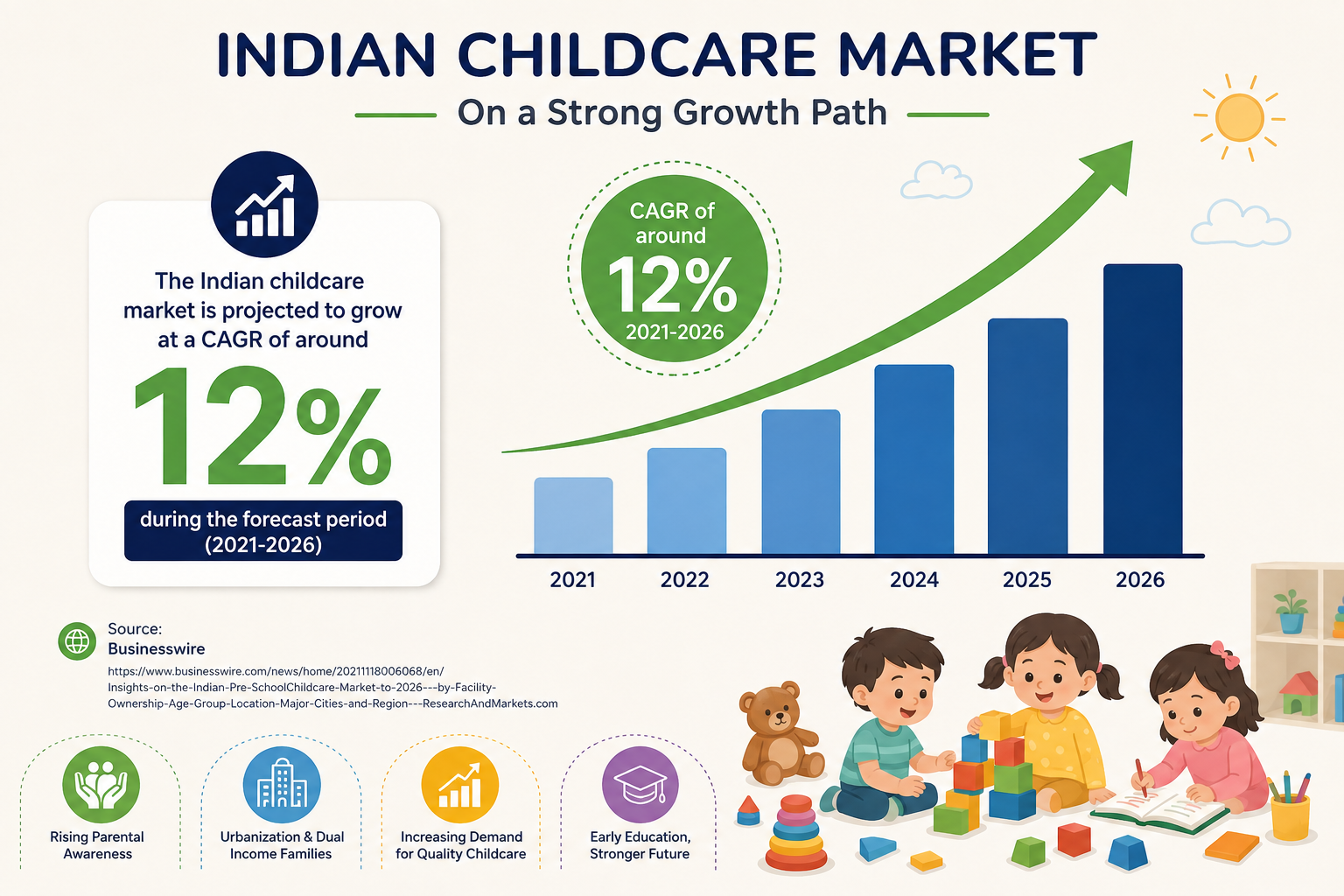
According to an article by Gulf News, a labour ministry official stated that the Worker Population Ratio for women aged 15 years and above rose from 22.0 percent in 2017-18 to 40.3 percent in 2023-24, while the Labour Force Participation Rate for women increased from 23.3 percent to 41.7 percent in the same period. That's a sharp jump in less than ten years; more mothers are out working full time now, and that shift alone has changed who's actually home when the school bell rings at 3 pm.
And it's not just about mothers going back to work. A few other things have piled on at the same time:
Rise in dual-income households
Earlier, it was mostly one income; now most urban households need both parents earning, simply because that's what it takes to keep up with city life costs.
Nuclear families and fewer grandparents at home
The mother going to work wouldn't have been such a big shift before either, because there was usually a grandparent or an aunt in the house to take over. That backup isn't there anymore for most families, especially once they move cities for work.
Longer working hours and urban lifestyles
It's not a 9-to-5 anymore for most people, and even if it was, school gets over way before the office does. So that gap between 3 pm and whenever the parents actually reach home has to be filled by someone.
Increasing demand for reliable childcare
With no one steady at home anymore, parents can't just wing it with random arrangements. They need something they can actually depend on, every single day.
Parents looking for daycare centres that offer more than supervision
And now that daycare has become necessary rather than optional, parents aren't settling for just "someone watching the kid." They want those hours to actually add up to something.
What Purpose Does Daycare Actually Serve?
Once you get past the "why," it's worth asking what daycare actually does for a family day to day. A few things stand out:
Keeps children in a supervised environment
No child is left alone or unaccounted for during those in-between hours. Someone responsible knows exactly where they are and what they're doing.
Company, not loneliness
Instead of sitting alone at home or waiting around, kids are around other children their age. That empty, lonely feeling from earlier just doesn't happen here.
No wasted time
Those hours after school aren't just passing time anymore. Kids can finish homework, revise, or get help with something they didn't understand in class, so by the time they're home, that part is already done.
Parents feel relieved
Maybe the simplest one, but it matters the most. Parents can actually focus at work without that constant worry in the back of their head about who's with their child right now.
Also Read: Why Expressive Students Often Go Further in Life
Aadya Academy: Where Daycare Meets Boarding, and No Child Feels Left Behind

This is where the daycare conversation gets more interesting for parents specifically looking at top schools in Bangalore. Aadya Academy runs as a day cum boarding school, and that setup solves a problem most standalone daycare centres simply can't.
Here's the thing about a regular day school daycare: once evening rolls around, the number of kids left starts thinning out fast, and eventually it's just a handful of children waiting for their turn to be picked up. That's the exact lonely feeling parents worry about.
At Aadya Academy, day scholars are on the same campus as boarding students, and that changes the entire feel of the after-school hours. A day school child staying back for daycare isn't just sitting around with two or three others waiting for a parent; they're surrounded by boarding students who are there for the evening too, doing homework, playing, just being kids together. Nobody's watching the gate wondering when someone's coming.
Aadya Academy's day care facility covers students from KG to Grade 8, supervised by trained teachers, with a structure that leaves room for both academics and free play. Homework and assignments get done during this time itself, so parents aren't dealing with tired, cranky homework battles once they're finally home. Located on Budigere Main Road in North Bangalore, it's positioned as one of the ICSE options for parents who want their child's after-school hours to feel less like a holding pattern and more like an extension of school life, just with friends who happen to stay a little longer.
For more information regarding this and other residential schools


















 as a preferred source on