





Imagine your child correctly defining evaporation during an exam but struggling to explain why wet clothes dry faster on a windy day. They remember the textbook answer, yet applying that knowledge to real life feels difficult.
This is a common challenge in science education. Children may memorise definitions without fully understanding the ideas behind them. That is why practical learning deserves attention. For parents exploring schools such as Sri Devaraj Urs International Residential School (SDIRS), Bangalore, understanding the value of hands-on science education can help them ask better questions about their child's learning.
Why Memorising Science Is Not the Same as Understanding It
Memorisation helps children recall important facts, formulas, and definitions. However, remembering information does not always mean understanding how it works.
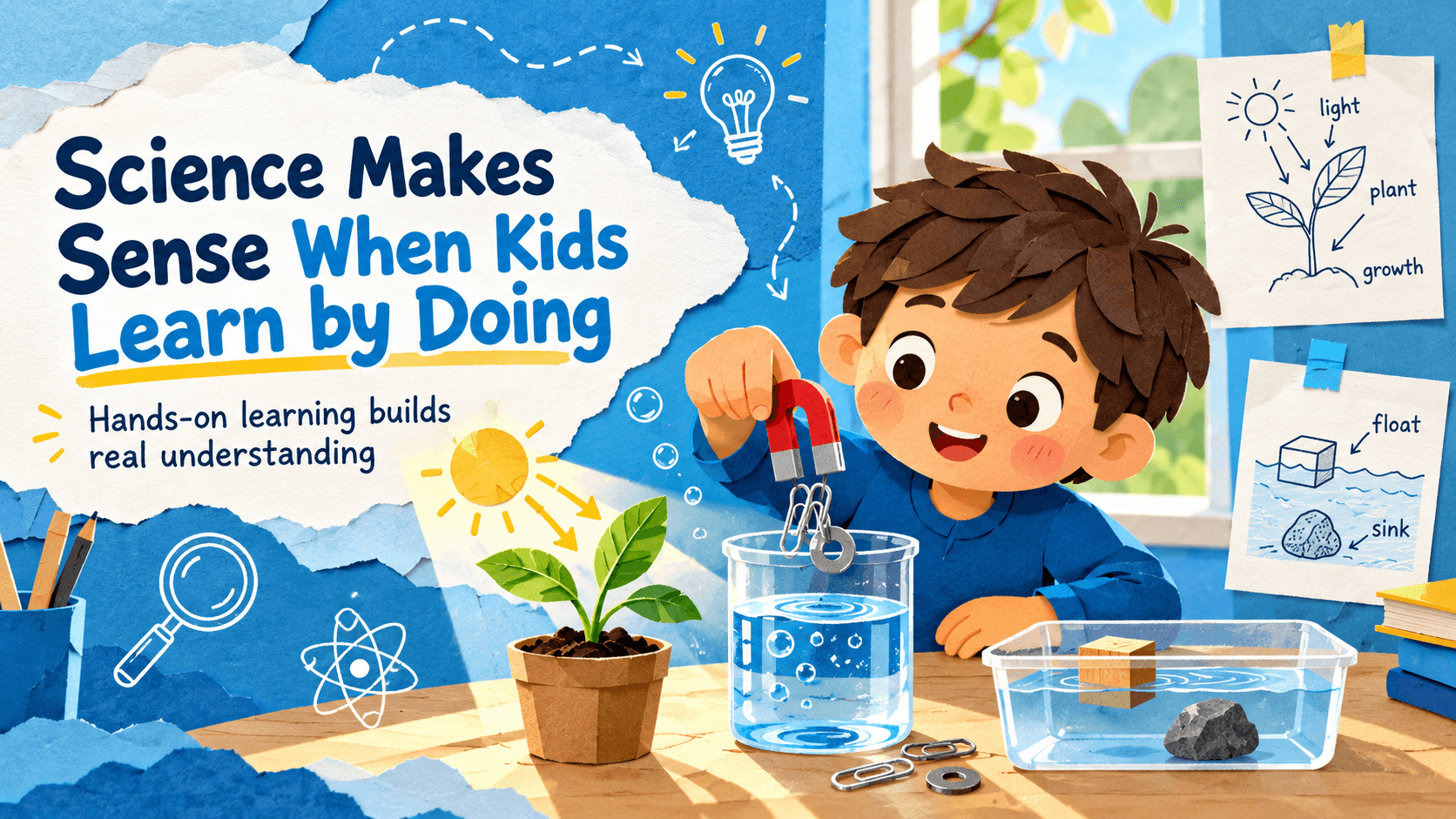
Consider a child learning about floating and sinking. A textbook may explain density, but the concept can still feel confusing. Now imagine the child placing a stone, a wooden block, and a plastic bottle in water.
They notice that some objects float while others sink. When a teacher helps them connect these observations with density and buoyancy, the lesson becomes more meaningful.
The National Academies' Framework for K–12 Science Education emphasises investigation, evidence, and explanation as essential parts of scientific learning.
Practical experiences can help children connect new information with things they have already seen. Instead of remembering an isolated definition, they begin understanding when and why a scientific principle applies.
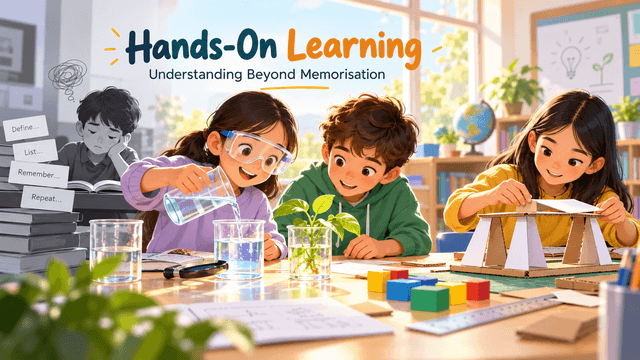
What Happens When Children Learn Science by Doing?
Hands-on science learning involves much more than performing interesting experiments. Its real value comes from helping children think about what they observe.
A meaningful science activity usually involves four connected steps.
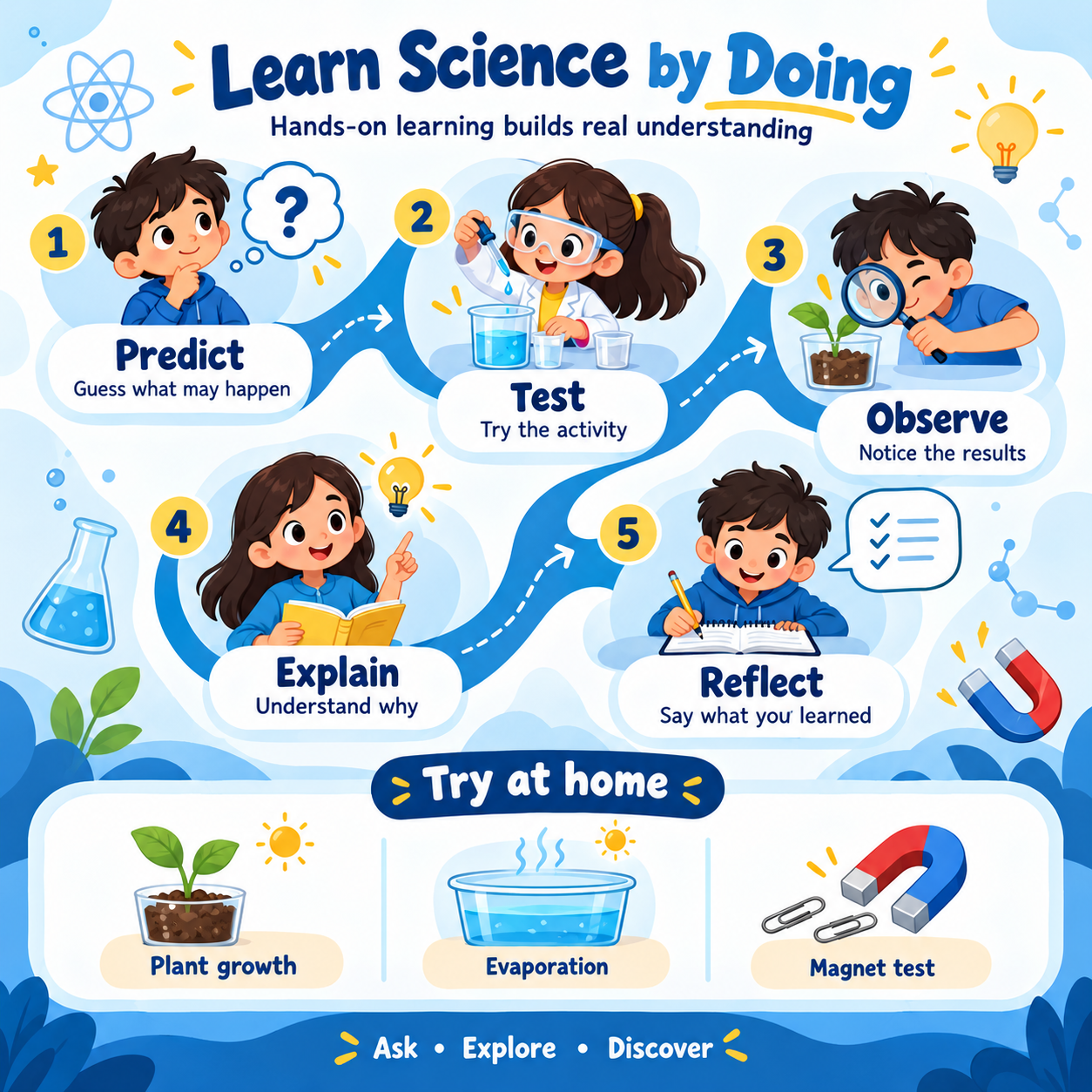
1. Making predictions
Before an experiment begins, children consider what might happen. For example, will a wooden block sink if it is larger than a stone? Making predictions encourages them to use their existing knowledge.
2. Observing results
Children then test their ideas and observe the outcome. They may discover that size alone does not determine whether something floats. This gives them a reason to question their original assumptions.
3. Understanding the explanation
With appropriate guidance, children connect their observations to scientific concepts. A teacher might explain how an object's average density and the buoyant force influence floating.
4. Reflecting on what they learned
Finally, children discuss what surprised them and what they would test next. Explaining the results in their own words helps reveal whether they genuinely understand the concept.
India's National Education Policy 2020 encourages experiential and hands-on learning across subjects.
However, simply completing an experiment is not enough. Children need opportunities to discuss the results, ask questions, and understand the science behind what happened.
Simple Science Activities That Make Learning Meaningful
Science does not always require expensive laboratory equipment. Parents can create valuable learning opportunities using everyday materials.
1. Discovering How Plants Grow
Ask your child to grow two similar plants, keeping one in natural light and another in a dimmer location.
Keep the water, soil, and other conditions as similar as possible. Encourage your child to observe changes over several days.
This helps introduce the importance of light for plant growth while teaching children how to compare observations.
2. Understanding Evaporation
Place equal amounts of water in two identical shallow containers. Keep one in a breezy location and another in a sheltered area, with adult supervision.
Ask your child to predict which will lose water faster.
Comparing the water levels later can introduce the relationship between air movement and evaporation. Discussing other factors, such as temperature, adds depth to the lesson.
3. Exploring Magnetism
Give your child a small magnet and safe household objects made from different materials.
Ask them to predict which objects the magnet will attract.
They may discover that magnets attract some metals but not others. This opens a discussion about magnetic materials rather than assuming that all metals behave identically.
The purpose of these activities is not merely getting the correct result. It is encouraging children to observe carefully, question assumptions, and explain their findings.
How Parents Can Encourage Scientific Thinking Beyond School
Parents do not need advanced scientific knowledge to encourage curiosity. Simple conversations can help children develop stronger reasoning skills.
Instead of immediately explaining why something happens, ask questions such as:
- What do you think will happen next?
- Why do you think that happened?
- What could we change to test your idea?
- Can you explain what you discovered?
Children should also feel comfortable making incorrect predictions. An unexpected result can lead to a useful discussion and another experiment.
Everyday activities like gardening, cooking, and observing weather changes can become opportunities for scientific exploration.
When evaluating a school, parents can also ask how teachers connect laboratory activities with classroom lessons. Access to equipment matters, but meaningful guidance and discussion are equally important.
Practical Science Learning at Sri Devaraj Urs International Residential School
Sri Devaraj Urs International Residential School (SDIRS), Bangalore, describes science and mathematics laboratories among its academic facilities. These resources are relevant when considering how schools can support practical learning alongside textbook education. Parents searching for a Top Boarding school in India or the Best Boarding school in India should look beyond infrastructure alone and ask how frequently students conduct experiments, receive guidance, and discuss their observations. Such questions help families evaluate the learning opportunities available in a residential school.

Conclusion
Science becomes more meaningful when children can connect what they learn with what they experience. Memorising facts remains useful, but asking questions, testing ideas, and explaining observations helps build deeper understanding.
Parents can encourage this approach through simple activities and everyday conversations. The goal is not just to help children remember scientific answers, but to help them understand the world around them.
For more information on this and similar schools, check out this list of the best boarding schools in India.








 as a preferred source on