




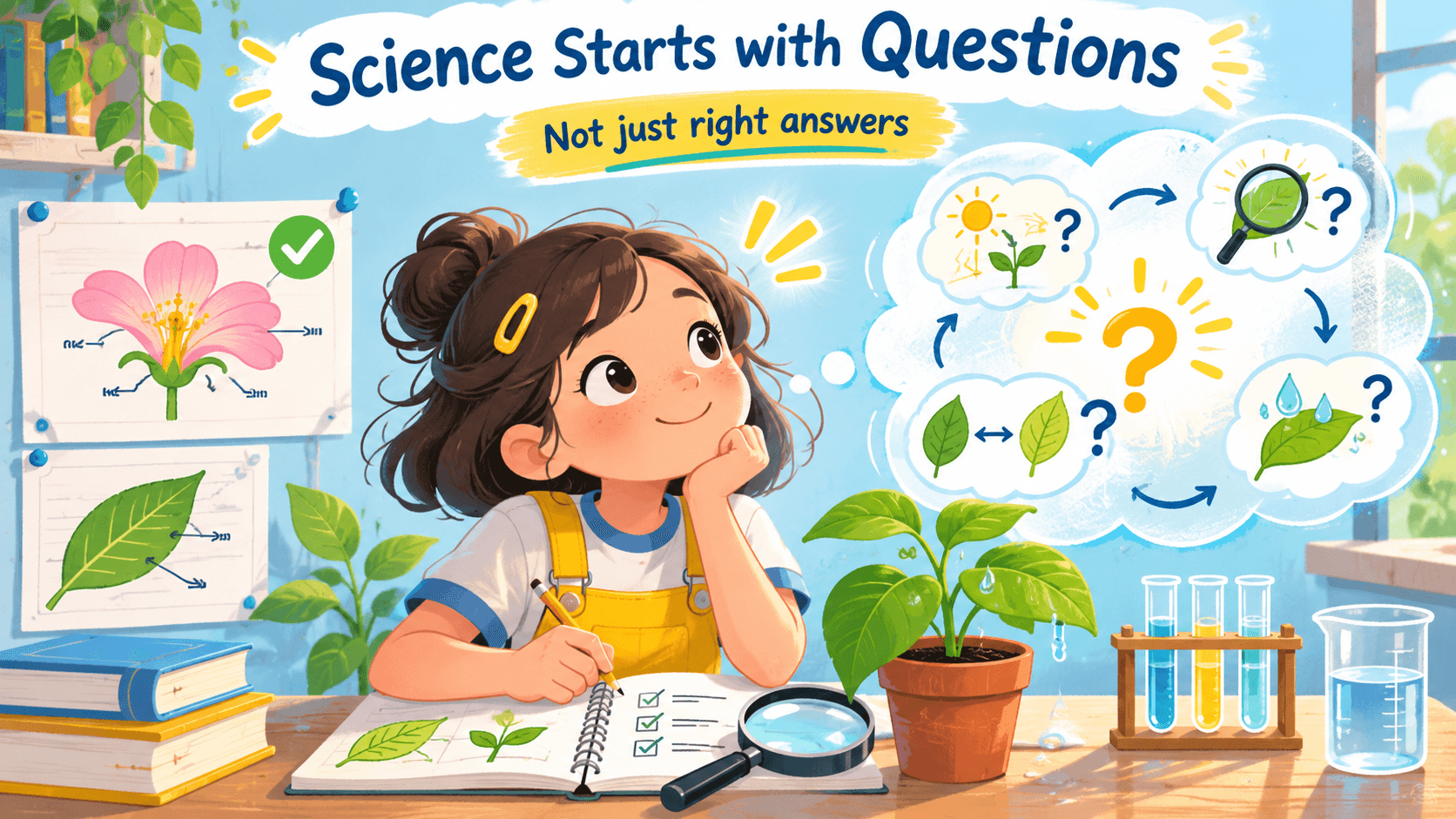

Your child can explain photosynthesis, identify the parts of a flower and score well in science tests. But when you ask, “What would you like to find out about this plant?” they shrug and say, “I don't know.”
This gap matters to parents exploring Top schools in Greater Noida West, including Delhi World Public School(DWPS), Knowledge Park V, Greater Noida West. Understanding a lesson and asking an original question require different kinds of thinking. A child may be good at one but need more practice with the other. Questioning can develop through everyday conversations and observations.
Why Is Knowing an Answer Different from Asking a Question?
When children learn that sunlight helps plants make food, they gain useful scientific knowledge. But asking why a plant near a window grows differently from one in a dark corner involves noticing something, considering explanations and deciding what to investigate.
India's National Curriculum Framework for School Education (2023) emphasises both scientific concepts and the ability to observe, ask questions, make predictions and examine evidence. Knowing facts is important, but science also involves testing ideas rather than accepting every explanation without inquiry.
A child who answers textbook questions correctly may simply have had fewer chances to frame questions independently. That is not proof of weak understanding or poor curiosity.
What Stops Children from Asking Their Own Science Questions?
They are used to finding the expected answer. In many learning situations, an adult asks and the child responds. When asked to invent a question instead, the child may not know where to begin.
They worry about sounding silly. A child might wonder whether a shadow can change size but remain silent because they think everyone else already knows. Correcting every unusual thought too quickly can make sharing ideas feel risky.
Everyday science is easy to overlook. Water droplets on the outside of a cold glass, a disappearing puddle or a rusting gate may seem ordinary. Children might not realise these are starting points for investigation.
Their questions are still broad. “Why does ice melt?” is a reasonable question, but deciding what to compare requires another step. Children may need help turning curiosity into something they can observe or test.
Not every curious child asks questions aloud. Some prefer drawing, reading, quietly watching or trying things before speaking.
How Can Parents Encourage Scientific Curiosity at Home?
1. Start with what your child notices.
During a walk, ask, “What looks different about these two leaves?” or “Where is your shadow now?” Give your child time to look before expecting an answer. If they notice something unexpected, invite them to describe it.
2. Show that adults can be curious too.
Instead of immediately explaining why a metal spoon feels cooler than a wooden one, say, “That's interesting. What do you think is happening?” You can look up an explanation together afterward. Admitting “I'm not sure” shows that learning is not about pretending to know everything.
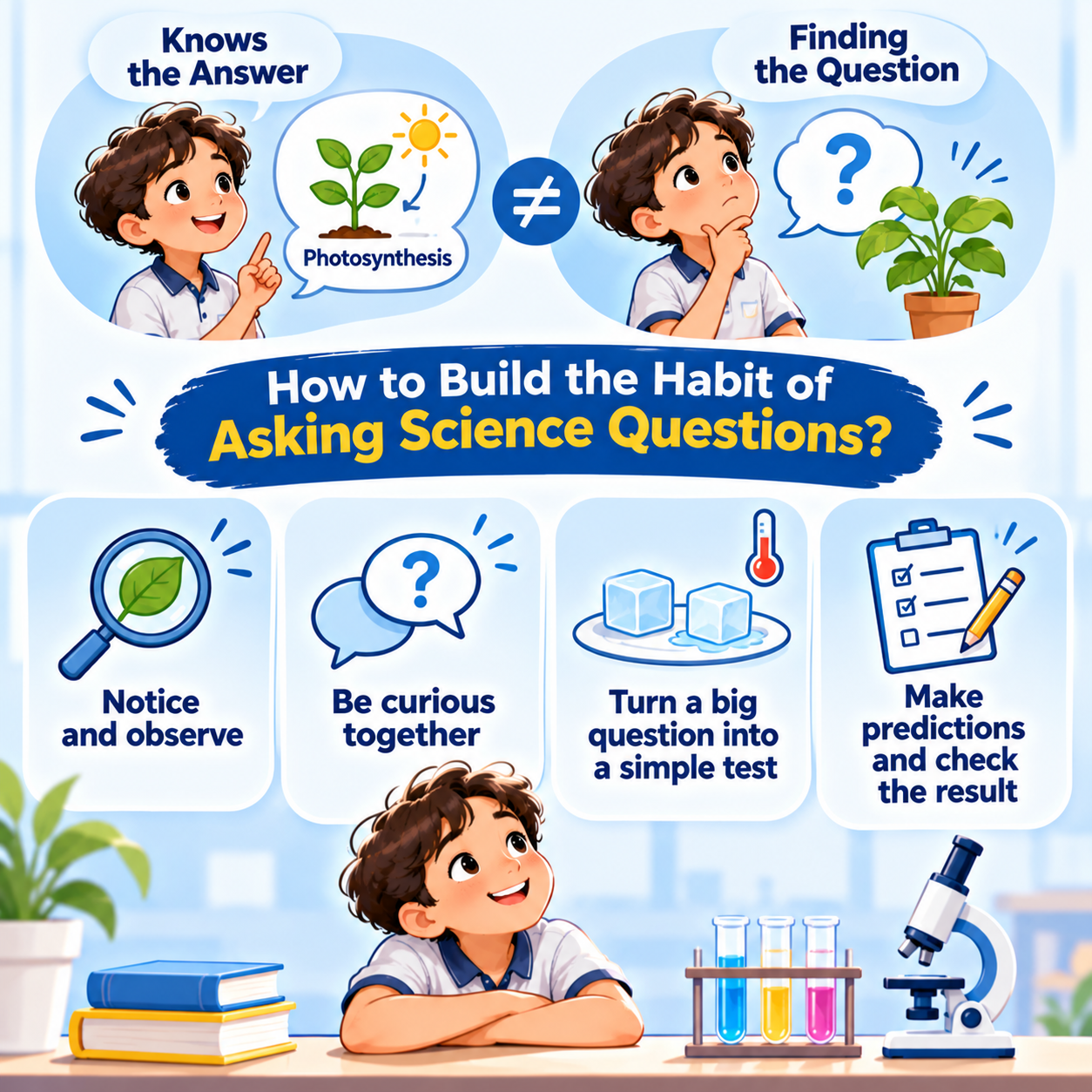
3. Help turn a big question into a testable one.
Suppose your child asks, “Why does ice disappear?” You might ask, “Does ice melt faster in the shade or in a warmer part of the room?” Use equal-sized ice cubes on similar plates, place them in safe spots and compare what happens. Keep the activity away from electrical items and avoid leaving water where someone could slip.
4. Ask for predictions and evidence.
Before starting, ask which cube your child expects to melt first and why. Afterward, discuss what happened. If the result differs from the prediction, treat it as interesting information rather than a wrong answer.
The US National Academies' Framework for K–12 Science Education identifies asking questions, planning investigations and interpreting evidence as central science practices. At home, a short observation can offer practice with all three, without becoming a formal experiment.
How Can Parents Recognise Growing Curiosity?
Do not measure curiosity only by how often your child raises a hand or asks “why.”
Look for small changes. Does your child notice patterns? Suggest another possible explanation? Want to compare two objects? Ask how someone knows a claim is true? Change their mind after seeing new evidence?
A child who draws the Moon's changing appearance over several evenings may be investigating quietly. Another might build two paper planes and compare how they fly.
These behaviours do not need to happen every day. The aim is to make questions welcome, not turn curiosity into another performance target.
Connecting Science Questions to Delhi World Public School
For families considering the Best schools in Greater Noida West, it can help to ask whether children have opportunities to investigate their own ideas. Delhi World Public School(DWPS), Knowledge Park V, Greater Noida West lists a Kepler Astronomy Club with telescope sessions and space-science projects, alongside Code & Circuit robotics activities such as coding and robot building. These are school-published programme descriptions; they do not establish how often each activity happens or whether participating students become better at asking questions.

Conclusion
A child who knows science answers may still need help learning how to form questions. That skill grows through noticing, wondering, predicting and checking evidence.
Parents need not create complicated experiments. By listening patiently and exploring everyday observations together, they can show children that asking a thoughtful question is itself an important part of learning.
To know more about other schools in Greater Noida West, click on the link below










 as a preferred source on