








When was the last time a child willingly sat in one place for thirty minutes without a screen?
Surprisingly, it happens more often around a chessboard than a smartphone. Yet, somehow, we are losing our children to a digital void rather than letting them unwind over a simple board game.
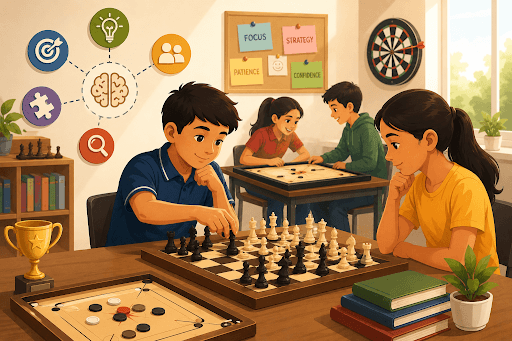
However, a walk down a school's indoor games area during a free period or break will reveal an interesting scenario. A group of students huddled around a carrom board, two children staring intently at the game of chess unfolding before them and sometimes a small line of students waiting for their time at the table tennis table, a bit impatient and quite excited to have the next turn.
Studies anyway suggest that screen time among school-age children has increased steadily over the past decade. At the same time, educators have been constantly discussing on another challenge: keeping students engaged in activities that require sustained attention. That is perhaps one reason indoor games continue to hold their place in the best schools in Bangalore, including New Oxford International School.
But what is it that indoor games do so right? Read on to find out!
Also Read | How Playing Games Can Make Your Child an Achiever?
Why Playing Indoors Isn’t That Bad an Idea
Parents often worry when bad weather keeps kids inside the house. We sometimes view being stuck indoors as a sort of punishment. It really does not have to be that way at all, especially since the four walls of a house hold immense potential.
Indoor play provides a quiet space for children to truly focus. It strips away the loud chaos of the outdoor playground. This allows them to engage deeply with the task at hand. To add to that, you can set up a game absolutely anywhere. A small table or a clean spot on the floor works just perfectly as an indoor game setup.
What Different Games Actually Build
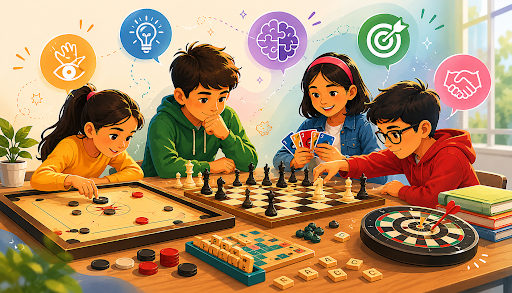
Different games work different muscles and develops different aspects:
- Carrom develops hand-eye coordination and fine motor control. It also quietly levels the playing field. A child who struggles in class sometimes discovers they have an extraordinary touch at the striker.
- Checkers and Brainvita are excellent for younger children getting their first taste of strategic thinking without feeling overwhelmed.
- Chess builds foresight and logical sequencing. It teaches children to think in consequences rather than impulses.
- Dart games train focus and body control. There is something deeply satisfying for a child about hitting what they aimed at. That small, repeatable experience of competence matters more than we often credit.
- Scrabble encourages children to explore language in a fun way. They learn spelling without feeling like they are studying.
- Uno teaches colour and number matching. It introduces the concept of strategic card holding. It guarantees loud laughter and fun family arguments.
What’s important to note here is that none of these are passive activities. Every one of them demands that a child show up mentally, not just physically. That is fundamentally different from watching a screen, even an educational one.
The Crucial Necessity of Indoor Games
The WHO estimates that 1 in 7 children between 10 and 19 globally experiences a mental health condition. In Indian cities, anxiety and attention difficulties are being flagged earlier and earlier, sometimes in primary school. The response tends to focus on intervention after the fact. But prevention matters enormously.
Play is one of the most well-documented preventive tools available to schools. Indoor games, specifically, create what researchers call a cognitive reset. After a stretch of focused academic work, a child's brain needs to shift gears before it can absorb more. A 20-minute game of chess or carrom does that more effectively than simply staring at a wall during a free period.
In addition to that, indoor games give children something new to look forward to instead of just being focused on academics. In most classrooms, children are constantly ranked. By grades, by speed, by how quickly they raise their hand. This is inevitable to some extent. But it also creates a quiet, persistent hierarchy that can be very hard on children who don't fit the academic mould. Indoor games disrupt that hierarchy.
Check Out | Why Inquiry-Based Play is the Foundation of Future Success
How New Oxford International School Inspires 360° Development through Indoor Games
While the New Oxford Group of Institutions was originally established in 2000, the Anekal international campus began its specific journey in 2019. NIOS is one of the best ICSE schools in Bangalore and aims to create an environment where students receive both guidance and individual attention.
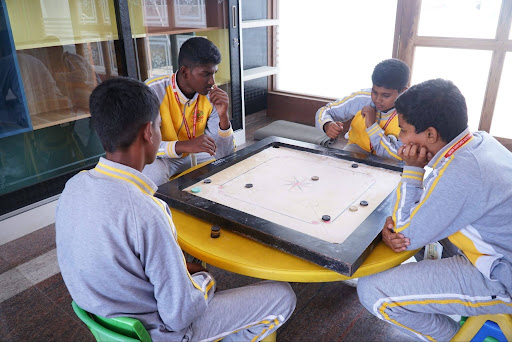
On indoor play, the school has taken a deliberate position. NOIS maintains a dedicated indoor games room stocked with carom, chess, dart boards, checkers, and brainvita. The stated reason is direct: the school believes mental development carries the same weight as physical development, and indoor games are one of the most effective ways to address both simultaneously.
NIOS’ indoor games room is also part of a larger beyond-academics programme that also includes weekly yoga sessions across all grades, karate classes, music and dance clubs, and a dedicated sports facility for outdoor games. The school frames all of this under a goal of 360-degree development, the idea that a child should leave each day having grown in more ways than just academically.
The modern campus provides a safe and inclusive learning environment. The educators combine subject expertise with a genuine passion for teaching. They work hand in hand with parents to nurture the leaders of tomorrow. The school truly lives up to its powerful motto to learn, lead, and achieve.
New Oxford International School's approach makes one thing clear: children are always learning, from every game, every small frustration, every moment of figuring something out without being told the answer. So, encourage your children to pick up a board game today and help build a healthy habit!
For more information on NIOS and similar other schools, check out this list of the best schools in Bangalore.
















 as a preferred source on