







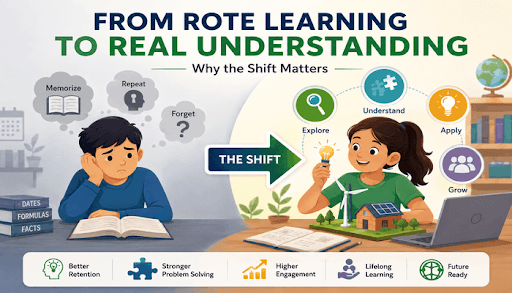

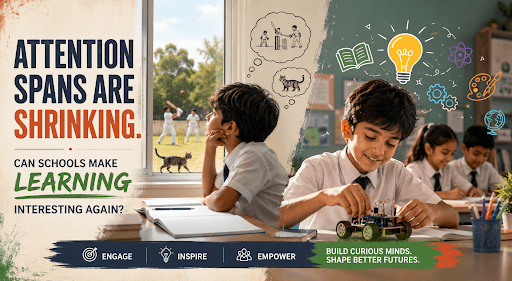
Do you remember the exact chemical formula for table salt or the specific date of a minor historical treaty? Most adults likely do not. Well, chances are high that most adults have forgotten the details that they learned while in school. This gets reflected in studies as well, since they show that students forget upto 75% of the newly learnt information within the span of a few days.
Parents often worry deeply when their child scores well on paper but struggles to apply those same concepts at home. But the concept of education is changing rapidly across the world right now. The focus is finally moving away from textbook memorization and towards conceptual understanding.
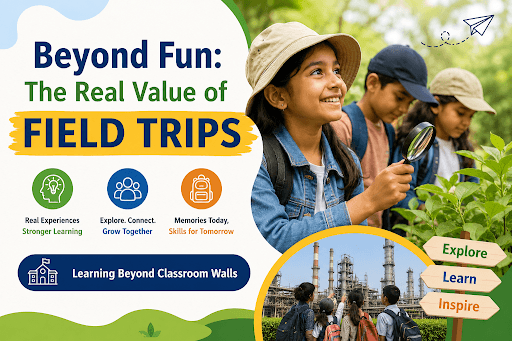
Progressive schools in Gurugram, like Manav Rachna International School in Sector 46 Gurugram, are actively driving this positive change, using hands-on experiences to help students with a real understanding.
Also Read | Shift From Traditional to Personalized Learning
Parental Unlearning: Most Crucial Aspect of the Shift
Most parents today grew up in a very different school system. We were praised for getting the highest marks in the class. Our teachers valued quiet students who could repeat the textbook word for word.
Because of this, we often bring that same pressure home to our children. We look at a report card and focus only on the final percentage. This requires a process of parental unlearning. We must realize that a high grade does not always mean high intelligence.
Real learning happens when a child can explain a concept in their own simple words. It happens when they can use a math rule to solve a real problem at home. So, as parents, we must shift our focus. We should ask our children what they discovered today rather than what they scored. Because, when the pressure to memorize is gone, the joy of learning returns naturally.
How Do You Recognize Real Understanding?
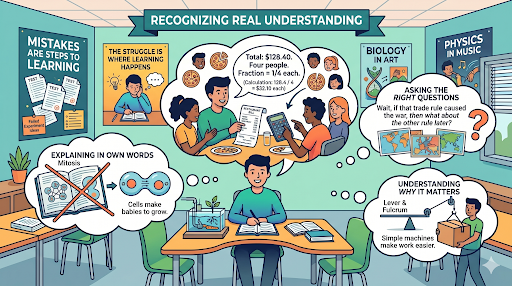
“Real understanding” is one of those phrases that sounds obvious until you try to pin it down. Real understanding, sounds good, sure. But what does it mean on a Tuesday afternoon in a classroom?
Here are a few simple ways to test it:
- Can the student explain the concept without using the words the textbook used?
- Can they use it somewhere it wasn't explicitly taught?
- Can they tell you why it matters, not just what it is?
A student who understands fractions can figure out how to split a restaurant bill. A student who memorised fractions can solve the worksheet. The former is useful in the world, while the latter mostly isn't.
Real understanding also shows up in the questions a student asks. Not "will this be on the test?" but "wait, if that's true, then what about..." That kind of curiosity doesn't appear by accident. It's built over years by teachers who make space for it and learning environments that reward it.
Here are a few things schools can do that genuinely support real understanding in the classroom:
- Let students grapple with a problem before giving them the method to solve it. The struggle is where learning actually happens.
- Bring in real-world context. A student who sees why something matters will always learn it faster than one who's told it's important for the exam.
- Mix subjects together rather than keeping them in separate boxes. Real problems don't come sorted by subject. Neither should education.
- Make failure a normal part of the classroom, not something to be hidden.
What Exactly are the Benefits of Real Understanding?
Educators now believe that learning should feel meaningful. Children learn better when they connect lessons to real situations. A science concept becomes memorable when students experiment with it. Mathematics feels easier when linked to daily activities. Language improves when children express opinions freely rather than memorising essays.
Let us look at a few of the benefits of real understanding:
- Better Retention of Knowledge: Children remember what they actively do. When they engage in practical activities, the concepts stick with them for years.
- Improved Problem-Solving Skills: Real understanding forces children to figure things out independently. They learn to test different solutions when the first one fails.
- Higher Engagement Levels: Children get bored easily with long monologues. Interactive projects keep them interested and excited about attending school every morning.
- Emotional and Social Growth: Collaborative projects teach children how to communicate better. They learn to share ideas and respect different viewpoints from their peers.
- Preparation for Future Careers: The job market is changing very fast. Future careers will require heavy innovation and creativity. Memorization cannot teach these specific traits.
- Encourages Lifelong Learning: Children enjoy the process of discovering new things. Because of this, they do not stop learning after graduation. They carry this natural curiosity into adulthood.
Check Out | Rote Learning vs. Concept Development: Which is the Way to Go?
Manav Rachna International School, Sector 46, Gurugram: Supporting Meaningful Learning
Established in the year 2008, MRIS is one of the best schools in Sector 46, Gurugram. The school is a part of the wider Manav Rachna Educational Institutions family, and is focused on shaping students into individuals capable of contributing to the world, not just navigating through exams.
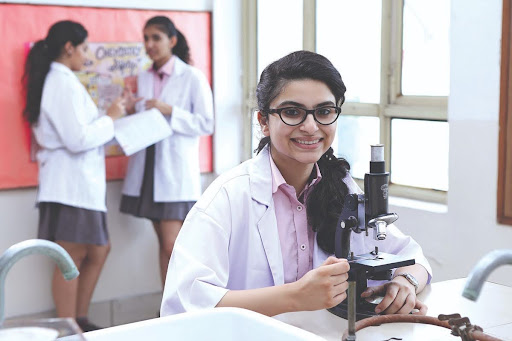
What makes MRIS-46 relevant to this conversation about rote learning is that the school has actually built its infrastructure around the alternative. Here’s how:
- Unique interdisciplinary curriculum called CREST, which focuses heavily on reasoning, exploration, and 21st-century skills through hands-on learning.
- The Future Skills and Sustainability Labs give students hands-on exposure to STEAM disciplines through real projects via:
- The Atal Tinkering Lab, where students take real-world problems and try to build working solutions to them.
- Media Shala for creative and digital expression, where students are trained in communication and production activities.
- Maker Shala for hands-on building and design, to encourage skills like agri-tech, sustainability and design thinking.
- At the senior secondary level, the school offers subjects like Artificial Intelligence, Design Thinking, Global Citizenship Education, and Fashion Technology alongside the standard streams. The curriculum is deliberately built to prepare students for where they're going, not just to satisfy where they've been.
- Active Special Education Department to assist students in their learning journey and shape them into independent learners.
MRIS-46 is also an IB Candidate School for the Primary Years Programme (PYP) and the Middle Years Programme (MYP). In the PYP, younger students explore ideas across disciplines through inquiry-based units, structured around questions rather than content delivery. The MYP builds on this, asking students to connect their learning to real-world challenges through sustained project work.
Both programmes are grounded in the idea that understanding, not recall, is what education should be building. That philosophy lines up very directly with what the school is trying to do across its CBSE wing as well.
What Matters Right Now
While rote learning will always have some role (like remembering the periodic table or important historical dates), memory matters. There are things worth knowing by heart. But it was never supposed to be the whole game. It was always supposed to be the starting point.
The students who will genuinely thrive in the next 20 years are the ones who know how to learn, who can handle a problem they haven't been prepared for, who can think alongside other people and most importantly, who can adapt when the rules change, and they will change. That kind of student doesn't appear by accident. They're built, slowly, in classrooms that take understanding seriously. The earlier that happens, the better.
Parents who are already asking harder questions about their child's school are ahead. The only question left is whether the school they're looking at has good answers.
For more information on MRIS and other similar schools, check out this list of the best schools in Gurugram.



 as a preferred source on