







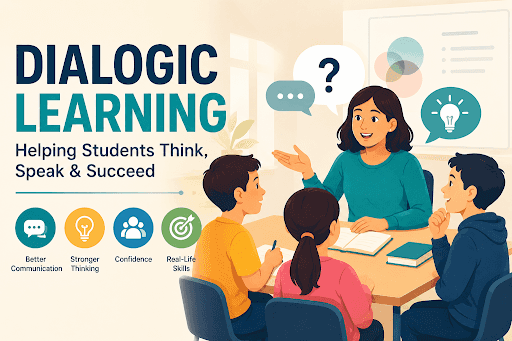

Ever notice how your child will happily talk your ear off about a game or a friend, then go completely blank when you ask what they learned at school? There's a reason for that. Talking is how children actually work things out. And there's a name for putting that instinct to use in a classroom, which is dialogic learning.
In one large study of close to 5,000 pupils, the children who learned through structured classroom talk pulled ahead by two full months in English and science. This difference was visible in roughly 20 weeks, not bad for an approach that mostly just gets children thinking out loud but together.
As of now, plenty of schools have caught up with the approach of dialogic learning, eminent among them being Queen Elizabeth’s School: one of the premier schools in Gurugram. The school builds real conversation into lessons, right from the Early Years up to Sixth Form.
But, what even is dialogic learning exactly? How does it work? Read on to find out!
Also Read | Attention Spans Are Shrinking. Can Schools Make Learning Interesting Again?
What does Dialogic Learning Mean?
The traditional education model often relies heavily on one-way communication between the teacher and the classroom. The teacher talks with a full room of students, just listening silently. The only chance for two-way communication happens towards the end of the class, when teachers ask students to ask their questions, but even that is met with silence most of the time.
Dialogic learning flips this traditional approach, wherein children ask questions, poke holes in each other's answers, explain, backtrack, and have another go. The teacher, in a dialogic learning setup, steers the talk instead of carrying the whole lesson alone.
The phrase comes from Professor Robin Alexander, a British researcher who spent most of his career watching how talk shapes thinking. His research found that we understand things best once we’ve said them in our own words. That rings true especially in classroom scenarios, where just nodding along silently might be a sign of being lost.
Dialogic learning successfully transforms the classroom into a dynamic hub of daily exploration. Children do not simply accept provided information from their textbooks without asking deeper questions. They learn to analyse, debate, and completely understand the underlying core principles of a subject, for example:
- A mathematics lesson may no longer end with a single correct answer as students may discuss different methods to solve the same problem.
- In literature classes, children may interpret characters differently.
- In science, they may question why certain experiments failed instead of hiding mistakes.
Why is Dialogic Learning Gaining Popularity?
Many parents today notice a strange contradiction. Their children score well in exams but hesitate during conversations. Some struggle to express opinions, while others avoid asking questions because they fear judgment.
The small changes happen first:
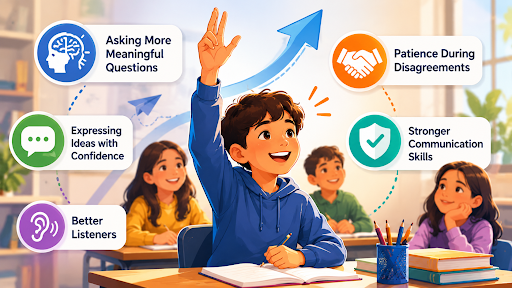
- Children begin asking more meaningful questions
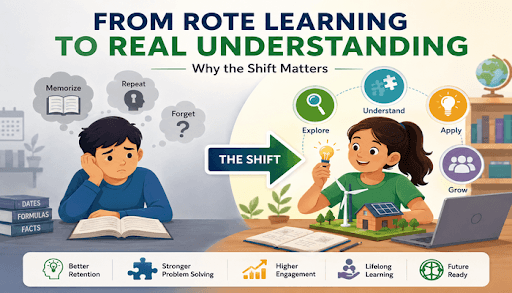
- They explain concepts instead of memorising definitions
- They become better listeners
- They show patience during disagreements
- They grow more confident while speaking in groups
This often happens because traditional classrooms reward silence and speed. Students learn to memorise quickly but rarely learn how to process ideas aloud.
Dialogic learning addresses this gap.
When children regularly participate in thoughtful discussions, they become more comfortable with communication. Over time, this confidence extends beyond classrooms. It appears during interviews, competitions, presentations, and even daily conversations at home.
Benefits of Dialogic Learning
The major benefit of dialogic learning is that it helps with better retention, thus seeing a jump in grades as well. That, however, is still the obvious part; what else happens is:
- Their thinking gets sharper as they form their arguments with logic.
- They turn into real listeners instead of quietly waiting for their turn to talk.
- Quieter kids find a voice, and they tend to carry it everywhere once they have it.
- Disagreement stops being scary as they pick apart an idea without picking apart a classmate.
- They learn to stick to it, as humans tend to hang on to things we've argued over far longer than things we were simply told.
For younger children, particularly, dialogic learning becomes fundamental to their cognitive and social development. Here’s how:
- Enhances Critical Thinking: Students must routinely justify their spoken answers with solid, logical reasoning and clear factual evidence. They learn to evaluate available evidence before forming a final academic conclusion. This analytical skill actively prevents them from accepting modern misinformation at face value.
- Improves Retention and Recall: Explaining a difficult concept out loud successfully solidifies the new information deep within the student's brain. Students can recall spoken classroom debates much more easily than dense textbook paragraphs. This directly leads to noticeably better performance across all core academic subjects.
- Develops Collaborative Skills: Group discussions require children to take turns fairly and listen actively to their peers without interrupting. They learn exactly how to give and receive constructive feedback gracefully. These are the exact interpersonal skills that future global employers will heavily demand.
Check Out | Teaching Students the Art of Listening
Queen Elizabeth’s School, Gurugram: Encouraging Dialogic Teaching-Learning
Tracing its name back to Queen Elizabeth’s School, Barnet, founded in the UK in 1573 under a royal charter, QE Gurugram follows a British International curriculum that leads to IGCSE and A-Level qualifications. The school aims to shape each student into confident, able and responsible citizens and makes a real point of knowing every child as a person rather than a name on a register.
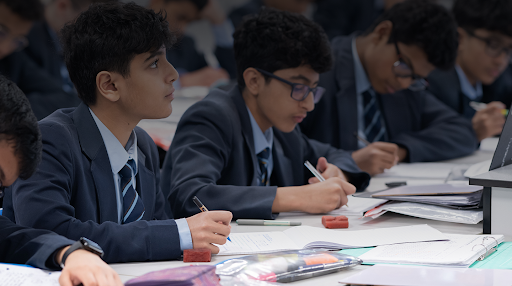
The school holds a very firm stance on the massive importance of dialogic learning. The educators here place considerable importance on developing strong speaking and listening skills across all subject areas. Purposeful dialogue is heavily encouraged right from the early stages of the Early Years programme. This intense educational focus continues seamlessly all the way through to the Sixth Form.
One of the best IGCSE schools in Gurugram, Queen Elizabeth’s School views oracy as an absolute foundational pillar for future career success. Classroom practices are consistently evidence-based and meticulously planned by the highly dedicated teaching staff.
Students experience a highly positive classroom culture that deeply values interactive peer discussion. Teachers actively encourage all learners to speak with total clarity and precision daily. Active listening is equally prioritised during daily subject lessons across the entire modern campus. Students thoroughly analyse and carefully evaluate the openly shared ideas of their classroom peers. They explicitly learn to respect differing viewpoints and embrace intellectual mistakes openly.
In addition to this, the school offers highly dynamic and engaging extracurricular daily activities. Students routinely engage in coding, artificial intelligence, and extended reality programs to build modern skills. The institution also provides competitive esports leagues for older, interested students to practice digital teamwork.
Conclusion
Dialogic learning circles back to something parents have always known in their bones. Children blossom when somebody listens to them and helps them find the words. So if you're sizing up schools for your child, here's a question worth slipping in. How do you handle talking in your classrooms?
A school that makes room for your child's voice is, when you really think about it, making room for your child.
For more information on Queen Elizabeth’s and other similar schools, check out this list of the best schools in Gurugram











 as a preferred source on