







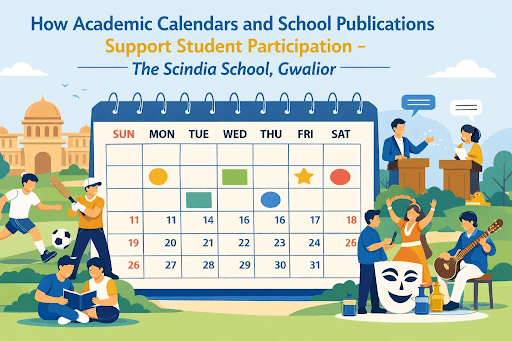

It usually doesn’t begin with confidence; it begins with hesitation. A child sitting in class, watching, listening, seeing others raise their hands, go on stage, and take part. And your child just stays there. Quiet, not because they can’t, not because they don’t want to, something else is missing. Clarity. Timing. A small push at the right moment.
Most parents assume participation is personality-based: “my child is shy” or “they’re just not interested.” It sounds like an easy conclusion, but it’s not always correct. Sometimes, it’s not the child at all; it’s the system around them. And that system is often shaped by two very simple things: academic calendars and school publications. They sound basic, almost boring even, but they quietly influence far more than we realise.
At The Scindia School, Gwalior, this becomes clearer when you look closely at the way the academic year is structured, how achievements are shared, and how opportunities are spaced out. All of it creates an environment where participation either feels natural or forced. And while shortlisting the best boarding schools in India, this is exactly the layer most parents don’t actively consider, even though it silently shapes how much a child actually participates.
Also Read | How Astachal Reflects the Power of Daily Reflection in Student Life
Why Do Academic Calendars Matter for Student Participation?

Think about this for a second: if your child doesn’t know an event is happening, how will they ever participate? A well-planned academic calendar gives information early. When a child knows:
- There’s a competition coming.
- A presentation day is planned.
- A sports event is scheduled.
They start thinking. Slowly. They imagine themselves in it. They discuss it with friends. They prepare without even realising. Participation begins there, not on the stage, not on the field, in the mind. According to the National Center for Education Statistics, students who receive structured and early information about activities show up to 35% higher participation rates. That’s not talent. That’s timing.
-
The Hidden Gap: Why Students Miss Opportunities
A parent once said something that stays. “My child tells me about events after they’re over.” And that’s the problem, if communication doesn’t reach on time it doesn’t exist for the child. When things feel unclear, children hesitate. They think: “Am I too late?” “What if I don’t know what to do?” Kids step back, and slowly, that becomes a habit. Not participating becomes normal.
-
How Structured Planning Improves Student Confidence
Children don’t decide instantly; they take time. They imagine, they process, they prepare internally. If they get time, they step forward; if they don’t, they withdraw. A structured academic calendar creates predictability, and predictability reduces anxiety.
A study from the Journal of School Psychology shows that structured environments improve student participation by nearly 25%. Because when things feel clear, they feel manageable, and when they feel manageable, children try.
-
The Role of School Publications in Encouraging Participation
Now this part is often ignored: school publications. Newsletters, Magazines, Updates, Circulars. Parents read them quickly, and sometimes they even skip them, but for children, they matter a lot. When a child sees:
- A classmate is being featured.
- Achievements being shared.
- Events are being talked about.
Something shifts, participation becomes visible. A report from the Educational Research Review by the American Psychological Association suggests that visibility of peer achievements increases participation by nearly 40%. Because children relate to what they see. Not what they are told.

-
Visibility Builds Motivation: A Simple Shift
A student flips through a school magazine and sees someone from their class featured. Nothing dramatic happens, but a thought appears. “I can try this too.” Next time, they don’t ignore the opportunity. They consider it, that’s how it works. Quiet. Gradual. Real.
-
Why Communication Systems Decide Participation Levels
Most schools have enough activities, but participation still stays limited. Why? Because communication is inconsistent, dates overlap, notices come late, information is unclear, and children don’t function well in confusion. They need structure. They need repetition. They need visibility. Without it, even the best opportunities go unused.
Check Out | Speak with Impact: The Comprehensive Communication Handbook for Students
Inside The Scindia School: A Structured Approach to Student Participation
Now here’s where things shift. At The Scindia School, participation is not left to chance. It’s planned. You don’t see last-minute rush or confusion; there is clarity. The academic calendar works like a guide. Not just a document. Students know what’s coming, not everything, but enough to prepare.
And that “enough” changes behaviour. They don’t react. They plan. There’s also a rhythm. Events are spaced. Not crowded. Not overwhelming. Which means students don’t feel pressured from all sides. They engage better.

Then comes communication. School publications are not just updates here. They reflect student life. Achievements are highlighted. Participation is visible. Efforts are acknowledged. And when students see this consistently, something shifts. They feel included, they feel seen. For parents searching for the best schools in Gwalior, this is something that often goes unnoticed. But it directly affects how a child grows within a school system. Because school is not just about teaching. It’s about being involved.
Participation cannot be forced. It doesn’t work that way. You can’t push a child into confidence. But you can build an environment where stepping forward feels easier. Where information is clear. Where timing is right. Where effort is recognised. That’s what academic calendars and school publications together create. A system. And systems shape behaviour.
Let’s look ahead. Children who participate more tend to communicate better. They adapt faster. They handle situations more confidently. These are not short-term gains. They stay. Beyond school. Beyond academics. And often, it all begins with something small. Knowing what’s happening. And having the time to step in.
What Parents Are Actually Worried About
You might not say it directly, but it’s there.
- “Why is my child not confident?”
- “Why do they avoid activities?”
- “Why don’t they take initiative?”
These questions matter, but the answer is not always personality. Sometimes, it’s exposure. Sometimes, timing. Sometimes, it's just communication gaps.
The Final Thought for Parents
Next time your child doesn’t participate, pause. Don’t just ask them why. Look at the system around them. Were they informed clearly? Did they have enough time? Did they see others doing it? Because sometimes, the issue is not ability. It’s awareness. And when awareness improves, participation follows. Slowly. But surely. That’s how it starts.
If you want to know more about this and other boarding schools, then check out the list of the top schools in India.




 as a preferred source on