







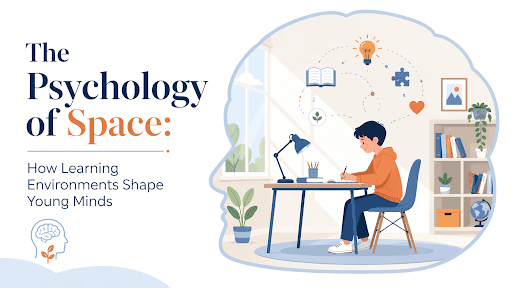

Learning of any kind depends a lot on the environment that the learners are in. For any student, a whitewashed classroom is a boring space. Young minds require stimulants continuously, and so the learning that happens in a boring classroom fails to attract their attention. And that is why every student wants to step out of the classroom, but what if the entire school itself becomes a source of learning? In this way, the learning is not just restricted to classrooms, but the entire environment of the school becomes a source of learning for students.
Imagine the student steps inside the gate and his learning starts, independent of periods, classes, teachers, and any other such structure.
A learning space that not only attracts attention, but also teaches students, in that space. And that is what we'll talk about through this article. We'll try to establish the importance of spaces in learning, visual learning, and other such points. We'll also talk about one of the best schools in Bangalore, The Cambridge International School — Sarjapur Road and how the school teaches through their learning spaces.
Learning Requires Attention

According to a study, attention is an essential function in school activities, as students must be able to direct their attentional focus on specific stimuli, such as the teacher’s verbal explanation. The study delves further into how Green Spaces are important for students, as it helps in learning.
In a thoughtfully designed school space, learning happens inside and outside the classroom. The space starts to work as a Visual Anchor, with examples such as math walls, word boards, or thematic murals. These structures act as calling cards that show up again and again, thus setting up different areas of knowledge.
The idea relates to Cognitive Priming, which is a psychological phenomenon where exposure to a stimulus (word, image, or event) unconsciously influences a person's response to a subsequent, related stimulus. In this way, the child does not need to flick a switch on to learn, but the learning happens almost automatically.
Read Further| Where Students Become Champions
Role of Visual Spaces in Learning
According to an article on Medium, humans are fundamentally visual creatures. Our brains process visual information dramatically faster than text — often cited in educational contexts as up to 60,000 times faster — allowing near-instantaneous pattern recognition and meaning-making.
This advantage stems from Dual Coding Theory, pioneered by psychologist Allan Paivio in the 1970s. According to the theory, we possess two distinct but interconnected mental systems: a verbal channel (for words and spoken language) and a nonverbal/visual channel (for images, spatial information, and mental imagery). When information is encoded through both channels simultaneously, it creates richer, more durable memory traces with multiple retrieval pathways. The above-cited data and facts successfully establish that Visual Learning is a much-needed form of learning.
However, according to popular belief, in a class, if there are too many visual cues present, it can also lead to students getting distracted, and thus, 20-50% of the school walls should be clear. Because of this resistance, it requires a special space in a school, where Visual Learning can happen. These Visual Learning spaces can play the following roles:
- Enhanced Cognitive Processing & Memory: As a vital teaching aid that helps students comprehend complex subjects faster and retain information longer through dual-coding—using both verbal and nonverbal channels.
- Engagement and Motivation: Engaging visuals, such as murals or interactive displays, break the monotony of traditional classrooms, turning passive spaces into stimulating learning environments that reduce anxiety and spark curiosity.
- Creating a Positive Atmosphere & Belonging: Well-designed visuals, including inclusive artwork and student-created projects, promote a positive school culture and help students feel represented and emotionally connected to the school.
- Encouraging Movement and Creativity: Visual design can transform, for example, long hallways into active learning spaces using floor graphics or encourage creative thinking in specialized art and maker spaces.
- Developing Social-Emotional Skills: Visuals can aid in forming strong, friendly bonds and help children come out of their comfort zones in a warm, welcoming environment.
- Supporting Diverse Learners: Incorporating visual elements recognizes and supports visual-spatial intelligence, which is often neglected in traditional verbal/text-centered teaching approaches.
Also Read| Building Entrepreneurial Skills in Young Learners
Understanding Visual Spaces better
That is the reason why a well-designed visual space becomes more than decoration. It becomes a memory map (something that is very popular in pop culture), where students associate concepts with specific locations and sights.
In this space, when students are exposed to a mix of art, culture, science, and storytelling within the same space, it encourages them to draw connections across subjects. This makes it a cognitive playground, where curiosity is constantly triggered. A single visual can lead to multiple lines of thought: a historical figure might spark interest in history, art, or even social values. A fictional character might lead to discussions about storytelling, culture, or imagination.
In such spaces, learning becomes less about absorbing information and more about discovering connections.
Now, these spaces in modern times have shifted from a decorative piece to an intentional design. From its aesthetic appeal to strategic learning tools, the visual elements have come a long way.
Learning corners are designed to provide continuous, low-pressure exposure to key concepts. They extend learning beyond the classroom and make it part of everyday experience. Because of this, we have one thing clear, learning does not happen only during lessons.
The Cambridge International School — Haralur Embodying this Philosophy
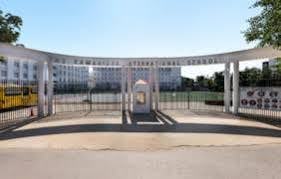
The Cambridge International School, Haralur, clearly shows that the school understands the importance of space as a learning tool, in the way that the school is designed and experienced. And that is what makes TCIS one of the best CBSE schools in Bangalore.
This aligns with the school’s broader philosophy of treating every space as a learning opportunity. At TCIS Haralur, classrooms are complemented by corridors and shared spaces that feature dedicated learning corners—covering areas such as science, mathematics, literature, and values. These are not isolated installations but integrated elements of the school environment, ensuring that learning continues beyond the confines of the classroom.
The campus itself supports this approach through thoughtfully designed infrastructure. Flexible classrooms, collaborative spaces, and activity zones allow students to move, interact, and engage with their surroundings in meaningful ways. This creates an ecosystem where learning is not static but fluid and evolving.
Additionally, the school’s emphasis on a child-centric approach ensures that these spaces cater to diverse learning styles. Visual learners benefit from rich imagery, kinesthetic learners engage through movement and interaction, and reflective learners find opportunities to pause and absorb.
The result is an environment where space actively contributes to the learning process—reinforcing concepts, stimulating curiosity, and supporting holistic development.
A Space That Teaches
What TCIS Haralur demonstrates is a forward-thinking approach to education—one that recognizes the profound impact of environment on learning. By designing spaces that are intentional, engaging, and multidimensional, the school ensures that education is not limited to textbooks or timetables.
Instead, it becomes an experience—one that unfolds continuously, in classrooms, corridors, and every corner in between.
In the end, the psychology of space reminds us of something fundamental: the environments we create shape the minds we nurture.
For more information on this and similar schools in the area, check out this list of the best schools in Bangalore









 as a preferred source on