








Entrepreneurship is no longer just a career choice — it is a life skill. Schools across India are slowly waking up to this reality, but very few have made it a structured part of their curriculum from primary school itself. Think about it — most children already display entrepreneurial instincts naturally. A child who organises a game in the playground and assigns roles to friends is thinking like a leader. A child who trades snacks at lunchtime is negotiating. Children who grew up playing games like Monopoly, Business, or even informal "shop-shop" at home were unknowingly building financial thinking, turn-taking strategy, and risk assessment. The instinct is already there. The question is whether schools choose to nurture it or let it fade.
Most students encounter concepts like business thinking, problem-solving, and innovation only after they enter college. By that point, years of rote learning have already shaped how they think — and unlearning that rigidity is harder than it sounds. Parents today increasingly want their children to be prepared for a world that rewards adaptability and original thinking, not just marks on a report card. Students themselves, especially teenagers, are drawn to real challenges over textbook exercises. They want to build, create, and be heard.
In this article, we explore why entrepreneurship education matters in schools, how it develops essential skills in children, and how one of the best schools in Bangalore, TCIS, has built a program that takes students all the way from classroom learning to real-world investor pitches.
Also Read | From Haralur to World Stage: How TCIS Transforms Students into National Champions and Global Scholars
Why Schools Must Teach Entrepreneurship Early
Introducing entrepreneurship early changes how children relate to learning itself. Children who learn entrepreneurship stop seeing problems as obstacles. They start seeing them as puzzles worth solving. This shift in mindset influences how they approach every subject — math, science, and even language. They ask more questions, they experiment, and they become more comfortable with not knowing the answer right away.
Running a business idea — even a small classroom one — requires teamwork, communication, and empathy. Children learn to listen to feedback, manage disagreements, and understand different points of view. These are skills that no textbook chapter can fully teach on its own.
What Entrepreneurship Education Actually Looks Like in Schools

Good entrepreneurship education is not about teaching children to sell things or memorise business terms. It is about creating experiences that genuinely mirror real-world challenges in age-appropriate ways. A child in Grade 4 might design a solution to reduce food waste in the school canteen. A student in Grade 9 might map out a business model for a problem they see in their own neighbourhood. The context changes with age, but the core habit — identifying a problem and working toward a solution — remains the same. This is what separates entrepreneurship education from a regular classroom subject. It does not have a fixed answer at the end of the chapter.
Project-Based Learning Is at the Core
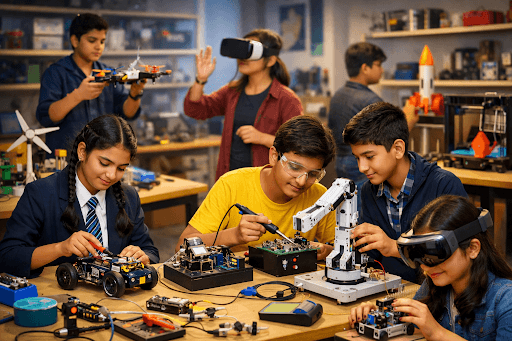
Effective programs use real tasks — designing a product, solving a community problem, or pitching an idea — to teach business thinking. Children do not sit and memorise definitions. They build, test, fail, and improve. This hands-on process teaches them far more than theory ever could.
Teachers Become Facilitators, Not Just Instructors
In entrepreneurship-focused classrooms, teachers guide the process rather than deliver information. Students take ownership of their ideas and decisions. This shift in classroom dynamics gives children a sense of agency that boosts both confidence and motivation.
Age-Appropriate Progression Matters
A seven-year-old and a fifteen-year-old think very differently. Strong programs design challenges that match cognitive development at each stage. Younger children might design a simple product for their classroom. Older students might research a market gap and build a full business model.
Also Read | Super Saturdays and Smart Classrooms
The Broader Skills Children Gain
Entrepreneurship education touches areas that go well beyond business knowledge. The skills children develop through this process quietly shape how they think, communicate, and carry themselves — in school and long after it.
- Financial awareness: Children learn how money works, how resources are limited, and why every decision carries a cost. This builds practical money sense from a young age.
- Critical thinking: Students learn to evaluate options, question assumptions, and choose the best path forward rather than the easiest one.
- Communication and presentation: Pitching an idea, even to a small group, builds the habit of expressing thoughts clearly and confidently. This skill travels with them into every profession.
- Resilience and handling failure: Entrepreneurship involves setbacks. Children who experience this in a safe school environment learn that failure is feedback, not an ending.
- Teamwork and collaboration: Building something together teaches children how to divide work, resolve disagreements, and value different strengths within a group.
- Empathy and customer thinking: Students learn to think from another person's perspective — what does this person need, and how can my idea genuinely help them?
- Time management and planning: Executing a project within a deadline teaches children to prioritise tasks and manage their own time without being told every step.
- Creative confidence: When children see their own ideas taken seriously, they stop second-guessing themselves. They begin to trust their own thinking — and that changes everything.
Check Out | Why Soft Skills Matter More Than Ever
Growing Young Entrepreneurs from Grade 3 at TCIS, Bangalore

One of the best CBSE, IB schools in Bangalore, The Cambridge International School (TCIS) in Haralur has built entrepreneurship education directly into its academic structure — and it starts earlier than most people would expect.
TCIS introduced its entrepreneurship program in Grade 3. The school believes that entrepreneurial thinking is a lifelong skill, not a senior-year elective. Students begin with foundational concepts and progressively take on more complex challenges as they move through each grade. By the time they reach senior school, they are not just learning — they are doing.
What makes the TCIS program especially distinctive is how it connects classroom work to the real world. Students participate in platforms like UQ Ventures and the India Future Founders Competition, where they pitch actual startup ideas to real investors. This is not a simulation — it is genuine exposure to how business decisions are made, evaluated, and refined. The program pushes students to think critically, communicate clearly, and stand behind their ideas with confidence.
This kind of structured, progressive exposure gives TCIS students a rare edge. They graduate not just with academic qualifications but with the mindset and experience of young innovators who have already tested their ideas in real conditions.
Conclusion
Teaching entrepreneurship early is not a trend — it is a necessity. The world children will enter tomorrow looks nothing like the classrooms of yesterday. TCIS Bangalore understood this early and built a program that grows with every student, from a curious eight-year-old sketching a product idea to a confident teenager standing in front of real investors. That journey — from Grade 3 to a live pitch stage — is exactly what meaningful education looks like. When schools stop waiting for the university to teach young people how to think, create, and lead, they give their students something no exam result ever can: the readiness to shape the world rather than simply enter it.
For more information on this and other such schools in the area, check out this list of the best schools in Bangalore.







 as a preferred source on