







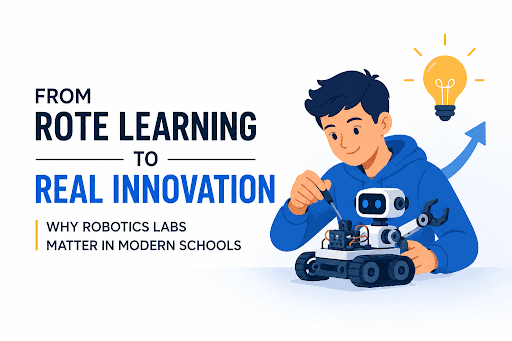

Technological advancements are moving quickly in the modern world. And the solution of any fast-paced environment is to find the answer quickly and effectively rather than from memory. However, until recent years, education involved memorisation. Students were expected to learn, absorb, memorize, and reproduce in examinations. While this system was effective in rewarding theoretical understanding, it often produced little to no amount of experiments, innovation, and curiosity.
But the same cannot be held true today. The world's advancements have been so quick that what was considered fiction a decade ago is the newfound reality. Artificial intelligence is transforming industries. Automation is reshaping jobs. Technology is influencing nearly every aspect of daily life. In such a rapidly evolving environment, simply remembering information may no longer be enough. Increasingly, the ability to think critically, solve problems creatively, collaborate with others, and adapt to new situations is becoming just as important as academic performance itself.
And it is because of this change that modern education is changing, where the need for understanding and implication is resulting in the foundation of what was considered educational. One of the clearest examples of this transformation can be seen in the growing emphasis on robotics labs, maker spaces, and Atal Tinkering Labs within schools. These spaces are not just about machines, coding, or futuristic gadgets. They represent something much larger: a move from passive learning to active creation.
Today, through this article, we wanted to talk about this change and how exactly it is leading to a better future. We’ll try to explain this with the example of one of the best boarding schools in India, Delhi Public School, Yamunanagar and how the school is trying to build the next generation of great minds.
Learning Through Practice
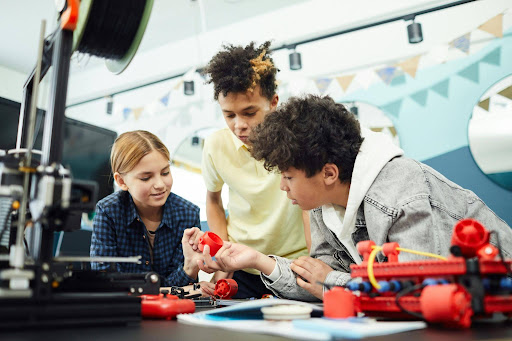
Children learn through exploration. Even before they enter classrooms, they learn by taking things apart only to try to build them back. But in classrooms, most of the learning happens theoretically. Students may understand scientific principles from textbooks, but they rarely get opportunities to apply them in practical situations.
And this is what makes learning in robotics and tinkering labs important.
A robotics lab combines multiple disciplines into one experiential environment. Students engage with coding, electronics, mechanics, physics, mathematics, and design thinking simultaneously. More importantly, they learn how these concepts connect in the real world.
Instead of only reading about sensors or circuits, students can use them to build working models. Instead of memorising programming concepts, they can apply logic to make a robot move, respond, or solve a task. This kind of experiential learning transforms education from something students consume into something they actively participate in.
Research in education has consistently shown that hands-on learning improves retention, engagement, and understanding. When students create something themselves, the learning process becomes deeper and more meaningful. They are no longer passive recipients of information; they become problem-solvers and innovators.
Also Read| How Sports help children become achievers
Rise of Maker Culture
According to the Maker-Culture philosophy, students are supposed to learn by building, experimenting, and innovating rather than simply following orders.
The idea that the Maker Culture works under is curiosity. It invites students to ask questions, test ideas, fail successfully, and ultimately improve through changes. All this sounds too close to reality.
Earlier, the idea of education was about rewarding the quickest one with the answer. Innovation-based learning, however, teaches students that mistakes are the very thing that makes learning exciting. Once, the inventor of the electric bulb, Thomas A. Edison, said that he did not fail a thousand times but instead found a thousand ways in which a bulb could not be made. And that is what this learning is, the better way to redo and improve.
This mindset is incredibly valuable beyond academics.
Students exposed to project-based learning environments often develop:
- stronger problem-solving abilities,
- greater resilience,
- improved collaboration skills,
- higher confidence,
- and more independent thinking.
These are qualities that extend far beyond school examinations.
Read Further| How to choose the best CBSE school
Advancing Students into A Changing Future
The career that students are going to choose tomorrow will be very different from the roles available today. In such a time, schools are facing a very important question: how to prepare students for a future that is impossible to predict with certainty?
The key to the query lies in teaching skills rather than only static information. Skills like adaptability, innovation, critical thinking, collaboration, and technological literacy are taking it to the modern education paradigm.
This is why innovation ecosystems inside schools are gaining attention. Robotics labs, coding spaces, AI exposure, STEM programs, and tinkering environments allow students to become comfortable with experimentation and emerging technologies from an early age.
Importantly, these spaces also make learning more engaging. Students often feel a stronger sense of ownership and excitement when they are building something tangible rather than simply preparing for tests.
Role of Schools in Encouraging Innovation

As educational priorities evolve, progressive schools are increasingly investing in experiential learning infrastructure. Robotics labs and Atal Tinkering Labs are becoming symbols of this larger transformation toward innovation-focused education.
At one of the best CBSE boarding schools, The Delhi Public School, Yamunanagar, robotics and tinkering initiatives appear to be integrated into a broader approach toward future-ready learning. The school’s robotics lab ecosystem includes exposure to robotics kits, sensors, microcontroller boards, 3D printers, innovation projects, and hands-on experimentation through Atal Tinkering Lab initiatives.
Such environments can give students opportunities to move beyond theoretical concepts and engage with practical application. Innovation-focused spaces within schools often encourage students to participate in collaborative projects, exhibitions, and problem-solving activities that promote creativity alongside technical understanding.
More importantly, they help normalise curiosity.
In many traditional systems, students may hesitate to experiment because they fear making mistakes. But innovation labs create spaces where questioning, testing, and trying again become part of the learning culture itself.
Beyond Marks and Memorisation
The modern education is not just about getting those good grades but also about the environment that nurtures a student’s creativity, confidence and adaptability.
Robotics labs represent one part of this broader educational evolution. They encourage students to think independently, engage deeply with concepts, and become active participants in learning. They help children understand that innovation is not reserved for scientists or inventors alone; it begins with curiosity, experimentation, and the willingness to explore ideas.
It is with this idea that Delhi Public School, Yamuna Nagar, works with the robotics lab. The idea is that schools will provide a structure and environment suitable for learning.
And as more schools start following it, perhaps that shift may become one of the most important transformations in modern education.
To learn more about this and other boarding schools, check out this list of the best boarding schools in India.
 as a preferred source on