









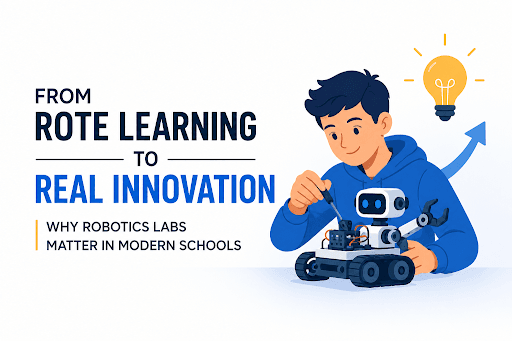
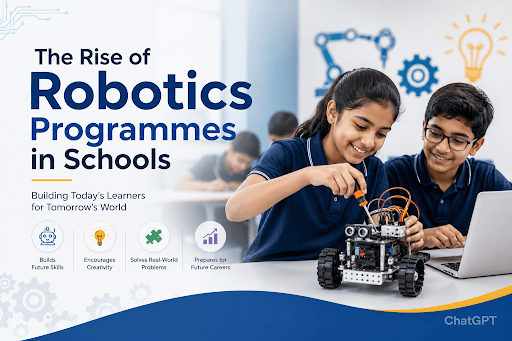
The global robotics technology market may grow to about $149.9 billion by 2030 and will greatly change how people live and work. As technology moves fast, learning about automation only in college is too late. Studies show that students who join robotics labs build important 21st-century skills needed for future jobs in AI, automation, and engineering. That's why some of the best schools in Bangalore are teaching robotics, making learning more fun and useful, helping students get ready for a world powered by technology.
Article Highlights
- Future-Readiness: Learning robotics helps students quickly understand STEM ideas and get ready for a tech-based future.
- Skill Fusion: Robotics teaches both technical skills like coding and mechanics, and life skills like teamwork and resilience.
- The Kesar Approach: At Kesar The International School (KTIS), students follow a “Constructionist” way of learning, they build things instead of just watching.
- Debunking the Myth: While some Bangalore schools use robot teachers like Eagle 2.0, KTIS encourages students to design and build their own robots.
- Anubhava Program: In KTIS’s special robotics lab, students treat failure as part of learning, not as a mistake.
Why Robotics in Schools Matters?
Starting a Robotics lab in best CBSE schools in Bangalore or other schools is not just following a trend; it is important based on facts. The World Economic Forum says that 65% of kids who start primary school today will work in jobs that don't exist yet. Robotics helps students get ready for these future new jobs.
When students work with robots, they don’t just play with toys. They connect what they learn in books to the real world.
Boosting Hard Skills: Robotics helps students learn hard skills. It combines many subjects. They use math to measure angles and distance, physics to understand things like speed and force, and computer science to write programs that control the robot. This way, hard STEM subjects become easier to learn and remember.
Improving Soft Skills: Robots rarely work perfectly the first time. This teaches students to think carefully and work together. They must talk and share ideas to fix problems. LinkedIn says good communication and problem-solving skills are very important for jobs today.
Also Read: From Skills to Success: Role of Value Added Programs
How Robotics Builds Mental Resilience?
Robotics helps students grow mentally in ways many don’t realize. In normal classrooms, getting an answer wrong feels like failing. But in a Robotics Lab, a "failure" means there is a mistake to fix.
This helps students build grit and keep trying. When a student writes code and the robot crashes into a wall instead of turning, they look for the mistake, fix the code, and try again. This teaches them how to solve problems.
Robotics is not just for making things in factories anymore. People use robotics in many areas like remote surgery in hospitals, automatic harvesting on farms, and self-driving cars in delivery services.
Schools with robotics programs see students get more interested in learning. By working with real machines, students learn how different parts like sensors and motors work together in a system. This helps them understand how the whole machine works.
Career in Robotics: Salaries, Scope, and Future
The demand for robotics professionals is growing faster than the supply. This creates good job opportunities. Robotics is not just used in factories now; it is also used in healthcare, logistics, and defense.
High Earning Potential
In India, new Robotics Engineers usually get a salary of Rs 5 to 8 lakhs per year. If they specialize in AI and Machine Learning and have 3 to 5 years of experience, their salary can increase to Rs 24 to 40 lakhs per year. Around the world, the average salary for robotics engineers is expected to be over $114,000 (about Rs 95 lakhs) in 2025.
Wider Job Roles
Robotics field offers many different jobs such as Robotics Systems Architect, AI & Machine Learning Specialist, and Computer Vision Engineer.
Expanding Industries in Robotics
Robots are used in many industries:
- Healthcare: Robots help with surgery and rehabilitation.
- Logistics: Big companies like Amazon and Flipkart use robots for managing warehouses.
- Agriculture: Robots help in harvesting and monitoring with drones.
- Defense: Robots are used for drones and surveillance.
Also Read: Raising Independent Individuals: Teaching Independent Living
Best Countries to Study Robotics (with High ROI)
For students who want global exposure, picking the right country matters the most. Below are the top countries that give the best Return on Investment (ROI):
Germany (Best ROI)
- Why: Most public universities in Germany charge little or no tuition fees.
- Scope: Big companies like KUKA and Siemens are based here.
- Result: Students get world-class education at a much lower cost than in the US.
United States (Highest Salary Ceiling)
- Why: The US has top universities such as MIT, Stanford, and Carnegie Mellon (CMU).
- Scope: It is the center of AI innovation and venture capital.
- Result: Education costs are high, but starting salaries often go above $100,000.
Japan (Best for R&D)
- Why: Japan leads the world in industrial robotics and humanoid research.
- Scope: The government offers many scholarships for science and technology students.
- Result: Students gain strong technical skills and can work with companies like Fanuc and SoftBank.
Kesar The International School Difference: Creating Makers, Not Just Users

Many schools in Bangalore are quickly adopting new technology, but Kesar The International School (KTIS) uses it in a more meaningful way.
It is important to clear up a common confusion in the Bangalore education market. Search trends often link "Robot Teachers" (specifically the Eagle 2.0 humanoid) with innovative schools. However, research clarifies that this specific technology is used at Indus International School. KTIS does not use robots to teach your children.
KTIS believes students should not just watch a robot teach them. Instead, KTIS helps students learn to build robots on their own. This difference matters. Kesar believes students learn best when they take charge of their learning instead of just listening to a machine.
Inside the Anubhava Robotics Lab
The KTIS curriculum centers on the Anubhava Program, whose main part is the special Robotics Lab. The lab uses the "Constructionist" approach created by education expert Seymour Papert. He believed students learn best when they build something that others can see, like a sandcastle or a machine.
What happens inside the KTIS Robotics Lab?
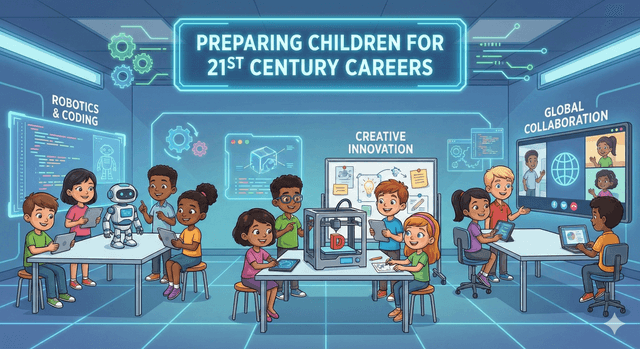
Designing Systems: Students don’t use ready-made kits. They design robots by working with real processors, motors, and sensors.
Physical Computing: Students write code that controls real machines. They watch their programs come alive through movement.
Failure Analysis: When circuits don’t work, students debug them. They find the mistakes and turn their frustration into curiosity.
Why is KTIS the Right Choice?
KTIS gives students a space to work with real hardware and solve real-world engineering problems. This helps your child build systems thinking and understand how different parts fit together. The lab’s facilities help students grow from beginners to confident makers who can design real-world solid solutions.
To learn more about this and other schools nearby, see this list of the top schools in Bangalore.








 as a preferred source on