







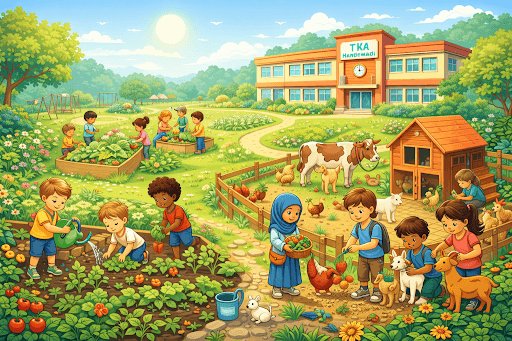

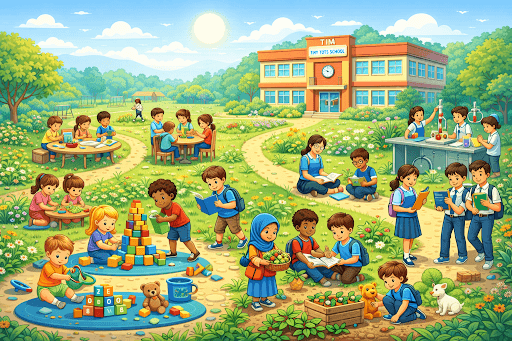
The smell of fresh soil, the chirping of birds, and children's laughter echoing through open spaces—this isn't a weekend getaway but a regular school day for many progressive institutions today. Indian education is finally breaking free from the four-wall syndrome, embracing gardens, animal care, and hands-on activities as legitimate learning tools.
The Keystone Ankuram in Handewadi, Pune, exemplifies this shift. Here, CBSE academics coexist with gardening patches, animal enclosures, and clay-moulding studios, creating an education model that values both textbooks and tactile experiences.
In this article, we explore how experiential learning is transforming Indian schools, why nature-based activities matter for cognitive development, and how institutions are balancing traditional skills with modern competencies to prepare well-rounded learners.
Also Read | Fostering Responsibility and Respect: The Code of Conduct at The Keystone Ankuram School
The Case for Experiential Learning in Indian Schools
India's National Education Policy 2020 didn't just recommend changes—it demanded a complete pedagogical overhaul. The emphasis? Moving from memorisation to understanding, from passive listening to active doing. But why does this matter?
Why Hands-On Learning Works
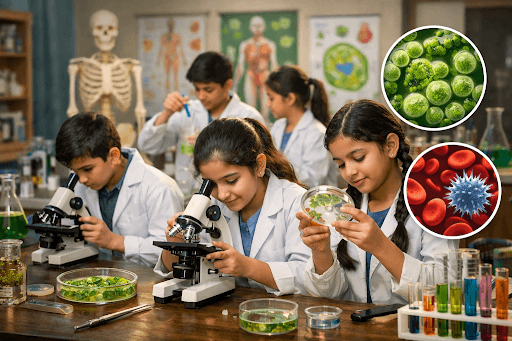
Research consistently shows that students retain only 10% of what they read but remember 75% of what they practice. When children plant seeds, measure growth rates, and document observations, they're not just learning science—they're living it. The abstract becomes concrete when theoretical photosynthesis happens in their school garden.
Traditional classrooms often struggle with engagement. A 2019 study across Delhi schools found that activity-based learning improved student interest by 64% compared to lecture-based methods. Children who touched, built, and experimented showed better problem-solving abilities than their textbook-bound peers.
The Disconnect Generation
Today's urban children can name dinosaur species but can't identify common birds. They understand algorithms but have never held soil. This disconnection from the physical world creates a critical gap in sensory development. Neurologists confirm that multi-sensory experiences in childhood strengthen neural pathways crucial for complex thinking later.
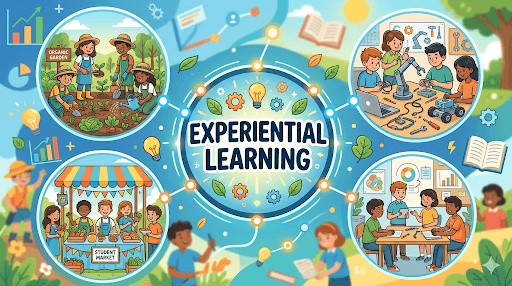
Experiential activities—gardening, animal care, cooking, crafting—aren't recreational add-ons. They're educational necessities that develop fine motor skills, patience, responsibility, and empathy. When a child waters plants daily or feeds animals, they learn commitment and consequence in ways no worksheet can teach.
Beyond Classroom Walls: Nature as the Third Teacher
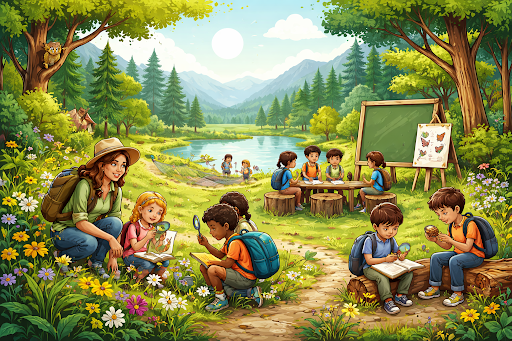
Progressive educators worldwide recognise three teachers in every child's life: adults, peers, and the environment. Nature, often called the third teacher, offers lessons textbooks cannot—unpredictability, patience, observation, and wonder.
The Outdoor Classroom Advantage
Studies from the University of Illinois reveal that children exposed to natural settings show 20% better concentration and reduced ADHD symptoms. Green spaces aren't just pleasant—they're therapeutic. Schools incorporating outdoor learning report fewer behavioural issues and higher academic performance.
When students observe seasonal changes firsthand, measure tree circumferences for math class, or write poetry inspired by monsoon rains, learning becomes contextual. Geography isn't about memorising capital cities; it's about understanding why certain plants grow in specific climates.
Learning Through Living Things
Caring for animals teaches responsibility that chore charts cannot. When children feed school chickens or tend to rabbits, they experience cause and effect immediately. Forget food? The animals go hungry. This direct accountability builds character.
Animal interaction also develops emotional intelligence. Children learn to read non-verbal cues, practice gentleness, and understand needs beyond their own. These soft skills—empathy, patience, attentiveness—prove crucial for collaborative work in adult life.
Bridging Traditional Skills with 21st Century Competencies
There's a misconception that clay modelling and coding can't coexist, that gardening and robotics are opposing forces. Forward-thinking schools are proving otherwise, creating curricula where ancient crafts inform modern innovation.
The Maker Movement in Education
The global maker movement celebrates hands-on creation—whether with clay, circuits, or code. Indian schools are catching on. When students mould Shadu clay figures, they develop spatial reasoning essential for 3D modelling software. When they design garden layouts, they're applying geometric principles used in architecture and engineering.
Traditional crafts aren't nostalgic exercises; they're foundational skills. The patience required to perfect pottery translates to debugging code. The precision needed in clay work applies to robotics assembly. These aren't separate skill sets—they're complementary competencies.
Integration Over Isolation
Smart schools don't teach technology in isolation. They use coding to track plant growth, employ sensors in gardens, and design animal habitats using CAD software. This integration shows students that knowledge isn't compartmentalised—science, math, art, and technology overlap constantly in real-world applications.
A student who programs a garden irrigation system learns coding, understands plant biology, calculates water requirements using math, and considers environmental conservation. One project, multiple disciplines—this is authentic 21st-century learning.
Age-Appropriate Development: The Right Activity at the Right Time
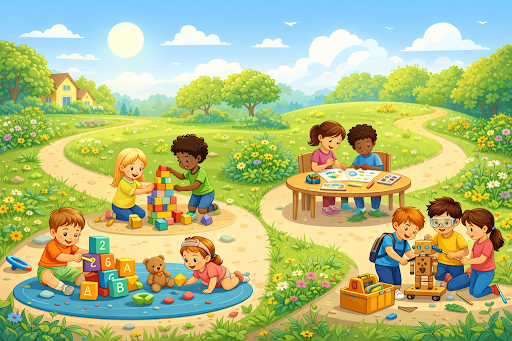
Not all activities suit all ages. Educational psychology teaches us that children's cognitive abilities develop in stages, and smart curriculum design respects these developmental milestones.
Foundation Years: Sensory Exploration (Ages 6-7)
Young children learn through their senses. They need to touch, smell, taste, hear, and see. Activities during these years should emphasise:
- Physical engagement: Digging in gardens, moulding clay, playing with natural materials
- Simple responsibilities: Watering plants, collecting fallen leaves, feeding classroom pets
- Observation skills: Watching caterpillars become butterflies, tracking weather patterns
These aren't frivolous playtime—they're building blocks for abstract thinking later. A child who observes seed germination understands growth cycles, patience, and cause-and-effect relationships that form the basis for scientific thinking.
Preparatory Stage: Expanding Horizons (Ages 8-10)
As children mature, their world expands beyond immediate self-interest. They're ready for more complex projects:
- Community connection: Creating gardens for others, participating in animal welfare drives
- Skill development: Learning cooking basics, advanced craft techniques, and team sports
- Creative expression: Music, dance, drama, integrated with environmental themes
This stage focuses on building confidence and self-reliance while maintaining the joy of hands-on discovery.
Middle Years: Critical Thinking (Ages 11-13)
Adolescents crave logical challenges and real-world relevance. Their activities should reflect increasing complexity. They can handle vocational skills, understand sustainable agriculture, participate in community service projects, and connect hands-on work with career possibilities.
At this stage, gardening becomes an agricultural science. Animal care connects to veterinary pathways. Clay work relates to industrial design. The activities mature alongside the students.
The Bagless Revolution: Rethinking School Structure
The traditional school day—seven periods, heavy bags, homework marathons—is being questioned. Progressive institutions are introducing bagless days where learning happens without textbooks, tests, or typical classroom constraints.
What Happens on Bagless Days
These aren't holidays. They're intensive learning experiences structured differently. Students engage in extended projects, field investigations, creative workshops, and skill-building sessions that regular timetables cannot accommodate.
A bagless day might involve creating a school garden from scratch, conducting animal behaviour studies, organising community clean-up drives, or learning traditional crafts from local artisans. The learning is real, relevant, and remarkably effective.
Benefits Beyond Books
Schools implementing bagless days report surprising outcomes. Students who dread Mondays start looking forward to activity days. Those struggling with conventional academics often excel in practical tasks, boosting their confidence. Parents notice improved enthusiasm, better retention, and increased curiosity about the world.
The model also reduces academic pressure. When education isn't solely exam-focused, children breathe easier. They discover learning can be joyful, not just dutiful.
Check Out | From Gurukula Traditions to Global Citizens: The Canara Gurukula Transformation
The Keystone Ankuram Handewadi: Nature-Integrated CBSE Education in Pune
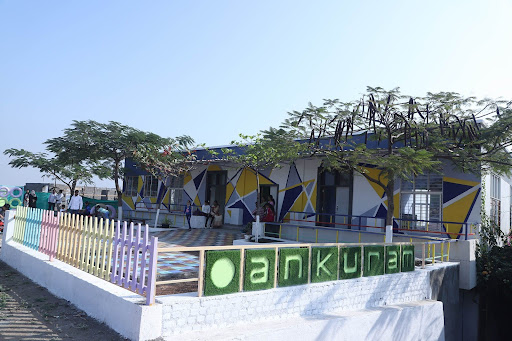
Located near Handewadi Chowk in Pune, The Keystone Ankuram (TKA) brings together everything discussed in this article. Founded by The Shalaka Foundations, this CBSE-affiliated school houses educators with over 50 years of combined experience. The campus, surrounded by diverse flora and fauna, serves as a living laboratory for students from foundational through middle stages.
TKA's tagline—"Celebrating the joy of unhurried childhood"—isn't marketing fluff. It's visible in their stage-wise approach. Foundational students (ages 6-7) engage in domain-based learning focusing on sensory experiences. They garden, care for animals, and explore nature daily alongside literacy and numeracy.
Preparatory students (ages 8-10) expand their horizons through clubs, community service, and creative expression. Middle-stage students (ages 11-13) tackle robotics, coding, and military training while continuing gardening and animal care, now with a deeper understanding.
What makes TKA distinctive is its refusal to choose between traditional and modern. Students mould Shadu clay sculptures in one period and program robots in another. They learn skating, play kabaddi, practice yoga, and study financial literacy. The curriculum doesn't compartmentalise—it integrates.
The school's Bagless Day of Fun (BDF) embodies this philosophy. Students engage in extended activities that textbooks cannot contain: cooking, advanced gardening projects, animal welfare initiatives, and vocational skill development.
With a 30:1 student-teacher ratio, TKA ensures personalised attention. The campus offers spacious classrooms, dedicated activity areas, gardens, animal enclosures, and modern facilities, including transport, medical checkup services, and daycare.
The school's curriculum follows CBSE guidelines but enriches them with experiential components. Standardised tests like SOF Olympiads provide benchmarking, while regular exposure to nature-based activities ensures holistic development.
TKA's mission—instilling love for learning through equal opportunity for every student—manifests in daily operations. The core values emphasise personalised education, safe nurturing environments, and strong partnerships between children, schools, families, and communities.
This isn't education for certificates alone. It's preparation for life. When students graduate from TKA, they carry more than academic knowledge. They understand responsibility through animal care, patience through gardening, creativity through clay work, and innovation through robotics. They've experienced learning as joy, not just duty.
Discover how The Keystone Ankuram is shaping young minds through nature-integrated learning. Visit the school to experience education that goes beyond textbooks and embraces the whole child.
For more information on this and other such schools in the area, check out this list of the best schools in Pune.






 as a preferred source on