









The world stands at a crossroads where environmental degradation and climate change demand immediate action. Schools today are no longer just centres of academic learning—they are becoming laboratories for sustainability, innovation, and social responsibility. Education systems worldwide are evolving to prepare students not just for careers, but for conscientious citizenship that prioritises planetary well-being alongside personal success.
In India, this shift is particularly pronounced as institutions integrate environmental consciousness into their pedagogical frameworks. St. Teresa School, Indirapuram, Ghaziabad, exemplifies this transformation, demonstrating how education can transcend textbooks to create real-world changemakers. In this article, we explore how sustainability-driven education shapes future leaders and examine the elements that make such initiatives truly effective.
Also Read | How Art is being integrated in Learning
The Rise of Sustainability Education in Indian Schools
India's education landscape is witnessing a paradigm shift. The National Education Policy 2020 explicitly emphasises experiential learning, environmental education, and value-based teaching. Schools are moving beyond theoretical environmental studies to hands-on conservation projects, waste management initiatives, and community engagement programs.
According to the Ministry of Education's recent guidelines, environmental education must be integrated across subjects rather than confined to science textbooks alone. This interdisciplinary approach helps students understand sustainability as a way of life, not merely an academic concept.
The Sustainable Development Goals, particularly SDG 4 (Quality Education) and SDG 13 (Climate Action), have become guiding frameworks for progressive schools. Young learners are increasingly participating in tree plantation drives, energy conservation campaigns, and social outreach programs. This grassroots involvement cultivates environmental stewardship from an early age, ensuring that today's students become tomorrow's responsible citizens.
What Makes Sustainability-Driven Education Effective?

Effective sustainability education requires more than token gestures toward environmental awareness. It demands systemic integration, practical application, and genuine commitment from the entire school community. Here's what distinguishes impactful eco-conscious education from superficial initiatives.
Experiential Learning Over Theoretical Knowledge
Reading about climate change in textbooks creates awareness, but planting trees, monitoring their growth, and understanding ecosystem dynamics creates a lasting impact. Students who engage directly with environmental projects develop deeper comprehension and personal investment in sustainability.
Hands-on activities like composting, water quality testing, renewable energy experiments, and biodiversity surveys transform abstract concepts into tangible experiences. This experiential approach enhances retention and motivates students to apply their learning beyond school boundaries.
Integration Across the Curriculum
Sustainability themes can enrich every subject. Mathematics classes can analyse carbon footprint data. Language lessons can explore environmental literature and persuasive writing on conservation. Social studies can examine policy frameworks and community-based solutions. Art projects can utilise recycled materials to spark creative thinking about resource management.
This cross-curricular integration ensures students perceive sustainability not as an isolated topic but as a lens through which to view all learning and life decisions.
Community and Nature Immersion
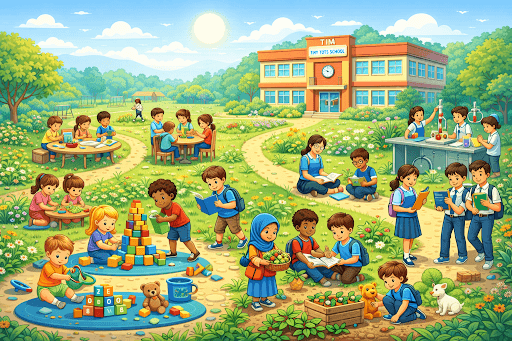
Direct engagement with nature fosters empathy that classroom discussions alone cannot achieve. Regular outdoor learning sessions, nature walks, wildlife observation, and field trips to conservation sites create emotional connections with the environment.
Community outreach extends this connection to social responsibility. When students participate in neighbourhood clean-up drives, teach environmental awareness to underprivileged communities, or collaborate with local authorities on green initiatives, they develop a sense of agency and purpose that defines true leadership.
Innovation Labs: Where STEM Meets Sustainability
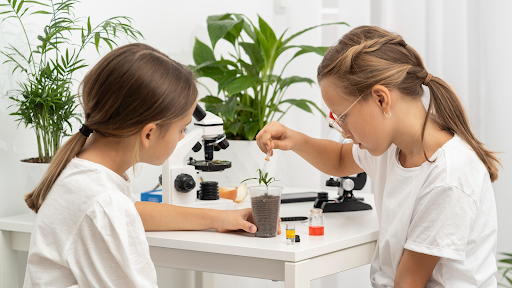
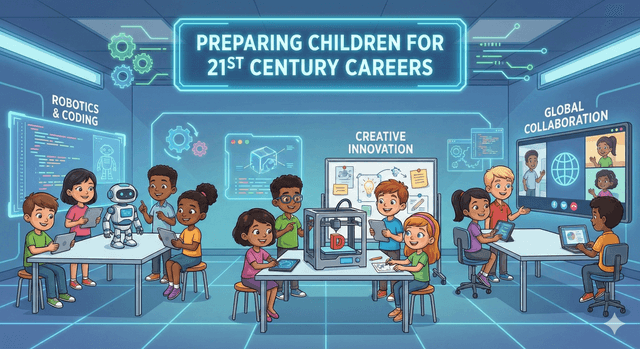
Innovation is the cornerstone of sustainable development. India's Atal Innovation Mission, launched in 2016, has established Atal Tinkering Labs in schools nationwide to nurture scientific temperament and problem-solving abilities. These labs provide students with tools and mentorship to develop innovative solutions for real-world challenges.
ATL facilities typically include:
- Robotics kits and microcontroller boards for automation projects
- 3D printers for rapid prototyping of sustainable designs
- Sensors and electronics components for environmental monitoring systems
- Computational tools for data analysis and modelling
Students in these labs create remarkable projects: solar-powered irrigation systems, waste segregation robots, water purification devices, and air quality monitors. Such initiatives demonstrate how young minds can harness technology for environmental conservation when given proper resources and encouragement.
The design thinking approach emphasised in innovation labs—empathise, define, ideate, prototype, test—equips students with problem-solving frameworks applicable to any challenge. This methodology, combined with hands-on experimentation, prepares students to become innovators who can tackle complex sustainability issues with creativity and confidence.
Check Out | The Role of Environment in Education
St. Teresa School, Indirapuram: Nurturing Eco-Conscious Global Citizens Through Award-Winning Excellence
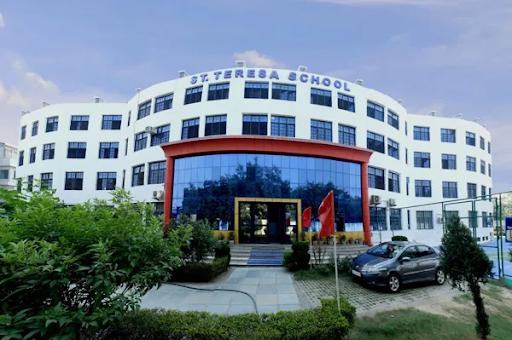
St. Teresa School in Indirapuram, Ghaziabad, is a CBSE-affiliated, co-educational English medium institution managed by the Boman Charitable Trust. The school's mission centres on fostering deeper associations with nature, self, and community through continuous engagement with the natural environment.
The school's commitment to excellence has earned remarkable recognition. It ranks as the 1st Best School in Ghaziabad according to the Dainik Jagran Survey 2025 and 2nd Best School by the Times School Survey 2024. The institution has received the prestigious Global Sustainability Award 2024 for its SDG Superheroes initiative, the Times Business Award 2025, and the ET Leadership Excellence Award North 2025. These accolades reflect the dedication of students, faculty, and leadership toward holistic education.
Established in November 2022, the school's ATL provides students from grades IV to XII with mandatory exposure to cutting-edge innovation. The lab is equipped with robotics kits, 3D printers, sensors, microcontroller boards, and even an astronomy club with telescope facilities. ATL activities are integrated with the curriculum, ensuring students develop critical skills like design thinking, computational reasoning, and adaptive learning. The lab serves as a bridge between theoretical knowledge and practical application, allowing students to test scientific theories and observe real-time results.
St. Teresa School emphasises life skills and values education alongside academic excellence. The curriculum nurtures critical thinking, creativity, empathy, integrity, and respect for diverse perspectives. Students learn through a balanced blend of scholastic pursuits, co-curricular activities, and reflective practices.
Community outreach forms an integral part of the school's ethos. Students provide free tuition for underprivileged children, participate in health camps and blood donation drives, and engage in awareness programs. The school maintains a strict zero-tolerance policy toward bullying, ensuring every child feels safe, valued, and inspired to flourish.
The school's architecturally designed campus includes spacious classrooms, smart classes with audio-visual aids, well-equipped science labs (chemistry, physics, biology), a mathematics lab, a computer lab, a music room, and a modern library. Sports facilities include a synthetic basketball court, indoor badminton and shooting range, lawn tennis court, skating arena, and cricket practice area.
Ready to explore an educational environment where sustainability meets excellence? St. Teresa School, Indirapuram, offers a transformative learning experience that prepares students to become environmentally conscious global citizens. Visit the campus to witness how innovation, nature-integrated learning, and holistic development come together to shape tomorrow's leaders.
For more information on this and other similar schools in the area, check out this list of the best schools in Greater Noida West.









 as a preferred source on