







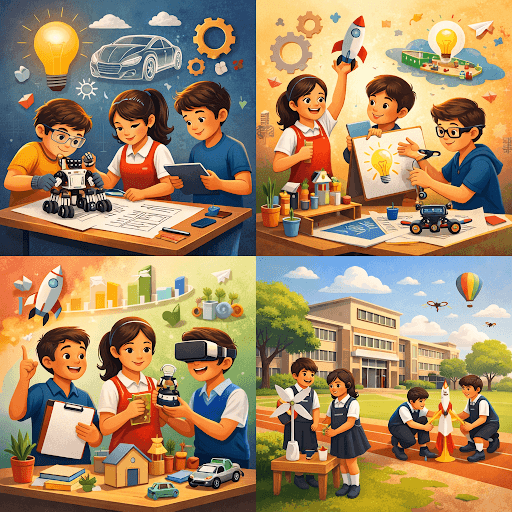

Have you ever wondered why some students confidently turn ideas into action while others hesitate to think beyond textbooks? In today’s fast-evolving world, success is no longer defined only by academic scores; it is shaped by creativity, adaptability, and the courage to innovate.
Parents and educators now recognize that students must be equipped with skills that go beyond rote learning. The ability to design solutions, think creatively, innovate fearlessly, and approach challenges with an entrepreneurial mindset has become essential for navigating future careers and real-world problems.
This article explores how a structured focus on Design, Innovation, Creativity, and Entrepreneurship (D.I.C.E) helps students develop critical thinking, problem-solving abilities, and confidence in their ideas. It also highlights how Swarnprastha Public School, one of the best boarding schools in India, through its integrated D.I.C.E framework, nurtures future-ready learners by encouraging experimentation, collaboration, and real-world application from an early age.
Also Read | Build Confidence with Flexi-Boarding at Swarnprastha Public School
Understanding the D.I.C.E Framework in Modern Education
Design, Innovation, Creativity, and Entrepreneurship (D.I.C.E) represent a shift in how education prepares students for the future. Instead of focusing only on content mastery, this framework emphasizes how students think, create, and apply knowledge in real-world contexts. D.I.C.E equips learners with skills that remain relevant regardless of how industries and careers evolve.
At its core, the D.I.C.E framework encourages:
- Design thinking as a mindset: Students learn to observe problems closely, empathize with real needs, and design thoughtful solutions. This process teaches them to approach challenges systematically rather than relying on trial and error.
- Innovation through experimentation: Innovation is nurtured by allowing students to test ideas, learn from failure, and refine their thinking. D.I.C.E-based learning creates safe spaces where experimentation is encouraged and mistakes are seen as learning opportunities.
- Creativity beyond artistic expression: Creativity within D.I.C.E is not limited to art or design; it extends to original thinking, idea generation, and unique problem-solving approaches across subjects and projects.
- Entrepreneurial thinking for initiative and ownership: Entrepreneurship teaches students to take initiative, manage resources, and think independently. It builds confidence in turning ideas into actionable outcomes while developing leadership and responsibility.
By integrating these elements, the D.I.C.E framework prepares students to become active learners and solution-oriented thinkers, capable of adapting to change and contributing meaningfully in a complex, fast-moving world.
How D.I.C.E Helps Students Develop Future-Ready Skills Beyond Academics
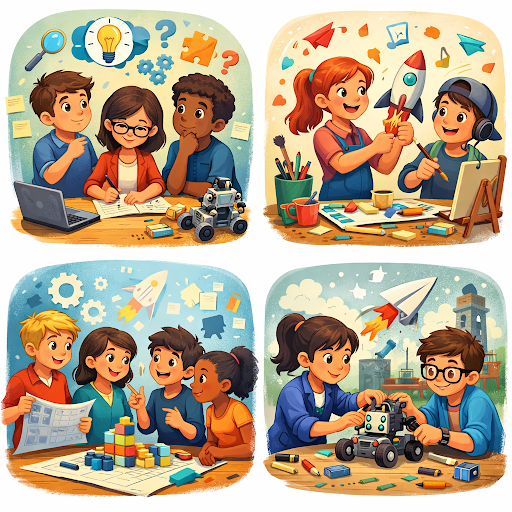
In a world where careers are constantly evolving, students need more than subject knowledge to succeed. The D.I.C.E framework plays a crucial role in developing transferable skills that prepare learners for challenges beyond classrooms and examinations. By engaging students in hands-on, idea-driven learning, D.I.C.E nurtures abilities that remain relevant across disciplines and professions.
Through structured D.I.C.E practices, students begin to develop:
- Critical thinking and problem-solving skills: Learners are encouraged to question, analyze, and break down problems before proposing solutions. Instead of searching for one “correct” answer, they explore multiple possibilities and learn to justify their decisions.
- Confidence in creative expression: When students are given the freedom to experiment and present ideas, they begin to trust their creative instincts. This confidence empowers them to share original thoughts, innovate freely, and take intellectual risks without fear of failure.
- Collaboration and communication abilities: D.I.C.E-based activities often involve teamwork, where students brainstorm, plan, and execute ideas together. This strengthens communication skills, empathy, and the ability to work productively with diverse perspectives.
- Adaptability and resilience: By engaging in iterative processes, designing, testing, and refining, students learn to handle setbacks constructively. They become more adaptable, resilient, and open to change, traits that are essential in an unpredictable future.
By focusing on these competencies, the D.I.C.E framework ensures that learning is not limited to academic achievement alone. Instead, it prepares students to think independently, collaborate effectively, and approach real-world challenges with confidence and creativity.
The Role of Project-Based Learning and Real-World Application in D.I.C.E
One of the strongest pillars of the D.I.C.E framework is its emphasis on project-based learning, where students learn by doing rather than memorizing. This approach bridges the gap between theory and practice, allowing learners to apply concepts in meaningful, real-life contexts.
Through project-based learning, D.I.C.E transforms classrooms into spaces of exploration and innovation by encouraging:
- Learning through real problems: Students work on projects inspired by real-world challenges, designing solutions, building models, or proposing ideas that address practical needs. This makes learning purposeful and deeply engaging.
- Ownership of learning: Instead of following fixed instructions, students take responsibility for planning, researching, and executing projects. This sense of ownership builds independence and accountability.
- Collaboration and idea exchange: Group projects require students to brainstorm, divide roles, negotiate ideas, and work towards a common goal. Such collaboration mirrors professional environments and strengthens teamwork skills.
- Application of interdisciplinary knowledge: D.I.C.E projects often blend concepts from science, technology, humanities, arts, and business. Students learn how different subjects connect and how integrated thinking leads to stronger solutions.
- Reflection and improvement: Project-based learning encourages students to reflect on outcomes, identify what worked, and improve their ideas. This iterative process reinforces learning and nurtures a growth mindset.
By grounding creativity and innovation in real-world application, D.I.C.E ensures that students are not just learning concepts but learning how to use them effectively. This practical exposure prepares learners to take initiative, adapt quickly, and confidently navigate future academic and professional challenges.
Check Out | From Board to Brain: Role of Chess in Strategic Learning
Swarnprastha Public School: Cultivating Innovation Through D.I.C.E
Swarnprastha Public School, one of the best CBSE Boarding Schools in India takes pride in nurturing an educational environment where creativity, innovation, and entrepreneurial thinking are integral to everyday learning. Through the structured integration of Design, Innovation, Creativity, and Entrepreneurship (D.I.C.E), the school prepares students to become confident thinkers and proactive problem-solvers in a rapidly changing world.
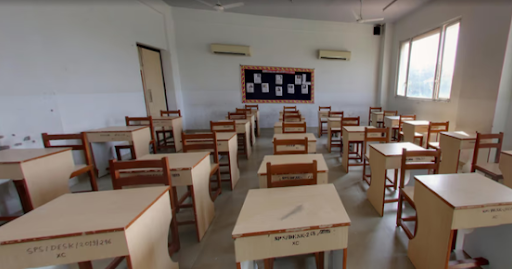
At Swarnprastha, D.I.C.E is not treated as an isolated programme but as a mindset woven across learning experiences. Students are encouraged to question, explore, experiment, and translate ideas into meaningful outcomes, skills that go far beyond academic achievement.
Highlights of the D.I.C.E Approach at Swarnprastha Public School
- Design-led learning experiences that encourage students to identify problems, empathize with real needs, and develop thoughtful, practical solutions.
- Innovation-driven activities where learners are motivated to experiment with ideas, learn from trial and error, and refine their thinking through reflection and feedback.
- Creative expression across disciplines, enabling students to think imaginatively, whether they are working on scientific models, artistic concepts, or interdisciplinary projects.
- Entrepreneurial exposure that builds initiative, leadership, and confidence, helping students understand how ideas can be transformed into impactful solutions.
- Collaborative project-based learning that mirrors real-world environments, strengthening teamwork, communication, and decision-making skills.
Through its D.I.C.E framework, Swarnprastha Public School empowers students to take ownership of their learning journeys. Learners gradually build the confidence to innovate, adapt, and lead, qualities essential for success in higher education and future careers.
By fostering design thinking, creativity, and entrepreneurial spirit from an early age, Swarnprastha Public School demonstrates that education is not just about preparing for exams, but about preparing for life. Students emerge as future-ready individuals equipped to face challenges with imagination, resilience, and purpose.
To learn more about this and other schools nearby, see this list of the top boarding schools in India.










 as a preferred source on