







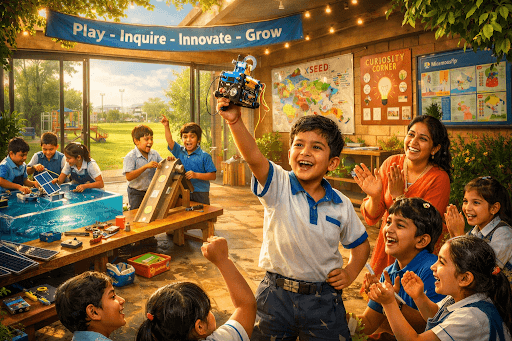

There is a moment every parent quietly dreads, watching their child stand in a room full of peers and shrink. Not because the child isn't capable, but because, somewhere along the way, the classroom taught them to wait for the right answer rather than trust their own instincts.
That moment doesn't come from a lack of intelligence. It comes from an education that trains children to receive knowledge rather than discover it.
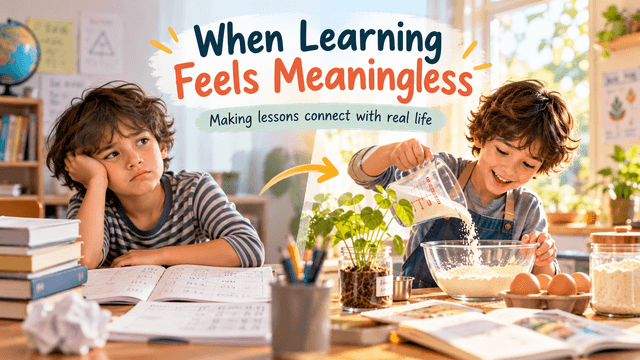
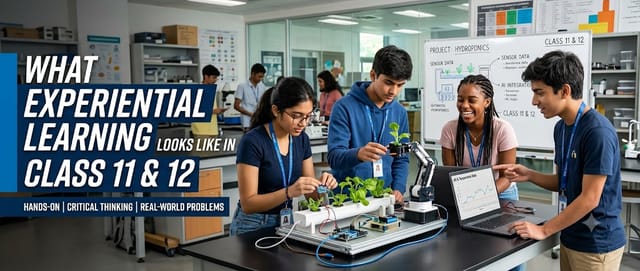
The good news is that schools across India are actively changing this. The philosophy is called experiential learning or simply, "learning by doing." What is new is the seriousness with which some schools are making it a daily practice, not just a once-a-term activity.
In this article, we explore why experiential learning builds deeper confidence in children, and how Sheoran International School, one of the best Schools in Greater Noida, are embedding this philosophy into everyday practice.
Also Read: From Passion to Performance: Help Your Child Discover Their True Calling
The Confidence Gap: Why It Starts Earlier Than You Think?
Most parents associate confidence with personality; some children simply have it. But developmental psychologists argue otherwise. Confidence is far more closely tied to a child's sense of competence: how often they experience the feeling of figuring something out on their own.
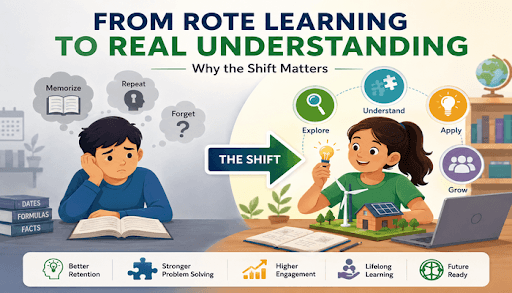
When a child spends years in an environment where the teacher holds all the answers, that sense of competence rarely gets exercised. The child learns to depend on external validation rather than internal judgment, and over time, that becomes a habit that is hard to break.
What "Learning by Doing" Actually Means?
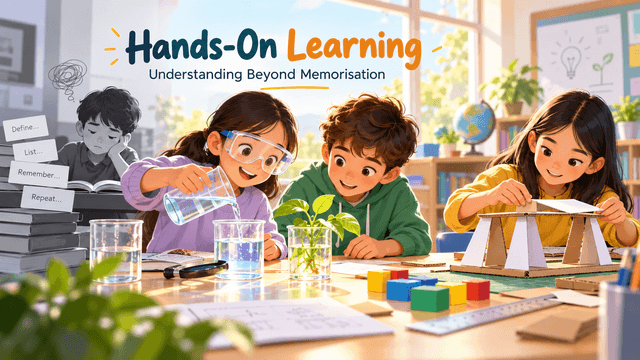
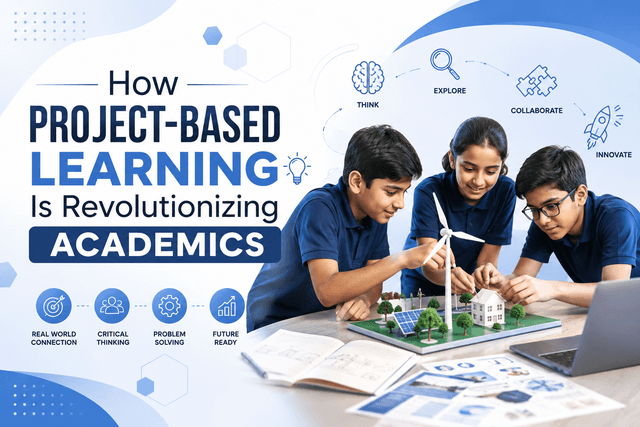
Experiential learning is not simply adding a science project to the calendar. It is a deliberate approach where students learn through cycles of action, reflection, and application. The model rests on a simple insight: children retain far more of what they do than what they hear or read.
Research from the National Centre for Education Statistics consistently shows that active, hands-on learning environments produce better outcomes in both academic performance and socio-emotional development. Children in such settings are more likely to ask questions, tolerate failure, and collaborate effectively.
What Does It Look Like Inside a Classroom?
Here are the hallmarks of a classroom that has genuinely embraced experiential learning:
-
Mistakes are treated as data, not failure.
Children test hypotheses, make errors, and revise their thinking. The teacher asks, "What did you notice?" instead of "Is that right?"
-
Concepts are introduced through problems, not definitions.
Before a child learns what gravity is, they drop things. The abstraction follows the experience, not the other way around.
-
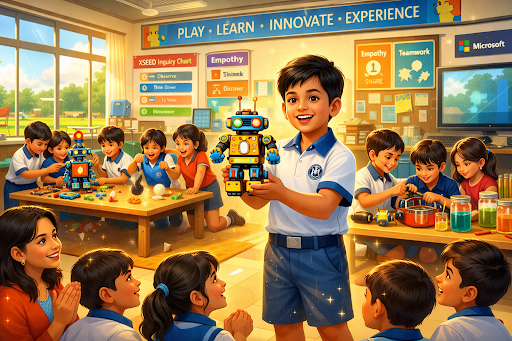
Children talk as much as they listen.
Group discussions, debates, and show-and-tell sessions give children regular practice articulating their thoughts. This is where visible confidence comes from.
-
Assessment goes beyond the written test.
A child might demonstrate understanding through a model, a presentation, or a peer explanation, allowing different kinds of intelligences to surface.
Check Out: From Hobby Clubs to Global Exposure: How the Right School Opens Doors for Your Child
The Parent's Role
Experiential learning thrives when parents are partners, not spectators. One of the most powerful things a parent can do at home is resist the urge to give answers immediately. When your child asks why the sky is blue, ask them what they think first. When their block tower falls, let them figure out what went wrong before stepping in.
These small, daily moments are where real confidence is built.
The Bigger Question Every Parent Should Ask
When we look for a school, we ask about results, rankings, and infrastructure. These are not wrong questions. But there is a quieter, more important one: Does this school make my child feel capable?
Not just praised. Actually capable of figuring things out, bouncing back from mistakes, and walking into a room believing they belong there.
That feeling, built steadily through years of being trusted to explore, is what genuine education produces. And it is what every child deserves.
How Sheoran International School Is Making It Real?
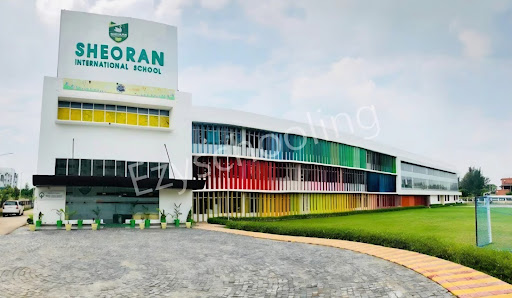
Among the best schools in Greater Noida actively building this kind of environment is Sheoran International School (SIS). Established in 2018 under the Jyoti Educational Society, SIS was built around a four-word philosophy: Play, Learn, Innovate, Experience.
A Curriculum Built Around Curiosity
SIS uses the XSEED curriculum, a research-backed framework centred on conceptual clarity and inquiry-based learning. Students are guided to understand the "why" behind every concept, arriving at understanding through exploration rather than repetition.
From Grade I, the school integrates Microsoft Showcase School resources, making digital literacy a native part of how children learn, not an afterthought.
Spaces Designed for Doing
SIS has dedicated Discovery Rooms for hands-on sensory and scientific exploration, spaces where children take things apart, observe how they work, and rebuild them. A Robotics Lab and early STEM modules give children the language and confidence to engage with technology thoughtfully.
Weekly Life Skills workshops on empathy, collaboration, and self-management are treated as core curriculum, not extras. Because the school understands that knowing how to work with people matters as much as knowing how to solve an equation.
Building the Voice, Not Just the Grade
SIS maintains a dedicated Language Lab focused on phonetics, diction, and early public speaking. Regular "Show and Tell" sessions and thematic assemblies give every child consistent practice expressing themselves in front of an audience.
Children who speak regularly in structured, supportive settings develop a relationship with their own voice, and that relationship doesn't leave when they step out of school.
For more information on similar schools in the area, see this list of the best schools in Greater Noida.


 as a preferred source on