







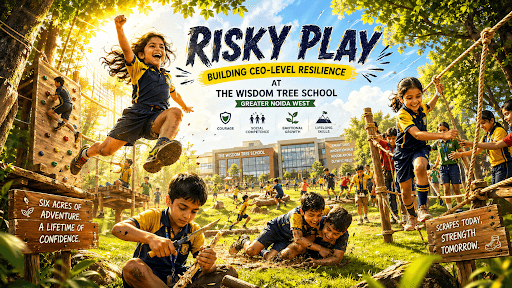

You've bubble-wrapped their knees, sanitised their lunch boxes, and chosen the school with the safest playground in the neighbourhood. And yet, somewhere deep down, you wonder if you're raising a child who can handle the real world, or one who's never had the chance to try?
Not the fear of scrapes and bruises, but the fear that in protecting everything, we've accidentally taken away the one thing our children need most, the experience of not being protected.
The world's most forward-thinking schools in 2026 are answering this question differently. And the answer starts with something called Risky Play. But what does this Risky Play actually mean?
What the research says about its profound impact on resilience, why leading schools are embedding it into everyday learning, and how one school in Greater Noida West - The Wisdom Tree School is quietly doing what many are still only talking about. Let’s get all the answers.
Risky Play Isn't What You Think
When most parents hear the words "risky play," the image that comes to mind is a child dangling from a tree or sprinting across gravel barefoot. That instinct to panic is completely human. But it's also, according to a growing body of research, precisely the instinct that may be quietly limiting our children. Risky play, in its truest sense, refers to thrilling, challenging experiences that push children just past their comfort zone, climbing a little higher, jumping a little farther, navigating a disagreement without an adult stepping in.
A 2025 paper published in the BU Journal of Graduate Studies in Education describes it as "thrilling acts that push boundaries" that are, in fact, vital for raising children equipped to face life's challenges. The scrapes that come from risky play are minor. The skills that come from it are lifelong.
Here's what gets lost in the fear: children who are never allowed to take risks don't learn to assess them. They learn to avoid them.
What Science Has Been Trying to Tell Us?
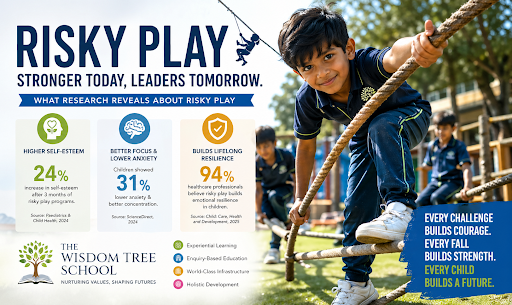
Research doesn't lie, even when it makes us uncomfortable. A review published in Paediatrics & Child Health in 2024 found that after a three-month school programme that intentionally introduced risky play opportunities, teachers reported students showed higher self-esteem, sharper concentration, and lower conflict sensitivity. These aren't soft outcomes, but are the building blocks of leadership.
A 2025 study in Child: Care, Health and Development, conducted with emergency care practitioners across Canada, found that doctors and nurses who were also parents believed children were more emotionally equipped to handle stress across their lifespan when exposed to challenging play during childhood.
These were people who saw injuries daily, and they still supported risky play. That says something. Research from ScienceDirect reinforces this: risky outdoor play is positively associated with social competence, emotional regulation, and fewer symptoms of anxiety and depression. The connection isn't casual, it's causal.
The data, across multiple studies and continents, point to the same conclusion: children need to fall sometimes. Not because we don't care but because we do.
The Quiet Shift Happening Inside Today's Classrooms
So what does Risky Play actually look like inside a school? It doesn't look like chaos, but it looks like intention. It's the classroom that replaces a pre-labelled science kit with a box of materials and an open question. It's the playground where children are supervised but not micromanaged, where a fall is witnessed but not catastrophised. It's the curriculum that asks a child to make a decision, defend it, and sit with the result.
It's the teacher who waits 17 seconds before intervening, a technique recognised in educational research, because those 17 seconds are often where the real learning happens. The schools doing this well share a common thread: they've replaced the goal of keeping children comfortable with the deeper goal of making children capable.
And that shift, subtle as it sounds, changes everything about how a child sees themselves by the time they're a teenager. Courage, after all, is not the absence of fear. It's what a child builds, slowly, every time they're trusted to figure something out on their own.
Check Out | The Importance of Foundational Years in Child Development – Insights from The Wisdom Tree School
The Wisdom Tree School - A Place That Believes in Who Your Child Is
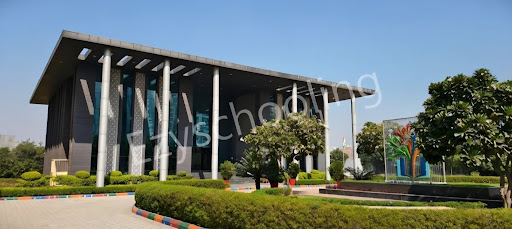
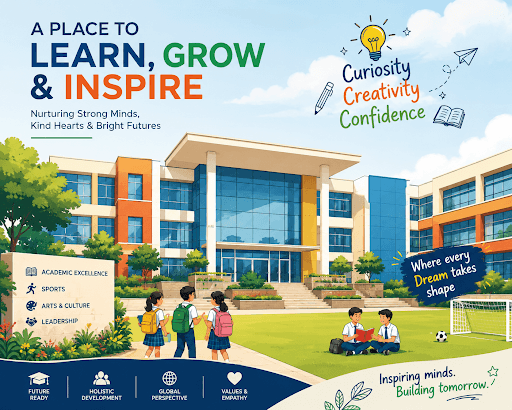
Tucked in the heart of Greater Noida West, The Wisdom Tree School was established in 2018 with a philosophy that feels, in 2026, more urgent than ever. Spread across a six-acre environment-friendly campus, this CBSE-affiliated school runs from Pre-Nursery to Class XII and is built around the principle that genuine education must fuse contemporary knowledge with timeless wisdom.
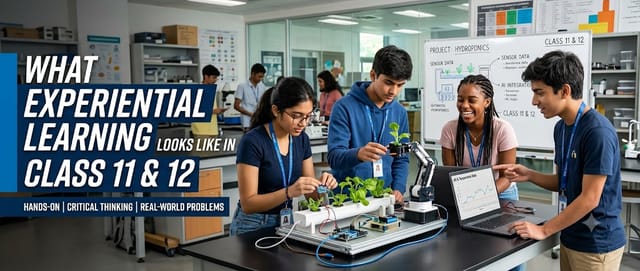
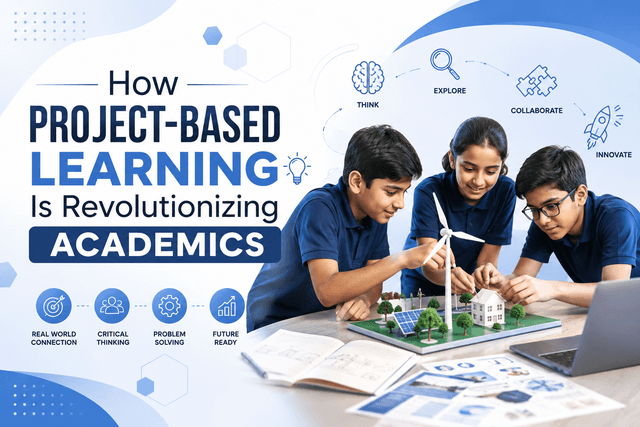
What sets TWT apart is its commitment to Experiential and Enquiry-Based Learning, a pedagogy that, by design, puts children in situations where they must think, choose, and respond. Its TDDAL methodology, a distinction it holds as India's first school to implement it, is not just a curriculum framework. It's a daily practice of asking children to engage actively rather than absorb passively.
The school's core values, Wisdom, Humility, Determination, Integrity, and Courage, are not posted on a wall. They are sculpted, as the school itself says, right through childhood. A child who is trusted to make choices at seven is a child who learns to lead at seventeen.
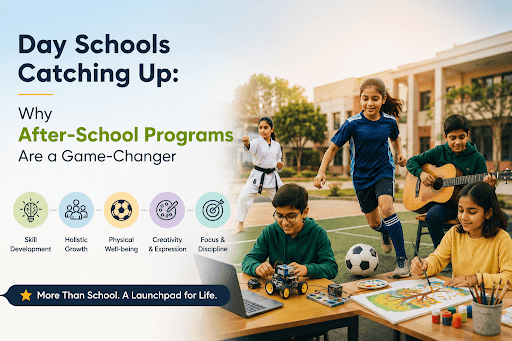
With world-class academic and sports infrastructure, smart classrooms, dedicated labs for science, mathematics, language, and social sciences, and extracurricular avenues spanning visual arts, performing arts, yoga, robotics, and swimming, TWT offers an environment where structured challenge becomes second nature.
Conclusion
Every parent wants their child to be happy. But what does happy look like at 25, at 35? Does it look like someone who played it safe or someone who learned, early and often, that discomfort is a signal to grow, not retreat? The schools building CEO-level resilience in 2026 are not the ones with the softest landings. They're the ones brave enough to let children stumble, and wise enough to be right there when they do.
To learn more about this and other schools nearby, see this list of the top schools in Greater Noida West.




 as a preferred source on