








That knot in the stomach when a child says, "I'm dumb." That quiet heartbreak when a brilliant kid calls school "boring." Parents feel it daily. The system keeps promising to see every child, yet most classrooms still teach to a phantom "average" student who does not actually exist.
In this article, we will break down why uniform teaching fails most children, how differentiation uncovers buried talents, and what real differentiation looks like in practice, including how one of the best schools, like Cambridge International School, has built its entire philosophy around this approach.
Also Read | Understanding the Link Between Differentiated Learning and Future-Ready Education
Your Child Is Not a Sponge
The factory model of education assumes all children absorb knowledge the same way. Sit. Listen. Memorize. Repeat. But a human brain is not a sponge. It is a fingerprint, unique, irreplaceable, and wired differently from the one sitting next to it. When a school refuses to differentiate, it does not create equality. It creates invisibility.
The quiet child who needs more time disappears. The restless child who needs more challenge gets labelled a problem. Both leave the classroom feeling broken, when in fact the only broken thing was the approach.
But why do so many schools still cling to this "same for everyone" model? And what does genuine fairness actually look like in a classroom? Let us step into that question next.
Why Does Fair Not Mean Same?
Most parents have heard a child protest, "That's not fair!" And most have replied, "Fair doesn't mean everyone gets the same thing. Fair means everyone gets what they need."
That parenting wisdom applies directly to classrooms. Giving every child the identical worksheet, the identical time limit, and the identical lecture is not fair. It is laziness dressed up as rigour.
-
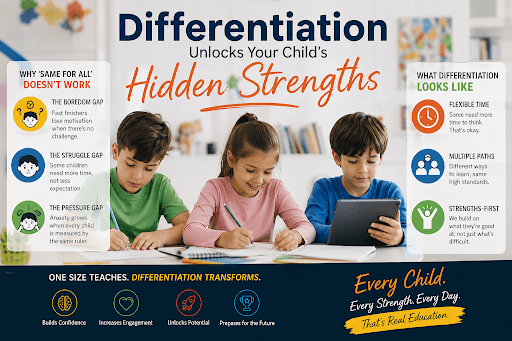
The fast finisher
The child with this quality is idle because learning that finishing early is a punishment, as nothing challenging awaits.
-
The struggling writer
If your child is struggling with writing, then they’ll stare at a blank page, learning that effort does not matter because the gap feels impossible to close.
-
The anxious perfectionist
If your child is anxious about perfectionism, then he/she will freeze under timed pressure, learning that their deep thinking has no value if it cannot be rushed.
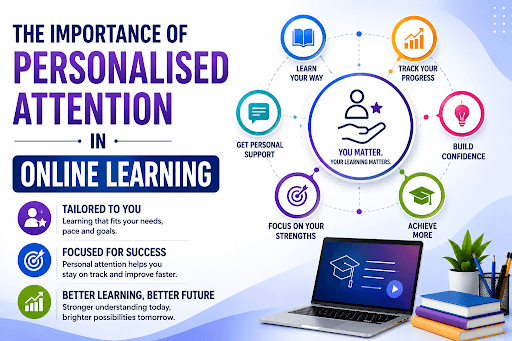
Differentiation untangles this knot by changing the how without lowering the what. The destination remains the same. The path simply adjusts to the child standing at the trailhead.
Understanding fairness is one thing. But what actually happens to a child's sense of self when fairness is absent day after day? The answer is more painful than most parents realise.
The Hidden Cost of Being Mislabeled
A child who cannot read by age seven is not "behind." A child who cannot sit still is not "naughty." Those are symptoms of a mismatch, not character flaws. Yet schools without differentiation turn symptoms into identities. A boy hears "lazy" so many times that he believes it. A girl hears "too sensitive" until she hides every emotion behind a mask. The original academic struggle heals into a deeper wound: I am not good enough.
An NLM Research confirms that a child's self-concept - the story they tell themselves about their own ability- directly predicts their willingness to try hard things. A single year in a rigid classroom can convince a curious child that curiosity is dangerous. Differentiation reverses that damage by offering small, consistent wins that rebuild the broken story.
So differentiation protects a child's self-worth. But what does that protection actually feel like from the child's perspective? What changes inside them when a classroom finally fits?
How Real Differentiation Feels to a Child
Imagine walking into a classroom where the teacher already knows how a child learns best. Not because of a label or a test score, but because the teacher watches, listens, and adjusts in real time.
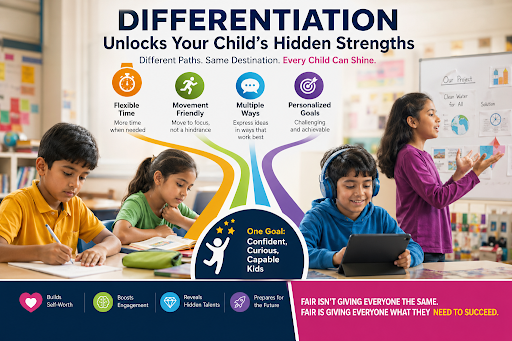
- The slow processor gets the same complex question but receives it ten minutes earlier, so thinking time is not a disadvantage.
- The restless mover gets to stand at a high table or squeeze a fidget tool while thinking, because movement and focus are not enemies.
- The verbal thinker gets to explain an answer out loud before writing it down, because spoken words unlock written ones.
None of these adjustments lowers the bar. They simply remove unnecessary hurdles. The child who used to dread math starts waking up excited. The child who used to hide in the back starts raising a hand.
That transformation is not magic, but differentiation. That sounds ideal in theory. But where can a parent actually find a school that takes differentiation seriously, not as a buzzword, but as a daily, non-negotiable practice?
Check Out | How TCIS Whitefield Is Teaching Kids to Think Like Entrepreneurs
The Cambridge International School - A School That Built Itself Around This Belief
Theory is useless without a home. Parents searching for a place where differentiation is not a buzzword but a daily practice will find it at The Cambridge International School, Varthur, Bangalore.

The school also integrates skill-based programs, co-curricular activities, and classroom participation frameworks that focus on building communication, collaboration, and critical thinking over time. Regular formative assessments and feedback sessions help track how each student is progressing, allowing teachers to adjust their approach when needed.
Another important aspect is pacing. Students are given opportunities to revisit concepts through guided support and interactive sessions, which helps reduce pressure and ensures deeper understanding instead of rushed learning. For your kids, this means they are not just keeping up with the class, but actually learning in a way that suits them.
Like many schools in Bangalore’s evolving education landscape, The Cambridge International School, Whitefield functions as both an academic space and a skill-building environment where differentiated learning is actively implemented.
Conclusion
Education is clearly moving toward more personalized and skill-focused learning, but this shift also brings a challenge to ensure that flexibility does not turn into inconsistency, and that every child still receives the right level of guidance. The way forward lies in creating a balance where students are supported individually while still following a structured learning path.
If you’d like to explore further, you can browse a curated list of top schools across India for additional options and insights.






 as a preferred source on