






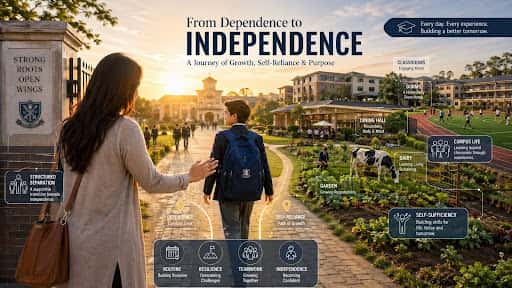

You feel that tug at your sleeve, the little hand reaching for yours a second longer than necessary. It is the quietest goodbye that often shouts the loudest in a parent’s heart. If you have ever peeled your child’s fingers off your waist at a school gate, you are living the “Velcro Parent” struggle.
We are the generation that ziplocked every sharp corner and tracked every heartbeat via smartwatches. Yet, oddly, the tighter we hold to keep them safe, the more we fear we are shrinking their world. We worry that without us, they will not tie their shoelaces, speak up for themselves, or even eat lunch.
So, let’s go through the delicate art of letting go, the psychological shift a new environment creates, and why the best boarding schools like Shekhawati Public School are teaching how structured separation can actually teach a child to fly.
Also Read | The Science Behind 100% Self-Sufficient Campuses: Environmental Education Through School Infrastructure
The invisible tether between anxiety and love
Psychologists call this "Velcro" or "Helicopter" parenting, a style defined by over-proximity and hovering. While it stems from a deep biological urge to protect, research shows that overprotective parenting can quietly hinder emotional development. When we remove all friction from a child's path, we also remove the friction that builds resilience.
The struggle is real because the stakes feel so high. We rationalise the hovering by saying, "I just want them to succeed." But success isn't zero scratches. It is the ability to heal quickly. The Velcro parent must learn a painful truth: your presence is becoming their crutch, not their wings.
And yet, knowing this truth does not make letting go any easier, because the real fear is not about them failing, but about what happens when you are not there to catch them.
The great unlock: a change in geography
Here is the secret that seasoned educators know: a child is never truly independent at home. Why? Because home is their stage, and you are the captive audience. At home, they cry, and you hand the water bottle. They lose a project, and you stay up to fix it. The dynamic is fixed.
But change the environment, move the child to a neutral, structured setting, and the psychological contract rewrites itself instantly. When the audience leaves, the actor stands up.
This is why a child who cannot pour milk at home suddenly becomes the organiser of their own cupboard. It isn't magic. It is a situational necessity.
But how exactly does distance, physical separation, rewire a child's brain to become more capable, not more anxious?
How does distance rewire the heart?
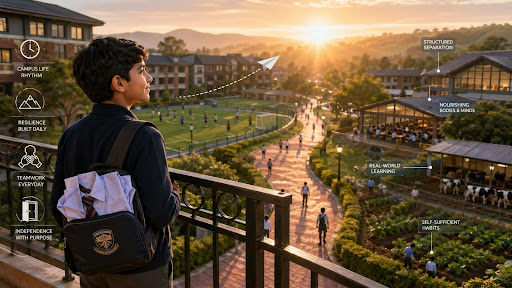
When you are not physically there to solve the problem, their brain clicks over from "helpless" to "hunter." They begin to problem-solve not because they want to, but because they have to.
-
A neutral witness changes everything.
At home, nagging kills motivation. In a school setting, a teacher offers guidance without emotional baggage. A child tries new things more easily when they aren't afraid of disappointing mom or dad.
-
Peer mirroring accelerates growth.
In a new environment, they look around. They see peers tying ties, making beds, and managing time. Humans rise to the level of the tribe they join.
This neurological and social rewiring happens fastest in environments where structure replaces hovering, which is precisely why boarding schools have become unexpected laboratories for independence.
The boarding school advantage
When we talk about changing the environment, a residential school is often the ultimate catalyst. A good boarding school does not simply babysit your child. It strategically removes the scaffolding piece by piece, forcing the student to bear weight. This structured separation, supported by faculty, actually models the healthiest form of attachment.
Children with anxiety (both Velcro parents and Velcro kids) thrive on predictability. A boarding school removes the chaos of "what's next," allowing the child to navigate independently. Independence isn't learned between 8 AM and 2 PM. It happens at 6 AM during a morning run or at 9 PM during study hours.
The immersive environment accelerates maturity because there is no "off" switch for life skills. There is also dignity in failing without a parent watching the crash.
If a child misses a deadline or forgets their kit, they face the consequence, adapt, and overcome without a lecture from you.
Still, knowing the science of boarding school benefits does not quiet the mother's whisper: "But what if my child feels abandoned?" That fear is valid, and the answer lies not in avoiding separation, but in choosing the right kind of separation.
Letting go is the new holding on
Perhaps you are reading this with a knot in your stomach. You feel guilty for wanting space, or terrified that distance means losing closeness. But history shows that the most successful adults were not the most "protected" children. They were the most trusted children.
Research from Cambridge University confirms that while early separation anxiety is real, the development of psychological resilience through managed separation has profound long-term benefits. By changing the environment, you are not abandoning your child. You are extending their horizon.
It is time to stop being Velcro and start being a base camp. They need somewhere to return to, not a cage to stay in. The goal isn't to make them stop needing you. The goal is to make them able to function without you.
That kind of trust requires a specific kind of institution, one that holds your child gently while quietly teaching them to walk alone.
Check Out | Life Inside the Residential Campus: Discipline, Mentorship and Pastoral Care at Shekhawati Public School
Shekhawati Public School - A place that understands this transition
Nestled in the rural belt of North-East Rajasthan, Shekhawati Public School (SPS), Dundlod, offers a compelling real-world example of what a self-sufficient campus can look like at scale.
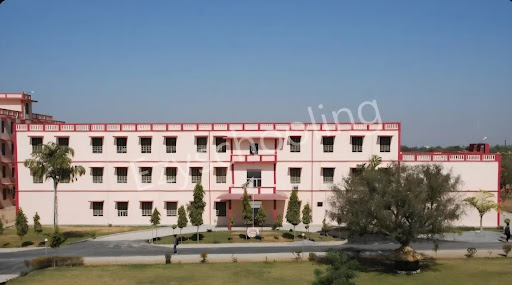
Established in 2004 under the Satwic Jeevanshala Trust, SPS is a CBSE-affiliated, co-educational residential and day school spread across 82 acres of lush, pollution-free land in Jhunjhunu, Rajasthan. For a school that serves students primarily from rural backgrounds, this scale of campus is not a luxury; it is a deliberate design choice.
One of the best boarding schools in Jhunjhunu, Shekhawati Public School, operates its own dairy, supplying fresh milk directly to students. Meals are prepared using produce from the institution's own farm, wherever possible. The cafeteria runs from morning to evening, offering balanced vegetarian meals with a doctor-advised diet for students who need it. These aren't amenities; they are environmental education made edible.
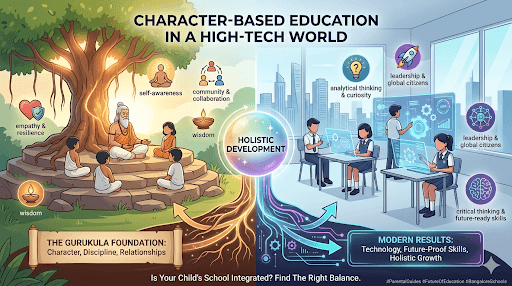
SPS's ethos draws explicitly from the Gurukul tradition, aiming to integrate India's cultural values with modern academic rigour. Round-the-clock Wi-Fi access and smart classrooms sit alongside horse riding academies, yoga, and organic food production, a rare balance that few campuses achieve. The school is also committed to accessibility, with ramps, elevators, and disabled-friendly washrooms embedded into its infrastructure.
Explore more options among the best boarding schools in India to find a place where your child’s spark can grow into a guiding light.





 as a preferred source on