








Every parent today holds a paradox in their hands. Devices answer any question instantly, yet children still look up and ask, "Why is the sky blue?" with a kind of wonder no algorithm can fake. The fear that AI will steal jobs is real, but the deeper truth gets overlooked.
AI can compute. AI cannot care. It can process mountains of data. It cannot feel heartbreak, sit through a tantrum, or know when a child needs silence instead of a solution.
The best schools in Bangalore, like Canara Gurukula Public School, are waking up to this distinction, shifting their focus from rote memorisation to emotional intelligence.
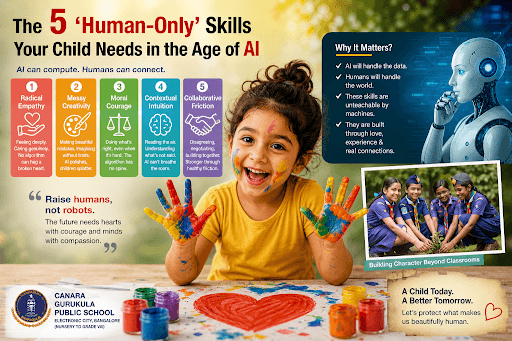
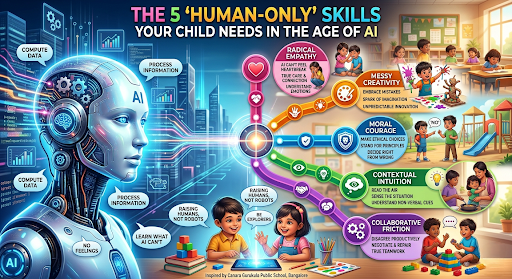
Reading till the end will let yoy discover the five deeply "human-only" skills that AI cannot replicate: radical empathy, messy creativity, moral courage, contextual intuition, and collaborative friction
Also Read | What Ancient India Got Right About Education That Modern Schools Are Now Scrambling to Rediscover?
The Intelligence of Care (Why No Algorithm Can Hug a Broken Heart)
No machine learns to care. It can simulate sympathy, but it cannot suffer alongside another human being.
UC Berkeley psychologist Alison Gopnik makes a sharp distinction between artificial and human intelligence. AI excels at exploitation, using existing data to solve a known puzzle, but it fails at exploration, according to her research on child development.
Children are the world's greatest explorers. When a young learner fails a math test, and a parent kneels to say, "Tell me what hurt today," that moment contains zero data points. Yet, it shapes resilience more than any tutoring app ever could.
The Power of ‘Messy’ Creativity (AI Polishes. Children Splatter)
Artificial intelligence generates perfect images, flawless essays, and technically correct music. But perfection is not creativity; often, it is the enemy of it.
A child's drawing has arms growing out of the ears. The sky is purple. The sun is crying happy tears. To an algorithm, this is an error. To a parent, this is a window into a soul. According to a World Economic Forum report on the future of jobs, creative thinking will be among the most sought-after skills by 2027 precisely because AI cannot replicate the unpredictable spark of human imagination.
A machine cannot be bored, cannot daydream, and cannot make a beautiful mistake. Parents who allow children to cook without a recipe, draw without instructions, and solve problems without step-by-step guides are not raising "messy" kids. They are raising innovators.
Moral Courage (The Algorithm Has No Spine)
A Brookings Institution study on education and automation highlights a critical limitation: AI lacks moral agency. It cannot decide when telling a small lie protects someone's feelings or when breaking a rule serves a greater good.
Consider a playground scenario. A group of children excludes a quieter child. AI, fed on data, might suggest "forming a new group" as an optimal social strategy.
A human child, however, might walk over, sit beside the excluded peer, and say nothing at all. That silence, that choice requires courage, not computation.
Parents searching for the best schools in Bangalore should look for institutions that actively teach ethical reasoning, not just obedience.
Contextual Intuition (Reading the Air AI Cannot Breathe)
An algorithm can analyse sentiment in a text message with decent accuracy. But can it walk into a kitchen, see a parent chopping vegetables in silence, and know to offer a hug instead of asking for a snack? That is contextual intuition.
A parent teaches this skill every single day without a lesson plan. By asking, "How do you think your friend felt when you said that?" or "Look at Grandma's face, what is she not saying?" parents build neural pathways that no chatbot will ever possess.
Schools that prioritise group discussions, role-playing, and reflective conversations, rather than just multiple-choice answers, are preserving this uniquely human muscle.
Collaborative Friction (The Art of Disagreeing Without Breaking)
One of the most overlooked human skills is the ability to disagree productively. Two children arguing over a Lego piece, then negotiating a trade, then building something together, are practising a form of intelligence that no AI can simulate.
The word "friction" here is deliberate. Collaboration without friction is just compliance. True teamwork involves frustration, repair, forgiveness, and a shared laugh after a fight. Parents who let children solve their own sibling arguments (without stepping in too early) are giving them a skill that will matter more in 2035 than coding ever will.
The best schools in Electronic City understand this deeply and design group work around conflict resolution, not just task completion.
Check Out | Scouts and Guides at CGPS, Electronic City, Bangalore: Building Character Beyond Classrooms
Canara Gurukula Public School - A Quiet Corner of Bangalore That Still Raises Humans, Not Robots
Canara Gurukula Public School is located in T. Gollahalli and is one of the best schools in Electronic City, Bangalore. It was established in 2015 and runs from Nursery to Grade VIII. The school is co-educational and uses English as its medium of instruction. CGPS runs a well-organised Scouts and Guides program as part of its co-curricular structure. Boys participate in Scouts and girls participate in Guides, while younger students join as Cubs and Bulbuls.

Every Tuesday, students wear their Scout and Guide uniforms as part of the official school uniform schedule. This shows how seriously the school treats this program. Students take part in drills, community activities, and team-building exercises through this program. The school believes that discipline learned through Scouts and Guides directly supports classroom behaviour and academic focus.
CGPS aims to produce students who are self-sufficient, disciplined, and responsible. The Scouts and Guides program directly supports this mission. It teaches students to be independent thinkers and compassionate community members. The program also builds the self-discipline that the school considers central to its education philosophy. Students who go through this program carry a strong sense of duty and leadership into their higher education and careers.
Conclusion
The age of AI is not a threat to childhood. It is a reminder of why childhood matters. Parents do not need to raise little computers. The world already has enough of those. What the world desperately needs are humans who can cry at a friend's story, laugh until they cannot breathe, stand up for a stranger, and build something ugly that means everything. Those five skills, care, messy creativity, moral courage, contextual intuition, and collaborative friction, cannot be coded. They can only be lived, modelled, and protected. And that is the one job no machine will ever take from a parent or a great school.
To know more about this and other schools in Bangalore, check out

 as a preferred source on