







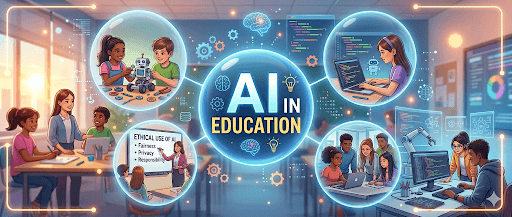

Artificial Intelligence has already become a household name. Ask any kid today, and they’ll probably tell you more about AI than most adults can. Artificial intelligence has already changed how businesses, hospitals, and institutions work, and now it is making its way into the classrooms as well.
In 2020, the National Education Policy made AI education mandatory in Indian schools from class 3 onwards. That’s a big shift in the education landscape of India! This signals that the country recognises where the world is heading today and what kind of education will prepare the kids for global competitiveness. Many top schools in Bangalore have already integrated it, like Podar Global School, Bangalore. So that students grow up seeing it as a normal tool, not a strange technology they'll have to figure out later in life.
In this article, we'll walk you through what schools are actually teaching under AI, why it matters, and how Podar Global School, Bangalore, is approaching it for their students.
Also Read: How Holistic Education Shapes 21st Century Learners at Podar Global School
What Does the AI Curriculum Include?
India's push for AI education in schools is not just an impulsive decision. CBSE introduced AI as an optional subject for Class 9 to 12 back in 2019. But what changed in 2026-27 is the scale. The Ministry of Education took a decision and made AI and Computational Thinking compulsory from Class 3 onwards across all CBSE schools, aligned with NEP 2020.
What is AI & CT Curriculum?
The AI & CT Curriculum is just another approach towards developing critical thinking and problem solving skills among the students. The goal is to move from just using AI to actually understanding it, and eventually using that understanding for public good. Here's what that looks like class by class:
Class 3 to 5
Many parents have this misconception that the schools will start teaching coding to a literal child. But this is not what it is like. At this stage it's all puzzles, games, and storytelling, woven into subjects like Maths and EVS rather than taught separately.
The focus is on getting children to think logically and spot patterns. Nobody's asking a 9-year-old to write Python, so don’t worry!
Class 6 to 8
This is where AI starts showing up as a real topic. Students learn how AI works in everyday life, what human-machine interaction looks like, and importantly, what AI ethics are, bias, and why not all AI systems are fair or accurate. Hands-on projects using school computer labs start here, too. At this level, they engage in a friendly interaction with AI.
Class 9 to 10
Things get more serious and upgraded here! The syllabus covers Python programming, Machine Learning, Neural Networks, Natural Language Processing, Data Science, and Computer Vision. Students work with real data and build small projects, not just theory anymore. This level teaches them how to work with AI systematically.
Class 11 to 12
AI becomes a full elective at this level, just like physical education or other subjects. Students go deeper into ML algorithms, advanced data handling, and real-world applications. NCERT is currently developing official textbooks for this stage to provide more structure to its teaching.
How Other Educational Platforms & Initiatives Support AI Education
DIKSHA
It is a Ministry of Education app for students, teachers, and parents. It has AI-powered video search, a read-aloud feature for visually impaired students, and curriculum-aligned content available offline. Basically, a free learning resource that works even without good internet.
SOAR
Launched by the Ministry of Skill Development, SOAR (Skilling for AI Readiness) is built specifically for Class 6 to 12 students and their teachers. It focuses on building practical AI awareness, not just theory.
SWAYAM
India's free online learning platform offering 110+ AI courses developed by IITs and IISc. Over 41 lakh students have already enrolled. Teachers can upskill here too, with courses designed specifically for K-12 educators, all free of cost!
Benefits of AI Education for Students
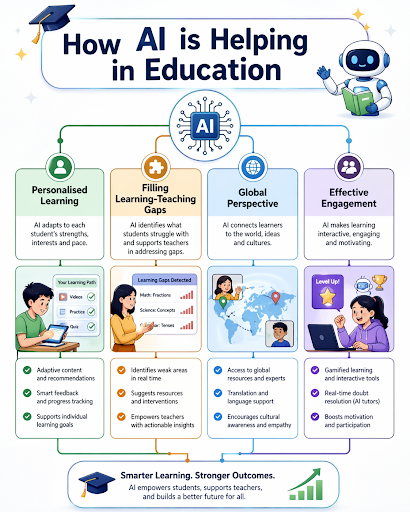
Builds Future-Ready Skills and Career Opportunities
Yes, AI will replace your jobs, but only if you don't know how to work with it. Students who grow up learning AI don't fear it; they use it. That comfort with technology early on is what makes them different from those who just see this as a technology.
Develops Critical Thinking
AI education isn't just learning about technology! It teaches students to look at a problem, question it, and think through it logically. A student who learns to analyse data in Class 8 is the same one who makes smarter decisions at 25.
Improves Creativity and Innovation
AI projects is not about getting everything right, every time. Students experiment, fail, try differently, and build something that works. That process of figuring things out on their own is where real creativity develops, not in filling out worksheets and papers.
Enhances Digital Literacy
Through coding, algorithms, data, and ethics, students learn what the world actually demands. That knowledge makes them more aware, more careful, and a lot harder to mislead in a world full of technology they can't see or touch.
Encourages Interdisciplinary Learning
AI doesn't sit in one subject. It shows up in Maths, Science, Social Studies, even Language. Students start seeing how everything connects and that kind of thinking, where subjects talk to each other, is exactly how real-world problems get solved.
How Podar Global School Integrates AI into Its Curriculum
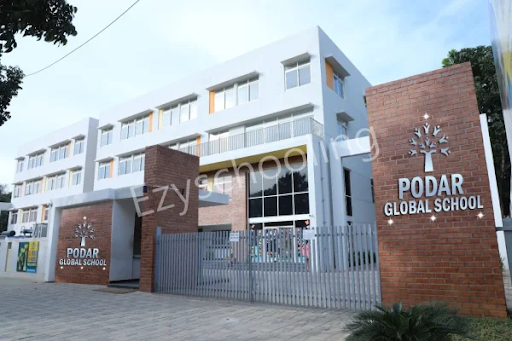
As the government made Artificial Intelligence a mandatory part of the school curriculum, many top CBSE schools in Bangalore began updating their syllabus to include technology-based learning. Podar Global School has also taken steps to introduce AI in a way that is practical and meaningful for students.
Rather than teaching AI only as a separate subject, the school tries to connect it with everyday learning so students become familiar with how technology works around them.
Here’s how AI is being integrated into students’ learning at the school:
AI-supported classroom learning: Teachers use digital platforms that help track how students are performing and suggest learning materials as per their pace and level of understanding.
Technology labs and digital classrooms: Students get opportunities to work in computer labs where they can try coding activities, explore digital tools, and take part in simple tech-based projects.
Workshops and interactive sessions: The school conducts sessions where students are introduced to basic AI ideas and learn how technologies work in real-life situations.
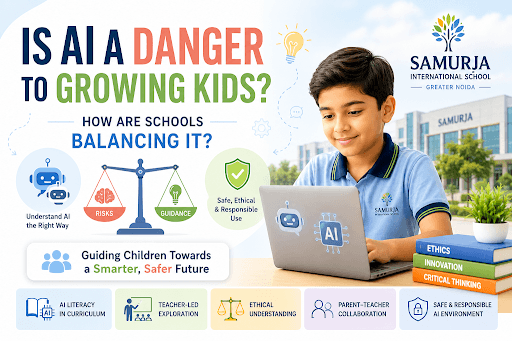
Discussions on responsible use of technology: Students are also encouraged to think about how AI should be used responsibly, including topics such as data privacy and ethical use of digital tools.
By introducing these learning opportunities, Podar Global School aims to help students become more comfortable with new technologies and develop skills that will be useful in the future.
Final Thoughts
Including AI education in schools is a very best decision because it is better for a child to get the exposure early on in their initial years rather than learning about it when half of the world already knows how to work with it. Podar Global School is making efforts to expand the scope more and to better integrate into the daily lives of students in a responsible and ethical manner.
For more information regarding the best schools in Bangalore offering future-ready skills




 as a preferred source on