








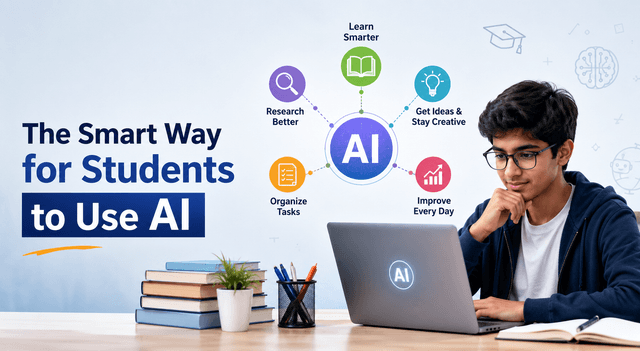
A few years back, artificial intelligence felt like a very fancy technology used exclusively by engineers and computer scientists. But today, a 12-year-old CBSE student is learning about it. They are using an AI tutor, generating a science project outline using AI, and also asking a chatbot to help them understand complicated terms like photosynthesis through animated videos generated by AI. Hence, it is no longer a debate whether students should be using AI or not.
And after the CBSE decision to introduce an artificial intelligence and computational thinking curriculum for middle school students, from class 3 to 8, to be implemented from the 2026-27 session, how prepared are schools for this?
The real question is how students can be exposed to this technology in a way that they understand the ethical use of AI, AI fairness, and digital safety. We will take the example of one such school of Greater Noida, that is Greater Noida World School(GNWS), Sigma I, to understand how such changes can be smoothly integrated into their curriculum.
Also Read| AI learning Good or Bad?
What does the data say about this?
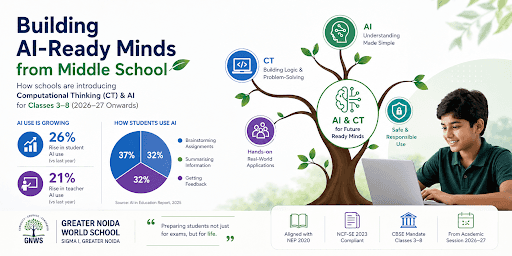
As per the AI in Education Report Survey data 2025, AI adoption is accelerating across education, as it says that
- AI use in schools among students jumped 26% higher than last year.
- And teachers and educators using AI increased by 21%
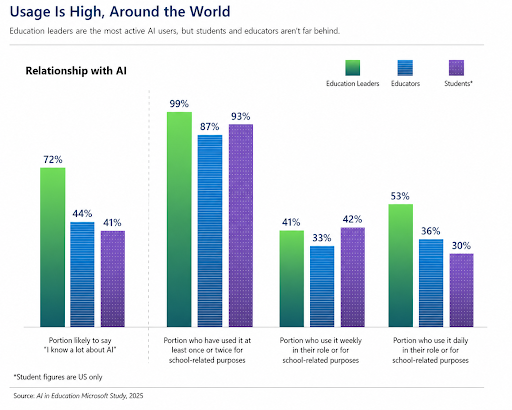
AI is a creative and collaborative partner helping students and educators globally. Data suggests that students using AI to summarise information are 33%, brainstorming assignments are 37%, and getting feedback are 32%.
Also, the educators are using ideation for 31%, simplifying complex data for 24%, and for differentiating instruction for 23%.
India has taken significant steps in this direction. The Union Ministry of School Education has already rolled out a 15-hour ‘Skilling for AI Readiness’ module specifically targeting Classes 6 to 8, the middle school years. The objective is clear: at this age, students learn about the practical applications of AI in everyday life, building a foundation before they explore AI innovation and emerging technologies in high school.
Why Middle School is the right place to implement this AI and CT?
Child development research says that children in the age group 10 to 14 have a heightened level of curiosity, abstract reasoning, and identity formation. This is precisely the age when students are in class 6 to 8. They start asking questions, “how it is done” instead of what it is.
What is the call of the Government on this stance?
There are certain policies and frameworks that the schools are adopting so that their students can learn about critical thinking skills, problem-solving, and decision-making skills.
- CBSE policy decision- It is mandatory to introduce AI and CT from classes 3rd to 8th from 2026-27.
- Aligned with National Education Policy 2020(NEP)- Focus on skill-based and future learning instead of rote learning.
- Based on National Curriculum Framework for School Education 2023(NCF- SE 2023)-This encourages technology integration, critical thinking and interdisciplinary learning in the curriculum.
- Ethical and safe AI usage included- Curriculum covers AI fairness, responsible use, and digital safety as per policy.
- Global Policy alignment- Inspired by the frameworks of UNESCO and OECD AI literacy models
In short, all these policies and frameworks are helping to change the rote learning to mindful learning, and AI and CT can play a major role in this.
What are the risks involved in this implementation?
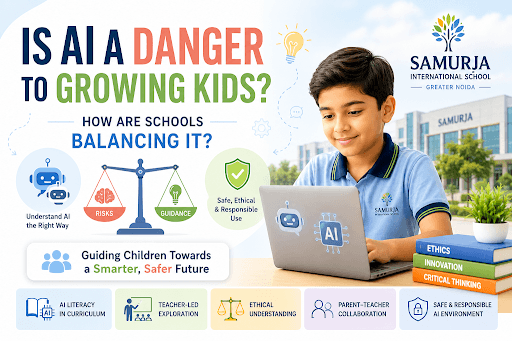
Parents and schools are both concerned about the exposure of AI in the lives of kids, how much balance is required, and how this can help them grow rather than building independency on this technology. Some of you might think that using AI can be dangerous, and we should not use it. But the same thing happened when calculators first entered the classrooms, and the lives of students, the same theories were there. But today we can see how calculators have made our lives easier.
Also Read| How AI is transforming education?
How are schools like Greater Noida World School(GNWS), Sigma I, Greater Noida, mindfully integrating AI and CT in their curriculum for classes 3rd to 8th?
Greater Noida World School(GNWS) is one of the top schools in Greater Noida that is nurturing curious and futuristic minds. With around 1500+ students, 100+ certified teachers, and a commitment to holistic and technology-driven education, GNWS prepares students not just for exams but for life.
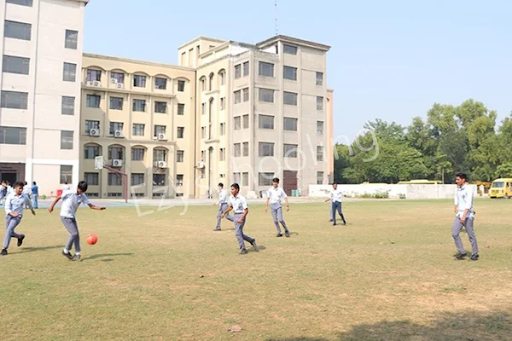
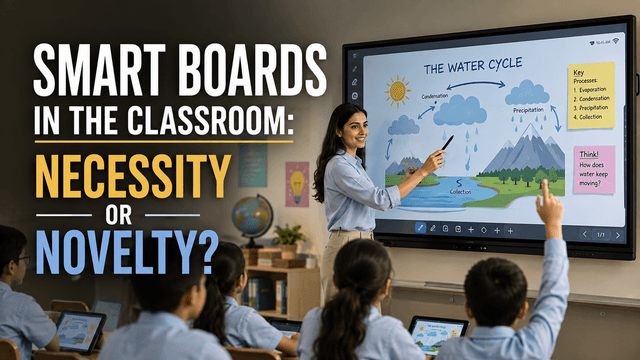
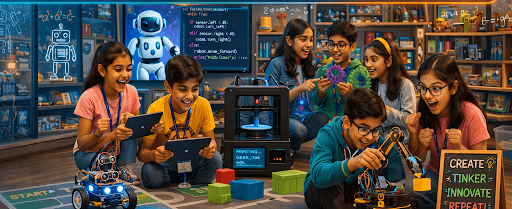
GNWS has always believed that every child is unique, and that a modern education must nurture both intellect and character. Their Atal Tinkering Lab, smart board classrooms, and science and math clubs already reflect a commitment to inquiry-based, technology-enabled learning. Introducing structured AI engagement for middle school students is a natural and purposeful extension of this philosophy.
They place a strong emphasis on what researchers call teacher-controlled guardrails, and ensuring that AI remains a support tool that sharpens thinking, not a shortcut that bypasses it. Their educators are trained to pose questions like: “How did the AI arrive at this answer? What might it have missed? How would you improve on it?” These are the habits of mind that separate capable AI users from dependent ones.
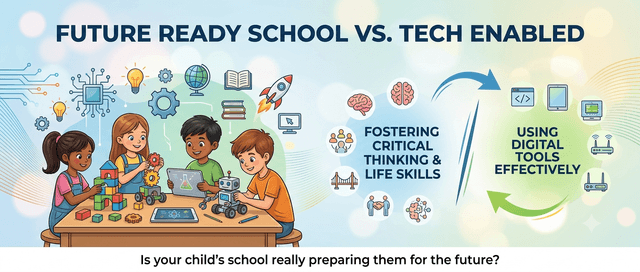
In short, schools like Greater Noida World School(GNWS) are preparing themselves for such a transformation. This transition phase could be difficult to tackle for the students. Ensure that the school you are choosing for your kid is
- Building Critical Questioning among students, in which they interrogate AI outputs rather than just accepting them.
- Human-AI collaboration in which students' voices and ideas remain the base.
- Ethics and Awareness where data privacy, bias, and responsible use of AI are learnt
- Subject Integration- AI can be introduced through science, maths, social science, and language.
India is one of a handful of countries, alongside China, South Korea, and the UAE, that have already incorporated AI into school curricula at the primary and middle school levels. The government’s India-AI Mission has committed over ₹10,370 crore to build the research infrastructure and training ecosystem that will power this shift. Greater Noida, as a hub of educational and technological ambition, sits right at the middle of this transformation.
The students sitting in the classrooms today will enter the workforce in a world where AI literacy is not a niche advantage; it is a baseline expectation. At Greater Noida World School, they are committed to ensuring that their students are not just consumers of that future, but its confident and ethical architects.
To learn more about this and other schools in Greater Noida, check out our list here


 as a preferred source on