







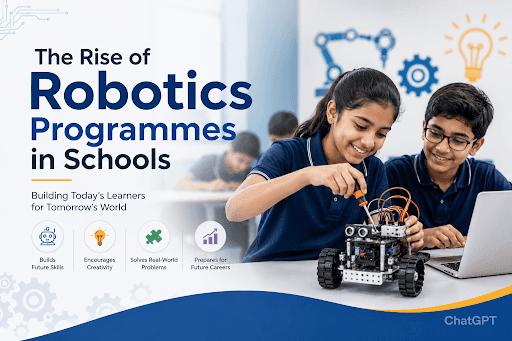

Some programmes are gaining popularity in the school curriculum for all the right reasons, and robotics happens to be one of them. Schools in Greater Noida West have already taken the lead, making room for robotics education long before it became a talking point in mainstream education circles.
Whether in a small town school or a busy city campus, students today are getting hands-on with building, coding, and thinking through real problems, the kind that no textbook exercise can quite replicate.
This article breaks down why robotics is finding its footing in schools and highlights what Salvation Tree School is doing with its robotics program.
Must Watch: https://youtu.be/LuyQ06bgQFI?si=xpbzXz8K8lDAnimS
Popularity of Robotics in Education & Reason Behind It
Robotics did not come into school one day and become a regular part of learning; the process was gradual. Do you know that the global educational robotics market is projected to grow from USD 1.4 billion in 2024 to USD 5.8 billion by 2030?
In India, the shift is already visible on the ground. By 2023, more than 10,000 schools across India were part of the Atal Tinkering Labs programme, giving students direct hands-on experience with robotics. 74.4% of schools with these labs report a visible growth in students’ interest in STEM subjects.
If you ask, why this change? Then the big reason behind this momentum is NEP 2020. Every school in India is required to integrate coding, AI, and robotics into their curriculum from Grade 6 onwards, across all national and state boards. Taking it a step further, the Minister of Education has made robotics a mandatory subject for classes 8 to 10 starting the 2025-26 academic session.
By seeing the growing number in the industry, you might already have an idea of what the future of robotics globally looks like.
What Does Robotics Actually Look Like in a School?
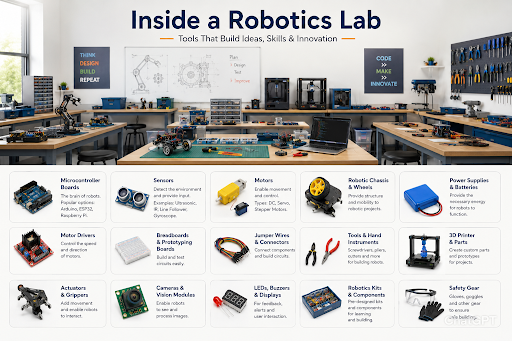
For most people, the word “robotics” brings to mind a high-tech lab with expensive machines and students in lab coats. The reality in schools is far more accessible and honest.
A typical school robotics session starts with a problem. Students are given a challenge, like building a robot that can move through a maze or respond to a sensor.
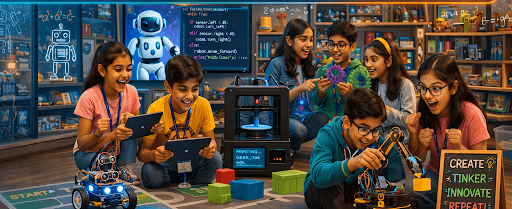
The tools they work with are beginner-friendly and hands-on. Most schools use kits like LEGO Mindstorms, VFX Robotics, or 3D tools that come with motors, sensors, wheels and programmable controllers. Students assemble the parts, write basic code to control the robot’s movement, test it, watch it fail and then fix it again.
Advantages of Robotics Programs in Education
Critical Thinking
When the robot does not move the way it should, a student cannot guess their way out of it. They have to stop, think and find what went wrong and then fix it. That’s the real structured thinking, practised repeatedly.
Problem Solving
Students are given a task, say building a robot that picks up trash. The students have to figure out which sensor to use, where to place it, and how to write the condition in code.
Creativity
Two students with the same kit will build two different robots with different purposes. One might add an extra wheel for stability, another might reroute the wiring entirely.
Teamwork
One student writes the code, while another handles the wiring and a third tests the movements. If something fails, they have to communicate clearly to find out whose part went wrong.
Also Read: Future-Proof Your Child: Tech Labs + Global Curriculum Secrets Revealed at Salvation Tree School
Inside Salvation Tree School Robotics Program
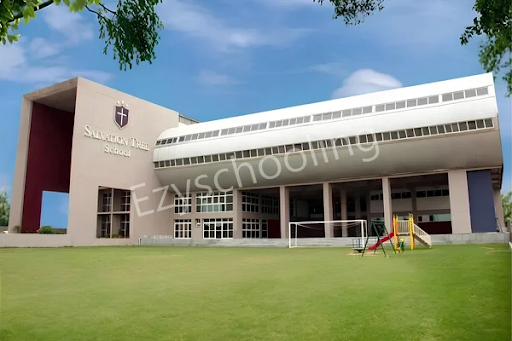
Schools in Greater Noida West are preparing students for the future skills through AI & Robotics programmes. At Salvation Tree School, the Robotics Program introduces students to the exciting world of automation, artificial intelligence, and engineering, fostering creativity and critical thinking through hands-on projects.
The work is not just assembling the machines, but it is a gateway to STEM (Science, Technology, Engineering, and Mathematics).
The program enhances logical thinking, creativity, innovation and collaboration. The Robotics Lab is equipped with art kits, coding platforms and AI-powered tools to encourage exploration. Here’s what the lab offers:
- Basic Robotics & Automation
- Coding & Programming
- Artificial Intelligence & Machine Learning
- Drone Technology & 3D Printing
- Competitions & Hackathons
The main goal of the robotics program is to equip students with the skills they need to thrive in the digital age. The school provides the right platform to all the aspiring engineers, programmers, or tech innovators to explore, experiment and excel.
Final Note
Not every child who builds a robot will grow up to become an engineer, and that was never really the point. What robotics gives a student is something quieter but far more useful: the habit of sitting with a problem until it starts making sense.
Schools are catching on, and the ones that have already made room for robotics in their classrooms will tell you the change they are seeing in the mindset and approach of the students.
For more information regarding such schools offering modern education





 as a preferred source on