







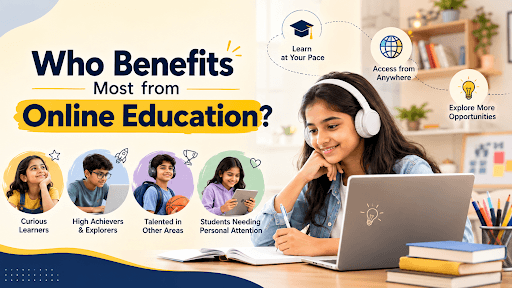

After COVID, online classes suddenly became the norm, and everyone started calling it "the future of education." But honestly, this future should have arrived much earlier, because school was never meant to work the same way for every child. Think about it. Not every kid is meant to sit through twelve years of classrooms and then walk into a conventional career. Some children are already training for national-level sports by the age of ten. Some are shooting for their first film role while their classmates are still learning fractions. These kids don't stop needing an education; they just can't get it the traditional way, sitting in a fixed seat, at a fixed time, following a pace built for thirty other students.
This is where the idea of a Class of One really makes sense: an education that moves with the child instead of expecting the child to move with it. And it's exactly why so many parents today are exploring the Best Online Schools in India, not as a backup plan, but as the smarter one. This article will show you for which students online schooling benefits the most.
Also Read: How Online Schools Are Shaping the Future of Education in India
9 Types of Students Made for Online Education
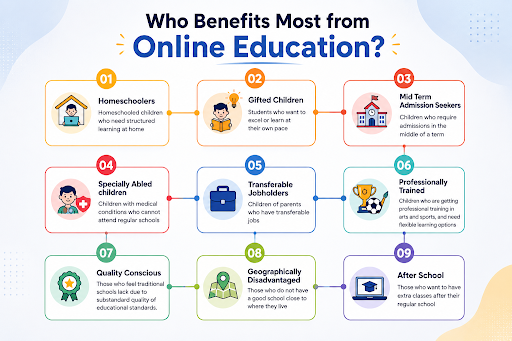
1. Homeschoolers
Homeschooling parents usually start with good intentions. A proper timetable, subjects divided, everything planned out. But a few weeks in, that routine quietly falls apart. Some days studying happens in the morning, some days at night, some days not at all. The child is still learning, sure, but the one thing missing is consistency, and that's actually what matters most.
This is exactly where online schools help. The child still stays home, no commute, no school hassle, but now there's a real teacher, fixed class timings, and an actual syllabus to follow. Basically, you get the same freedom you wanted from homeschooling, minus the messy, inconsistent part.
2. Gifted Children
Some kids just pick things up faster than the rest of the class, and honestly that becomes a problem in a normal school. They finish the work early, then just sit there, waiting for everyone else to catch up. It’s not that the teacher’s doing anything wrong; the class is simply paced for the average student, not the fastest one.
With online learning, kids move at their own pace. Understood a topic already? Move to the next one. No sitting around, no artificial slowdown just because the rest of the room needs more time.
3. Mid-Term Admission Seekers
Try getting your kid admitted into a school in November. Most schools will just say no; admissions only happen at the start of the year, no exceptions. But life doesn't really work on a school calendar. Families relocate, situations change, and sometimes the decision to switch schools just doesn't happen on time.
Online schools are a lot more flexible about this. A child can join mid-year without losing months or getting stuck repeating a grade just because of bad timing. One less thing to stress about when everything else is already up in the air.
4. Specially Abled Children
For a lot of specially abled kids, learning itself isn't the hard part, getting to school and sitting through a full day is. That's the actual barrier, and it's one online education genuinely solves instead of just working around.
Classes happen from home. Lessons can be repeated, slowed down, or paused depending on how the child's doing that day. Parents also stay a lot more involved in the process. This isn't some backup plan for these families; for many, it's the first time school has actually felt doable.
5. Transferable Jobholders
Ask any kid whose parent has a transferable job how many schools they’ve been to. The number’s usually higher than you’d expect. Every move means a new school, new syllabus, new teachers, and months spent just catching up on what the last school already covered. It gets exhausting after a while.
Online schooling removes that whole cycle. Same school, same teachers, same curriculum, no matter which city the job takes the family to next. The child’s education finally stays stable, even when everything else keeps changing.
6. Professionally Trained (Athletes, Actors, Artists)
Picture training for a national-level tournament and still being expected to sit through six periods of school the same day. Or shooting a scene early morning with class starting right after. Regular schools just aren't built to handle that kind of schedule, and honestly, they were never designed to.
Online classes can bend around the child instead of clashing with them. Missed a class for practice? There's a recording. Shoot ran late? Catch up in the evening. Nothing has to be sacrificed, not the training, not the schooling.
7. Quality Conscious Parents
Some parents just don't have a good school nearby, and "whatever's available" isn't really a fair choice. A lot of parents refuse to settle for that. Not because they're being difficult, but because they know the difference between a school that actually teaches and one that just fills up hours.
Online education gives access to better teachers, a stronger curriculum, and more consistent standards, regardless of where you live. For these parents, it's simply about not compromising on quality just because of location.
8. Geographically Disadvantaged Students
In a lot of India, a child's education still depends on where they happen to live. Small towns, remote areas, places where the nearest decent school is hours away or means the whole family relocating. That's been the reality for a long time.
Online schooling is one of the few things that's actually changed this. Now a student in a small village sits in the same class as one in Mumbai or Delhi. Same teacher, same material, no relocation needed. That shift matters more than it sounds.
9. After-School Learners
Not every child needs to switch to fully online school. Some just need a bit extra, help with a subject that isn't clicking, or a chance to get ahead of the current syllabus. That's a smaller need, and online after-school programs exist exactly for this.
No big change, just focused sessions that fit around the regular school day. Whether it's fixing a weak spot or getting ahead, this adds value without disrupting anything else the child's already doing.
Also Read: Is Online School a feasible option in a country like India?
Why The Class of One Fits Into This Conversation
If you've read this far, you already know online education isn't one-size-fits-all, and that's basically the whole idea behind The Class of One. It's a Ministry of Education recognised global school, built for kids who don't fit into a standard classroom setup, whether that's a homeschooler, a gifted child, a young athlete, or a family that keeps moving cities. Nothing here feels like an afterthought or a "we'll adjust for you" kind of setup; it's built around the child from the start.
What actually stands out is the range they offer. You can pick the Indian curriculum aligned with CBSE and NIOS, the UK curriculum through Pearson Edexcel, or Edu4All if affordability is the priority. There's also online tuition support for kids in CBSE, ICSE, state boards, or even international boards like IB and Cambridge. So whether a child needs a full school or just extra help alongside their current one, there's an actual option for it, not a generic one-size answer.
With over 5,500 students studying from 44-plus countries and 187 full-time certified teachers, this isn't some small experimental setup; it's a properly running school, just without the physical walls. Parents keep mentioning the same thing in their reviews too: the personal attention their kid gets, something that's genuinely hard to find in a packed classroom of 40.
Honestly, this is what makes The Class of One worth mentioning here. Among top online schools trying to solve the same problem- flexibility, access, and better learning for kids who don't fit the usual mould- this one seems to actually be built around the child first, and the system second.
For more information regarding these schools









 as a preferred source on