







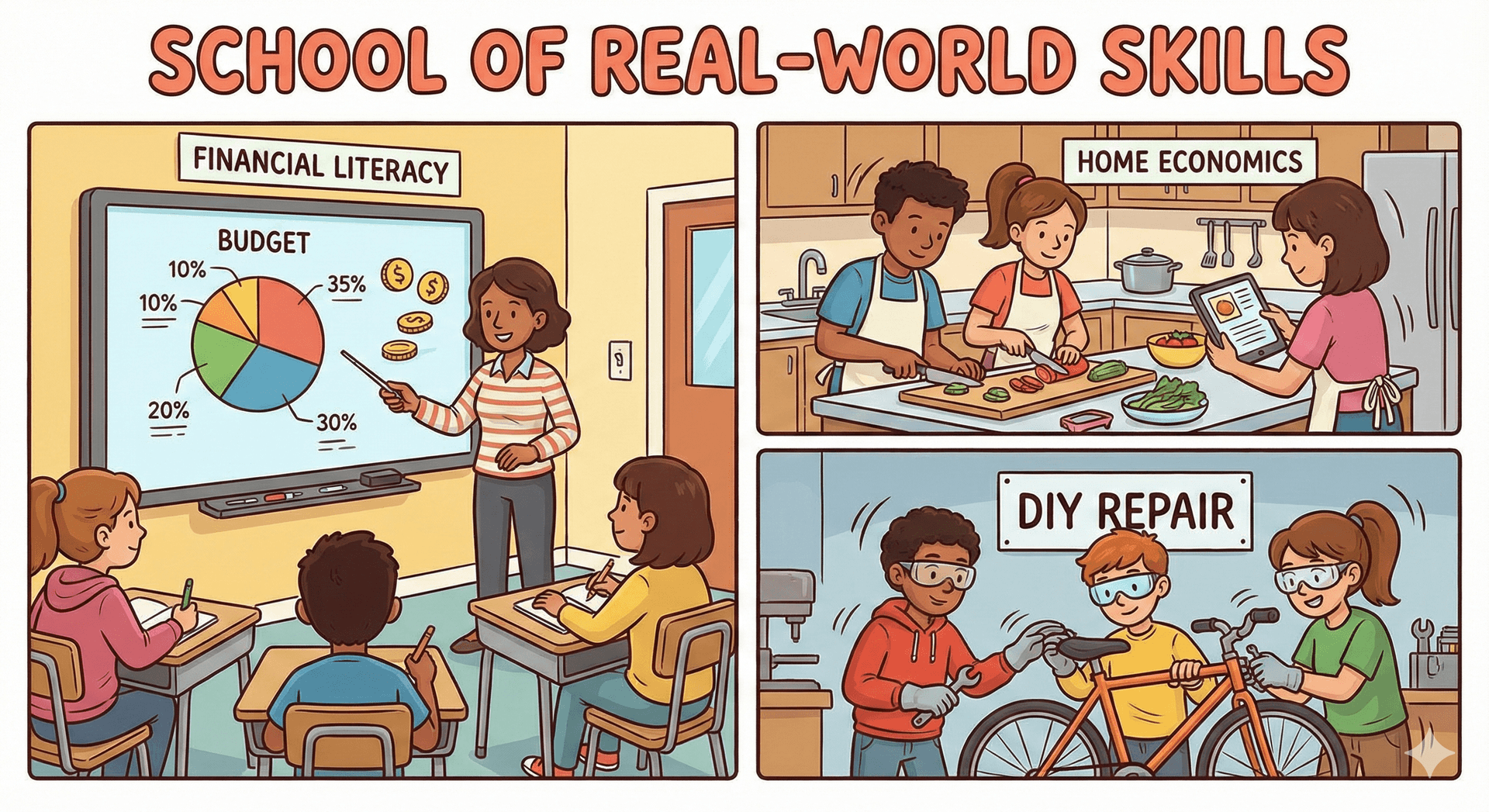

What if you graduate with top grades but fail your first job interview. You couldn't solve a simple problem without your textbook. This happens to millions of Indian students today. Recent data shows that only 42-45% of Indian graduates have the skills employers want. They lack major real-world skills like critical thinking. financial literacy, and communication.
Our schools teach students what to think, but they often forget to teach them how to think. This article explains why we must move from rote memorization to skill-based learning. It also shows how new models like Neoschools and some of the best online schools in India lead to this change.
Also Read: From Skills to Success: Role of Value Added Programs
Why Good Grades Aren't Enough Anymore?
For decades, the Indian education system has measured intelligence with one thing, i.e. memory. If a student memorizes a textbook chapter and writes it out on an exam paper, people call them smart. But the real world does not work like a multiple-choice test. In a modern job, no textbook tells you how to deal with a tough boss, manage your monthly budget, or work with strangers to build a product.
The gap between school and real life grows bigger every day. A recent report shows that students graduate in huge numbers, but over 50% of them lack major skills. They know what profit means, but they cannot make a simple business plan. They solve quadratic equations, but they struggle to figure out loan interest for a car. This employability gap hurts careers and life. When schools skip real-world skills, they create students who pass exams but cannot handle everyday problems.
What Are Real-World Skills?
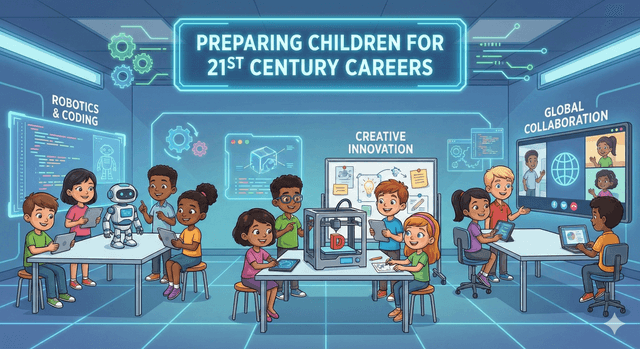
When we talk about skills, many parents first think of coding or robotics. Technology matters, but real-world skills run much deeper. People often call these "21st-century skills" or the "4 Cs":
- Critical Thinking: Look at a problem. Analyze the facts. Find a solution on your own.
- Collaboration: Work well with others. Even people you don't like. Reach a common goal together.
- Communication: Express ideas clearly. Use speech or writing. Do more than just answer exam questions.
- Creativity: Use your imagination. Invent new solutions. Don't just copy old ones.
You also need Financial Literacy (understand money), Emotional Intelligence (manage stress and show empathy), and Resilience (bounce back from failure). These tools decide success in life. A student who handles unfair criticism well will succeed in a high-pressure job. That student beats one who only knows the atomic weight of Boron.
Why Start Young?
Many adults think, "Kids will learn these skills when they start working." This idea is a big mistake. Research shows that the teen brain (ages 10-19) grows in a special way. It locks in habits easily. If kids sit quietly for 12 years of school and just listen to lectures, they build a habit of doing nothing on their own. They learn to wait for adults to tell them what to do.
We should teach skills like money planning or public speaking when kids are 10 or 11. Then these skills feel natural to them. For example, a 12-year-old who practices negotiation by trading items in a class project grows up to negotiate a salary with confidence. If you wait until college, it's like teaching a 20-year-old to walk. You can do it, but it's much harder than teaching a toddler.
Bridging the Gap: Teach Skills, Not Just Chapters
How do we teach this? We can't just add a "Critical Thinking" textbook to the syllabus. Students must practice real-world skills. They can't just memorize them.
Project-Based Learning (PBL): Students don't take a math test on percentages. Instead, they run a mock "school store." They calculate costs. They set prices. They manage inventory. They figure out profit margins. If they make a mistake, they lose mock money. This teaches math and business at the same time.
The Flipped Classroom: Students watch the lecture videos at home. In class, they don't sit and listen. They work in groups to solve problems from the video. The teacher doesn't lecture. The teacher acts as a coach. The teacher helps teams when they get stuck.
Failure Analysis: In a normal school, you get a red "X" and lose marks for a wrong answer. In a real-world classroom, failure is a step forward. Students look at why their science experiment failed. They study why their bridge design collapsed. Then they fix it. This builds resilience and engineering thinking.
Also Read: Rising Strong: Building Resilience in the Classroom and Beyond
Hands-On Ways to Teach Practical Skills
Hands-on methods help young students learn real-world skills. They turn lessons into fun, everyday adventures that make skills stick.
Market Days Develop Business Skills
Students set up mini-shops. They sell handmade crafts or snacks. They price items, count cash, and calculate profits after costs like ingredients. In one Delhi program, 200 kids ran stalls. They boosted their money math by 25%. They learned negotiation from real chats with customers.
Budget Challenges Teach Smart Spending
Groups get fake money and they plan events like class picnics. They list needs, like food, games, transport, and balance the total without going over. This cuts impulse buys. Studies show kids who practice budgets save 30% more of their allowance later. Add twists like surprise "price hikes" to build flexibility.
Team Quests Develop Problem Solvers
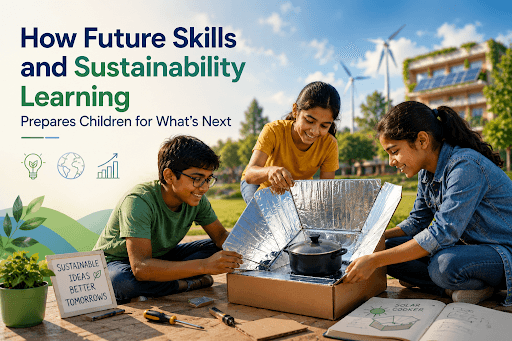
Kids team up to build models, such as solar-powered toys or clean-water filters. They divide roles, designer, builder, tester. They apply science and teamwork. PBL quests raise critical thinking scores by 20-30%. Teams debate fixes and present results, and they also get to know how to use recycled items for eco-lessons.
Role-Play Shops Grow Decision Skills
Students act as buyers or sellers in mock stores for homes, bikes, or apps. They compare loans, interest, and deals. They spot scams. Financial roleplay in programs like Saksham improved choice-making by 18% in young groups. Rotate roles weekly to develop empathy and decision-making skills.
Daily Skill Drills Keep It Fresh
Short 15-minute drills fit any class. Track lunch money weekly or pitch fix neighborhood trash ideas. Smile Foundation trained 34,000 youth this way. It helped 20,000 get jobs through quick retail drills. Track progress with stickers or apps for motivation. Hands-on activities triple retention over books.
StayQrious Neoschool's Skills & Project Curriculum
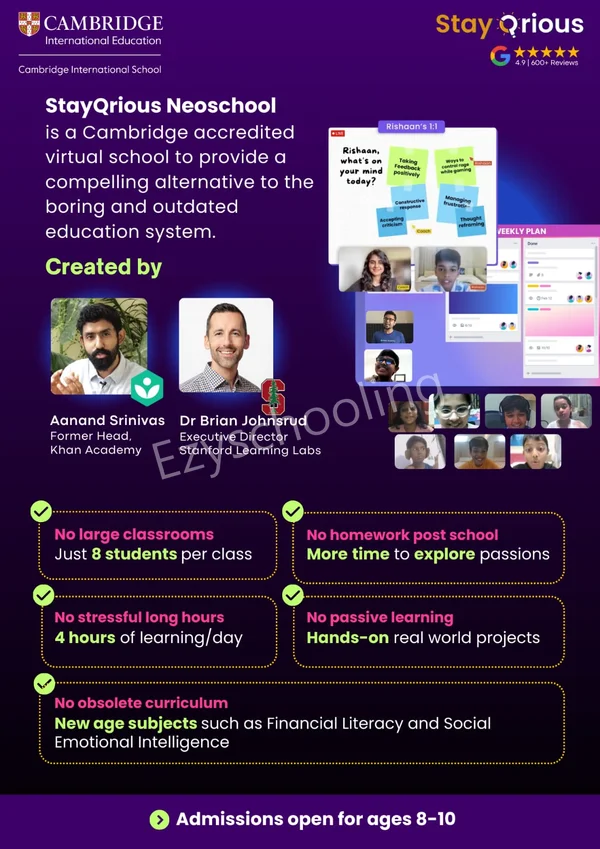
While many traditional schools struggle to adapt, a new wave of some of the best cambridge online schools in India are coming up to fix this problem. StayQrious Neoschool leads the charge by teaching real-world skills that traditional schools ignore.
StayQrious calls itself a "Neoschool." It reimagines school structure where kids do not just sit muted in a class with 50 students and one talking teacher. Instead, they work together in a collaborative workspace to solve complex problems.
The Skills & Project Curriculum
StayQrious focuses on skills which gives children a ten-fold advantage in terms of developing thinking and analytical skills for future jobs. The curriculum mixes subjects into exciting domains, not rigid ones like History or Physics:
- STEM Foundations: StayQrious teaches "Computational Thinking," not just coding syntax. Students break big problems into small pieces (decomposition) and find patterns.
- Applied Science (The "Why"): Students build a virtual business to understand math or design a Mars habitat to grasp physics. They skip formula memorization.
- Social-Emotional Learning (SEL): StayQrious treats emotional skills as core subjects. Students learn to "communicate courageously" and "handle rejection" for better mental health and careers.
Learning Pods and Active Collaboration
Online classes often lack connection but StayQrious online school solves this with Learning Pods. Here’s how:
- StayQrious keeps the student-teacher ratio small, like 1:6 or 1:8. Every child gets seen and heard.
- Students join trusted teams. They keep videos on, talk, and collaborate as active teammates, not passive listeners.
- Adults serve as learning coaches, not lecturers. Coaches motivate, unblock struggles, and ignite discussions, like managers in modern companies.
Real Projects, Not Just Textbooks
StayQrious uses project-based learning. A 7th grader does not just study economics, they join the mock factory to learn things in real-time. The team acts as factory owners. They:
- Source raw materials (Geography and Supply Chain).
- Calculate production costs (Math and Accounting).
- Design packaging (Art and Design Thinking).
- Pitch the product (Public Speaking and Persuasion).
Students experience profit and loss firsthand. In Mars Mission, they calculate trajectory angles (Geometry) and fuel consumption (Physics) to land a rover. These projects make learning stick to the mind. Kids remember concepts because they take part in real-life activities.
StayQrious proves that creation excitement beats exam fear. Children learn faster and better. They shift from "Will this be on the test?" to "How can I solve this?", which builds future leaders.
Conclusion
Data shows our rote learning creates big problems. Only less than half of graduates find jobs easily. Schools must teach real-world skills now. Students aged 10-19 need critical thinking daily. They also need financial literacy and teamwork skills.
Over 50% of graduates lack major job-oriented skills. High grades do not mean readiness. Start teaching skills in adolescence now. This period builds strong habits best.
Use active projects like mock businesses. They work better than just listening. Parents should seek output-focused programs. Schools should start asking what kids built today instead of asking what problems they solved in their notebook. StayQrious Neoschool shows the way. Kids in small groups solve actual world problems, helping them to be future-ready and street-smart.
To learn more about this and other schools nearby, see this list of the top online schools.







 as a preferred source on