







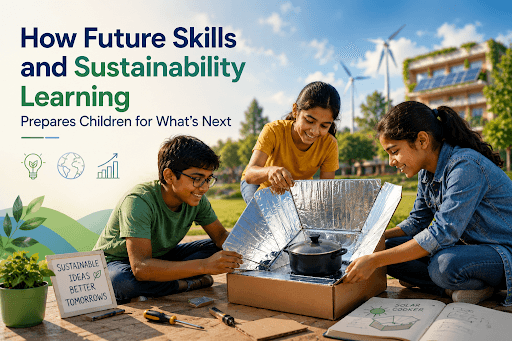

It is 2035, and your child just walked into their first job interview. There is no question paper, no marks to fall back on. Just a real problem in front of them, and the expectation that they know how to think on their feet.
Do you think your child’s school is preparing them for this? Most schools are still built around grades and annual exams. All of that matters, but it is not the whole picture anymore. The world our children are stepping into needs more than just toppers. It needs problem-solvers, critical thinkers, and young people who actually understand the planet they are inheriting.
This is the conversation that every parent and every top school in Gurgaon, Sec 46, needs to be having. And it starts with two things that belong together: Future skills and sustainability learning. Schools like MRIS Sector 46, Gurgaon, are already doing this, and doing it well. Here is why it matters and what it actually looks like.
Also Read: Why the Shift from Rote Learning to Real Understanding is Needed
What Are Future Skills & Why Do They Matter?
When it comes to future skills, many parents believe they involve building a robot or a time machine. This is not what we mean when we say your child should learn future skills. What we actually mean is way more ordinary than that. It’s what kids fall back on when there’s no answer key in front of them. No teacher standing there telling them exactly what’s right.
Let’s suppose 4 students are working on a group project. One wants to divide the work, and another wants to redo everyone else’s part. And somehow, there's usually one kid in the mix who gets everyone rowing in the same direction without a fight breaking out. That kid isn't necessarily the smartest one in the room. She's just had practice doing this before, probably messed it up a couple of times first, too.
These kinds of skills matter most in life, and for that, your child doesn’t need to score 100/100 on a test. Here’s what we’re actually talking about when we say future skills:
Problem Solving
Solving 2x2 is not problem-solving. Give a problem to a child like “how can you use solar energy to light up a room with no electricity,” and watch what happens. There’s no formula for that.
Communication
It's about saying what you actually mean and also listening when someone says something you don't agree with, instead of just waiting for your turn to talk.
Collaboration
Working with people who think as you do. Not your best friend who agrees with everything you say. The kid who wants to do it a totally different way, and you still have to get something done together.
Adaptability
Plans fall apart all the time; kids should know that, too. The project changes at the last minute, a group member drops out, and the rules shift halfway through.
Critical Thinking
Asking why instead of just accepting whatever they're told first. Not every answer on the internet is correct, and kids need to learn that early.
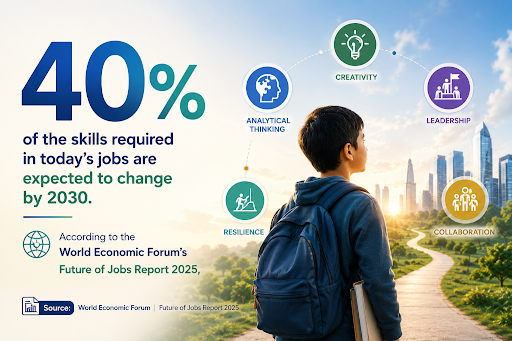
The World Economic Forum’s Future of Jobs Report 2025 found that nearly 40% of the skills people use at work today are expected to look different by 2030. And when employers were asked what they actually want more of, the list was analytical thinking, creativity, resilience, leadership, and the ability to work with others, not technical knowledge. That’s the exact gap future skills are meant to close.
Why Sustainability is No Longer Optional
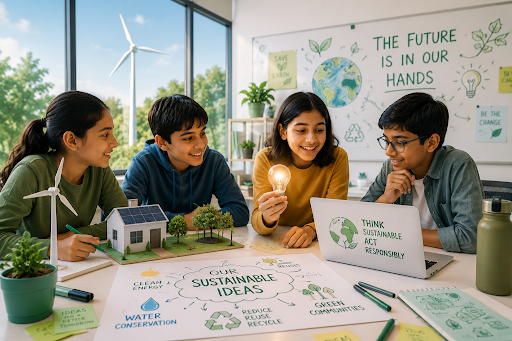
Alongside future skills, there is another area that schools can no longer treat as an extracurricular activity: Sustainability Education.
For many years, sustainability in schools has meant making a poster on how to save the Earth. Nice gesture, but forgotten by lunchtime. That’s not the sustainability we are talking about.
Frankly speaking, this generation of kids is going to inherit water shortages, extreme weather, and resource problems that aren’t theoretical; they’re real problems. A kid who doesn’t understand how energy, water, or waste actually work isn’t prepared for the world they are stepping into. Now, sustainability has become a core of every niche and everything.
So how do schools actually teach this, rather than just talk about it?
- Start with real numbers, not lectures. Have kids track their own home energy use for a week, or weigh how much food gets wasted at lunch.
- Build it into subjects that already exist, instead of adding a new one. Renewable energy fits into a science unit. Carbon footprints fit into a math unit on data.
- And give them something to actually build, not just read about. A simple water filter, a fix for classroom waste, anything that doesn't work on the first try, and forces them to figure it out.
None of this needs a big budget. It just needs schools to treat sustainability as a real subject, not a once-a-year event.
The Connection Between Future Skills & Sustainability
Future skills and sustainability learning are often discussed as separate ideas, but in practice, they work best together.
Sustainability is about encouraging students to understand challenges, think about solutions, and take meaningful action. And that process naturally develops many of the skills they will need in the future.
Here's what that can look like:
|
Sustainability Activity |
Future Skill Developed |
|
Conducting a waste audit in school |
Critical Thinking |
|
Designing a recycling campaign |
Creativity |
|
Working on a community awareness project |
Communication |
|
Participating in a water conservation initiative |
Problem-solving |
|
Managing a school garden |
Responsibility & teamwork |
|
Presenting sustainability ideas to peers |
Leadership & Confidence |
In many ways, sustainability becomes a natural training ground for future skills.
Also Read: Why Multi‑Sensory Learning Matters in Schools: A Look at MRIS Labs
How MRIS Building Responsible and Future-Ready Learners
Best CBSE Schools in Gurgaon actively integrate future-ready skills along with sustainable learning. At Manav Rachna International School, this kind of learning doesn't sit in a corner as a once-a-year event between exams. A Future Skills & Sustainability track is running from the early years right through senior school.
At MRIS, two spaces do most of the work. Maker Shala is where students get their hands on actual materials and build things, test them, watch them fail, and fix them. Media Shala works the same way, but with storytelling and media tools, kids create instead of just learning about how stories get made. Both rely on the same thing, really, trying something, getting it wrong, trying again. Same instinct behind the problem-solving and adaptability we talked about earlier.
Sustainability gets folded in the same way. It's not one chapter in a science textbook somewhere. It runs through regular classes, so kids are dealing with problems that are actually happening right now instead of memorizing a few facts they'll forget after the test.
A kid can do well on every paper and still freeze up the second something real and messy lands in front of them. That's the gap this whole program is trying to close. Not by adding more subjects to an already packed timetable, but by changing how kids interact with the ones they're already sitting through every day.
For more information regarding this and other schools that integrate
future-ready skills and sustainability as one subject







 as a preferred source on