







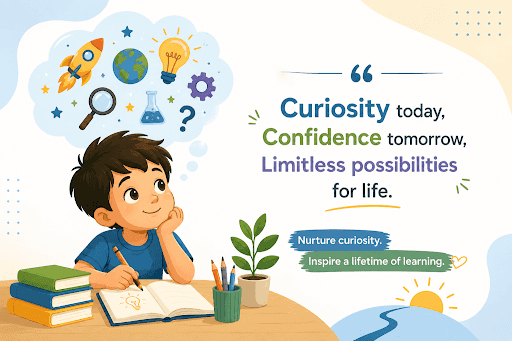

“Why is the moon following our car?”
Questions such as these act as the catalyst for childhood development. But have you ever wondered why your four-year-old constantly asks "why" about everything? It can feel exhausting on a busy day. Yet, research indicates that young children ask up to 300 questions a day.
A curious child explores the world with wide-open eyes. This natural drive builds a rock-solid foundation for lifelong success.
Schools play a massive role in keeping this early spark alive. Institutions like Manav Rachna International School, one of the best schools in Gurugram, actively support this through concept-driven inquiry. Let’s see how!
Also Read | Turning Curious Kids into Future-Ready Thinkers
The Science of a Curious Mind
When a child feels curious, their brain releases a chemical called dopamine. That chemical does two things at once:
- Makes the moment feel good → Making the physical act of learning highly enjoyable
- Locks new information into memory → Improving memory retention
Most importantly, children learn best when they are active participants. Passive listening rarely works for energetic toddlers. They need to touch raw materials, mix bright colours, and see real outcomes.
There is an emotional layer as well to this. Children who are encouraged to ask questions and explore tend to feel more confident. They learn that not knowing something is fine. It is, in fact, the start of something interesting.
Helping Children Make Sense of a Complex World

Have you ever had the chance to observe a child consciously experience his first rainfall? They have a ton of questions then: Where does the water come from? Does it go inside the ground? Why can't we play in the rain? And so on.
Answering these questions builds their understanding of natural systems, while also giving them confidence to navigate their surroundings. A confident child is more likely to take healthy risks later on in life.
In addition to this, curiosity also impacts social development. Children are naturally egocentric, viewing the world from their own perspective. However, with an inquisitive mind, children soon start noticing other people as well. Thus, children who are encouraged to ask questions become more inclusive adults. They do not fear the unknown. Instead, they want to learn about it.
What Happens When We Nurture Exploration
Encouraging an inquisitive mindset offers profound, long-lasting benefits for growing children, such as:
- Boosts Creative Problem Solving: Curious children look for multiple ways to fix a broken toy. They do not give up easily when faced with a roadblock.
- Develops Strong Independence: Kids who ask questions learn to seek answers on their own. This reduces their heavy reliance on adults for constant direction.
- Builds Emotional Intelligence: Curiosity extends to understanding other people's feelings. Children learn deep empathy by wondering how their friends feel.
- Enhances Future Adaptability: The future requires highly flexible thinkers. An inquisitive child easily adapts to new technologies and changing environments.
Why the Early Years and Not Later?
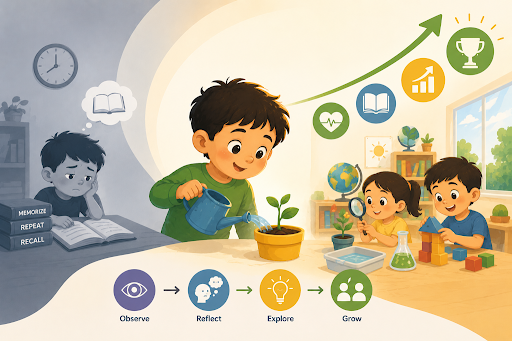
Early childhood is what people call a sensitive period. The brain is wide open to shaping right then. Habits of mind that set in at that crucial stage tend to stay. James Heckman, who won the Nobel in economics, found that money put into good early childhood education returns somewhere near 13% a year through better health, schooling, and earnings down the line. The "good education" Heckman meant here was focused on feeding motivation, social skills and curiosity, rather than drilling toddlers with flashcards.
This is also one of the reasons why modern learning has moved far beyond rote memorization. The best early learning frameworks now focus entirely on experiential learning with classrooms functioning as vibrant activity centres where students observe, reflect and test their own theories, with teachers acting just as gentle guides in the discovery process.
Encouraging Curiosity at Home
As adults, it is our responsibility to protect children's desire to understand the world. Instead of overlooking their questions, it is important that we answer them or, for bizarre questions, at least say something like "That is a great question. Let us find out." This helps to truly nurture their curious minds rather than just shutting them out.
Parents can easily build a curiosity-driven environment at home in the following ways:
- Provide Open-Ended Materials: Give them building blocks, clay, or blank paper. These items have no single correct way to play. They force the child to use their own imagination.
- Change Your Questions: Instead of asking what they did today, ask what made them laugh. Ask them to explain a game they invented with their friends.
- Embrace the Mess: Active learning is often very messy. Allow them to splash in puddles or mix mud in the yard. Sensory play triggers massive cognitive leaps.
Check Out | How can an Active Imagination Help in a Child’s Development?
How Manav Rachna International School, Sector 51, Gurgaon, Uses Curiosity to Enhance Learning
Located in Mayfield Gardens, Manav Rachna International School is one of the best CBSE schools in Gurgaon. The school runs on the belief that every child is special and ought to be noticed, with their abilities found and their hopes given space. Thus, the school focuses heavily on diversity, inclusion, and a purely student-centric approach.

The school takes a definitive stance on curiosity-driven learning. Their Foundational Years program revolves entirely around concept-driven inquiry. Educators utilize a highly specialized Learning Center approach, wherein classrooms feature play-based activity centers that actively stimulate young minds. Along with this, a unique Mother-Teacher concept provides a deeply nurturing atmosphere, building social competence and emotional balance. Learning happens through engaging themes that seamlessly integrate numeracy, language, and creative expression.
Similar practices carry on into the Primary Years, which covers Grades II to V. Teachers there pull in science investigations, hands-on projects, drama, games, discussions, and outdoor learning to keep curiosity going as the work gets tougher. The school treats these as a deliberate way to grow critical thinking and creativity, not as the occasional fun day.
The curriculum at MRIS runs across seven learning areas, CREST among them, which stands for conceptual learning through reasoning, exploration, skilling, and technology, sitting alongside literacy, numeracy, the arts, sports, and life skills. The school also features a soft-skills curriculum working on empathy, gratitude, and handling emotions.
Remember, the early years fly by in the blink of an eye. Guarding a child's curiosity through this stretch thus becomes one of the most useful things that a family and a school can pull off together. All this requires is a little bit of patience, time and a willingness to nurture the intellectual growth of our little ones.
For more information on MRIS and other similar schools, check out this list of schools in Gurgaon.











 as a preferred source on