







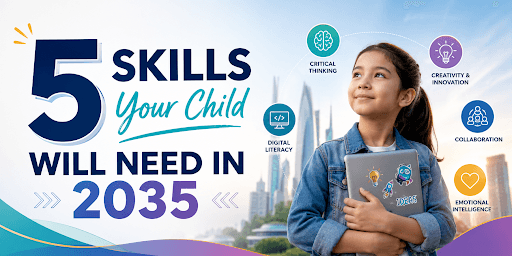

Ten years ago, if you’d walked into most of the top schools in Greater Noida and asked, “Are you teaching adaptability?” you’d have gotten a blank stare. Creativity used to be a fun Friday thing. Collaboration meant group projects that one kid always ended up doing alone.
And yet here we are. 2025. With 2035 feeling closer than it sounds, and the skills that will actually matter then looking like what most of us were graded on. The good news is that some schools saw this coming. Sheoran International School is one of them. They just started building it through robotics labs, makerspaces, personality programmes, and learning environments that treat curiosity as a core subject.
This article is about five of those skills. The ones quietly becoming non-negotiable. The ones that separate a child who's just educated from a child who's actually prepared.
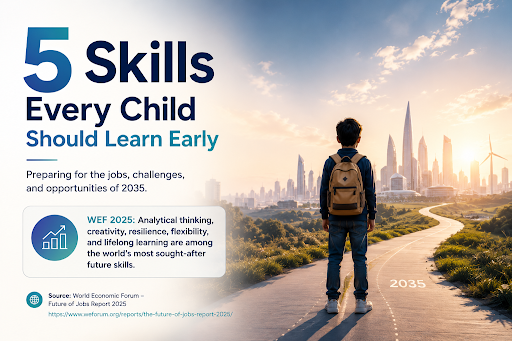
5 Skills That Every Child Should Learn Early
Adaptability
A decade ago, we taught our children that the ideal way to learn is to memorise answers. But now the world is not based on a single definition! Adaptability isn’t about being okay with change. It’s about being genuinely comfortable in uncertainty, the kind of person who doesn’t freeze when a plan falls apart or shifts.
Researchers at the World Economic Forum have consistently flagged adaptability as one of the top traits employers will seek well into the 2030s.
Creativity
There’s a version of creativity that lives in drawing competitions and drama performances. That’s wonderful, but it’s not the creativity the 2035 job market is hungry for.
The creativity that will matter is divergent thinking, the ability to look at a challenge from angles nobody else considered, to connect unrelated ideas, to build something new from existing constraints. It’s what makes someone irreplaceable even as automation scales.
Emotional Intelligence
Adaptability and automation are impressive. But it cannot sit across from a grieving colleague and say the right thing. It cannot read the room in a tense negotiation. It cannot build trust.
Emotional intelligence is the ability to understand your own emotions, manage them, and respond thoughtfully to others. These are not just soft skills but are now being widely recognised as strategic skills. EQ in children can be developed through group collaboration, conflict resolution, peer feedback and mentorship.
Collaboration
If you still believe that collaboration just means working in groups, then you need to update your definition. The collaboration required in 2035 will be cross-cultural, cross-disciplinary, and often entirely remote. It will require students to understand perspectives vastly different from their own, contribute meaningfully, and still arrive at something unified.
This is a skill that deteriorates in isolation. Children need exposure to different ideas, different strengths, and different ways of approaching a problem.
Self-Directed Learning
Perhaps the most quietly radical skill of all. By 2035, the most valuable professionals won’t be the ones who know the most; they’ll be the ones who can learn the fastest. Courses, tools, industries, and technologies will continue evolving faster than any fixed curriculum can keep up with.
Self-directed learning means a child knows how to identify what they don’t know, seek out reliable sources, practice with intention and reflect honestly on their progress.
The Skills of 2035 Aren’t Future Plans at Sheoran International School
Here’s the thing about skills like adaptability, creativity and collaboration: they don’t develop in classrooms where children sit quietly and copy notes. They develop when children are given real problems, real tools, and real space to figure things out.
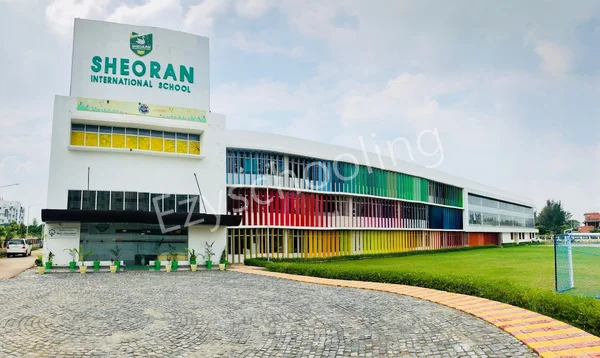
Among the top CBSE schools in Greater Noida, Sheoran International School stands out not for what it promises on paper, but for what actually happens inside its walls every day. Walk through the school, and you’ll quickly notice that the children are busy in a way that doesn’t look typical of school busyness.
There's movement, there's building, there's conversation that sounds like actual thinking. The Robotics lab, the Makerspace, and the Personality Development sessions. They're woven into it. And that makes all the difference.
Because when a child spends enough time in environments that ask them to create, to problem-solve, to communicate and sometimes to start over entirely, these five skills we've talked about don't need to be "taught" anymore. They just develop. Quietly, steadily, in the background of every project and every challenge the school puts in front of them.
That's the difference between a school that talks about future-readiness and one that's actually building it.
Final Note
The world your child walks into in 2035 will reward the ones who can think on their feet, create without a template, and work with people nothing like themselves. That's not a prediction anymore. It's already happening. The only question worth asking right now is — is your child's school ready for it?
For more information regarding schools that build their curriculum on future-ready skills






 as a preferred source on