








Most parents remember a time when school meant sitting quietly, copying notes, and preparing for the next exam. That world looks very different today. Children now grow up surrounded by smartphones, AI assistants, and technology that changes faster than any textbook can keep up with. The question parents and schools both ask is — are we preparing children for this world, or still preparing them for the last one?
One of the best schools in Devanahalli, Bangalore, MVM School follows the CBSE curriculum and the National Education Policy 2020. The school focuses on building skills alongside academic knowledge. It prepares students to think, create, and solve problems.
In this article, we explore the growing importance of STEM and AI education in schools today. We also look at how MVM School is taking a strong step in this direction through its new Cogno Space Lab.
Also Read | From Foundational Learning to Future Innovation: The MVM School Journey
Why STEM and AI Education Matters Today
The world is changing fast. Jobs that exist today may look very different in ten years. Students need skills that go beyond memorising facts. STEM education — Science, Technology, Engineering, and Mathematics builds those skills. When schools include AI and technology in learning, students get a head start.
When a child works on a STEM project, something shifts in how they approach a problem. They stop waiting for the right answer and start testing ideas. A student building a simple bridge with craft sticks learns more about weight and balance than a chapter on forces ever teaches alone. They try, fail, adjust, and try again and that habit of thinking carries into every subject they study.
Hands-on learning also unlocks creativity in ways that reading cannot. A child who designs a small working model or programmes a basic sequence of steps begins to see problems as puzzles worth solving. Real-world examples make this even clearer:
- A student who sorts objects by shape in early classes is already learning pattern recognition.
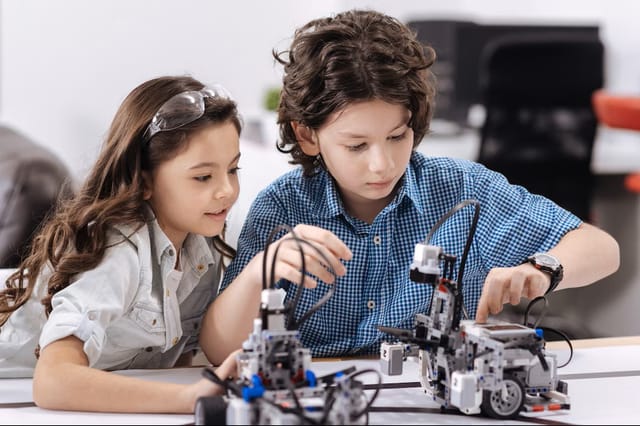
- A child who builds a model vehicle in a science activity is applying engineering thinking without even realising it.
- A student who debugs a simple coding error is practising logical reasoning in a very direct way.
How Schools Can Create Better STEM Environments
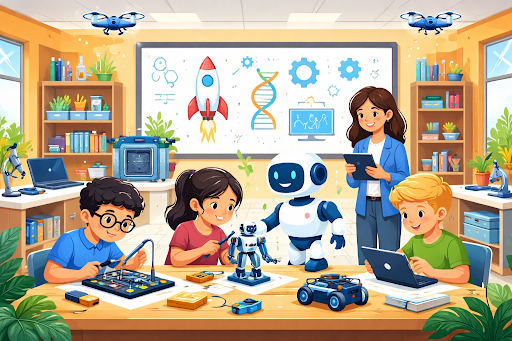
Good STEM education needs more than just a science lab. Schools must think carefully about how they set up spaces for learning. The goal is to make students active participants, not just listeners.
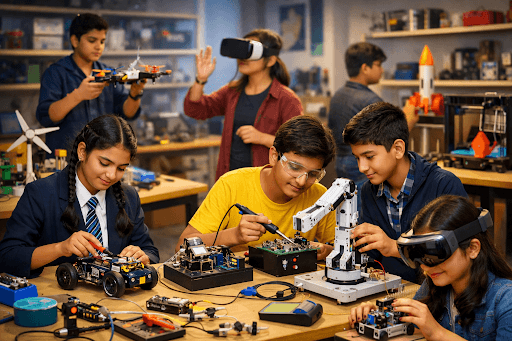
A well-equipped space sends a clear message to students. It tells them that exploration is important here. When students walk into a space with 3D printers, robots, and tablets, they feel excited. That excitement drives learning in a natural way.
Even the best equipment means little without good teachers. Educators must know how to guide students through projects. They must also feel comfortable with new technology themselves. Schools that invest in teacher training see better results in the classroom.
Students learn better when they see why something matters. STEM activities should connect to real problems in the world. When a student builds a small drone or programs a robot, they understand how technology works in real life. That connection makes the learning stick.
Parents play a big role in how students approach learning. When schools invite parents to see STEM projects and labs, it builds trust. Parents begin to support learning at home in new ways. This partnership between school and family strengthens the student's overall growth.
Also Read | From Karate to Coding: How MVM School Devanahalli is Redefining All-Round Education
The Role of AI in School Education
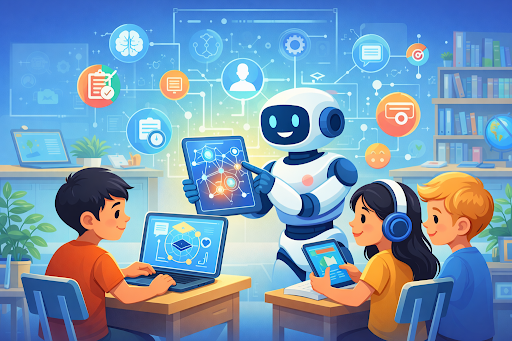
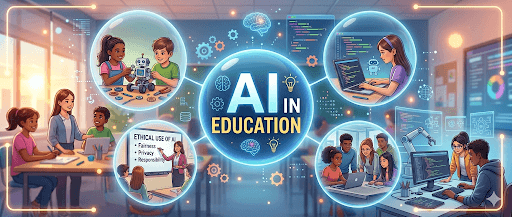
Artificial intelligence is no longer a distant topic meant only for engineers and researchers. It already shapes the daily lives of children — from the videos a platform recommends to the voice assistant that answers their questions at home. Schools that introduce AI concepts early help students understand the technology around them rather than simply using it without thought.
Teaching AI at school does not mean writing complex code. A primary student can learn what AI does by sorting pictures into categories, which mirrors how image recognition works. A middle school student can explore how a recommendation system decides what to show next. These small, clear activities build a foundation that grows stronger each year.
What matters most is the shift in how students see themselves. A child who understands even the basics of AI starts thinking like a creator, not just a user. They ask why an app behaves a certain way or wonder whether they could build something similar. That curiosity once it takes root shapes how they learn, question, and create for years to come.
Check Out | Where Gandhi’s Values Meet Modern Innovation
MVM School, Devanahalli — Building the Future of Learning
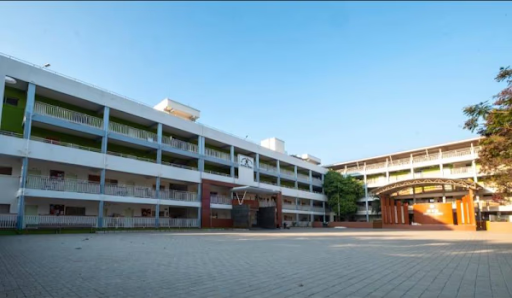
One of the best CBSE schools in Bangalore, MVM School in Devanahalli, Bangalore, is a school that follows the NEP 2020 framework. The school focuses on holistic development across all stages of learning. It has won the All-Rounder CBSE School Award, which reflects its commitment to quality education.
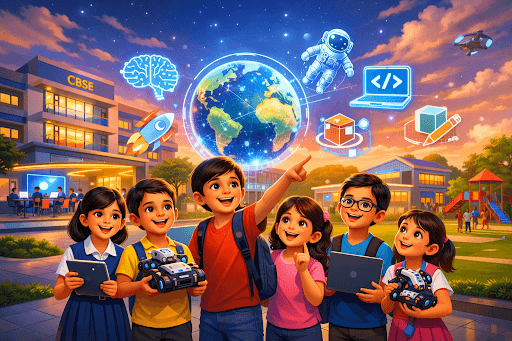
The school recently launched the Cogno Space Lab in partnership with Cogno Space, a technology company. This 700 sq. ft. lab sits on the third floor and holds laptops, tablets, 3D printers, televisions, and more. Students from Grades 1 to 10 can access this lab and explore topics like robotics, AI, drones, and engineering.
The lab covers 35 real-world concepts and gives students a full year of structured exploration. The program ends with a student expo, where learners showcase what they have built and discovered. This approach turns learning into an experience rather than just a process.
Conclusion
Good education has always been about preparing children for the world they will actually live in. Today, that world runs on technology, data, and the ability to think across disciplines. STEM and AI learning give students the tools to navigate that world with skill and confidence. Schools that create real spaces for exploration, train teachers well, and involve parents in the journey are not just teaching subjects, they are building capable, curious human beings. The choices schools make today about how and what children learn will shape not just individual futures, but the kind of society the next generation builds together.
For more information on this and other such schools in the area, check out this list of the best schools in Bangalore.










 as a preferred source on