








“Did the child finish homework?”
“How many marks did the child score?”
“Why is the child behaving this way?”
These are a few questions that have riddled all parents, one time or another. While we put in our absolute best towards raising our children, the human mind often wonders if we are falling short somewhere. Oftentimes, we are just left wondering, “Am I doing this the right way?”
Well, you are on the right track if that question hits you. It just means that you want to make sure that you become the perfect parent for your child. Now, that road is definitely bumpy, yes, but with positive parenting, you can be sure that your child is growing up under the right care and protection.
Schools like Mother's Pride, one of the top schools in Gurgaon, have built their entire approach around this understanding, making parent education a real part of what they offer rather than an afterthought.
Also Read | Why 'Good Grades' are the Biggest Lie in Modern Parenting
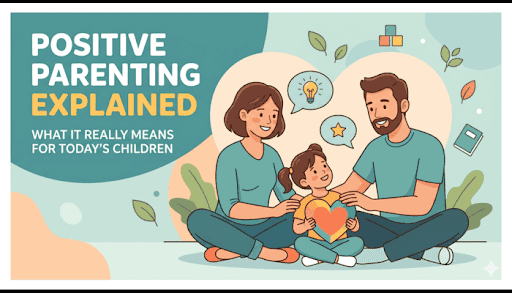
What is Positive Parenting?
Most people picture positive parenting as a parent who never says no or as someone who lets children run wild in the name of emotional freedom. However, that's not it.
Positive parenting comes down to how you respond to a child, not just what you respond to. The approach draws from decades of developmental research, most notably Dr. Diana Baumrind's studies from the 1960s, which identified what she called the "authoritative" style: warm but boundaried, responsive but consistent.
This parenting style does not believe in constant punishment or harsh control. Instead, it encourages parents to understand the reason behind a child’s behaviour.
For example, when a child throws a tantrum, positive parenting asks an important question. Is the child being stubborn, or is the child struggling to express frustration?
What is the Need for Positive Parenting?
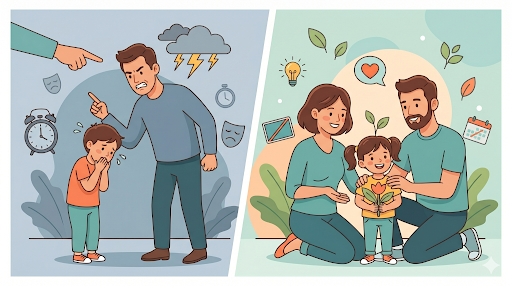
Many of us grew up in homes where fear was the main tool. Sentences like "Wait till your father gets home" were common. Obedience was the goal, and it sort of worked as children complied. But a study from the Journal of Child Psychology and Psychiatry found that children regularly exposed to harsh criticism were 3X more likely to develop emotional dysregulation by adolescence. This happens because with the harsh parenting, they didn't learn to manage feelings, but just to hide them.
The world children are growing up in today makes this even more relevant. Academic pressure kicks in at age three or four in many urban households. Screens are constant. Most nuclear families have no extended support structure around them. As a result, parents tend to feel overwhelmed on having no reliable source of parenting guidance outside of their immediate family.
What Exactly Does Positive Parenting Look Like?
This is where most parenting conversations stay vague, so let's get specific. A few things that genuinely define positive parenting in everyday life:
- Pausing Before You React: Two seconds of space genuinely changes what comes out of your mouth. Try it once and you'll see what I mean.
- Name What They are Feeling: Say things like "you're really frustrated right now, aren't you?" out loud. Feels odd at first, but naming the emotion teaches children the vocabulary to process what they feel instead of just acting it out, and that skill follows them well into adulthood.
- Explain Limits, Don’t Enforce: When you child just grabs something, explain with reason: "We don't grab things, I know you wanted that, let's ask nicely." A sharp "stop that" doesn't make them realise what they are doing wrong.
- Let Life Teach: Let life do some of the teaching. If your child refuses to wear a jacket, let them feel cold for once. That makes them understand what you were saying without having to give them a lecture.
- Watch What You Model: Children are always watching their parents. They notice how you speak to a frustrated customer service person. They observe whether you apologise when you snap. Every little thing registers with them.
Does Positive Parenting Actually Work in the Long Run?

One of the most common worries for someone starting to learn about positive parenting is "Won't my child walk all over me?" No, genuinely.
Warmth and firmness aren't opposites. Children raised this way tend to have better self-discipline over time, not worse, because they've internalised the reason behind expectations rather than just fearing what happens if they break them.
"I turned out fine, so how important can this really be?" Probably you did. But think about what you still carry. The way you react under pressure and how you handle being wrong. Some of that has roots somewhere. This isn't about blaming anyone for how they were raised. It's about choosing what to hand forward.
In fact, Stanford research found that children with warm, engaged parents showed significantly higher intrinsic motivation to learn. They were curious because they were curious, not because they feared failing. Anxiety and depression are measurably less common in children raised with consistent warmth and structure.
Check Out | The Beginner's Guide to Gentle Parenting
Mother’s Pride School, Sector 5, Gurgaon: Forerunner of Positive Parenting
Mother's Pride started in 1996, with one branch in Paschim Vihar, Delhi, built on a simple idea: let children be themselves. Today, it has grown to over 95 branches across Delhi-NCR. The Sector 5 Gurgaon campus holds to that same founding belief. It's the only preschool group in India with a dedicated research and development department, where the curriculum is updated continuously based on new findings in child psychology.
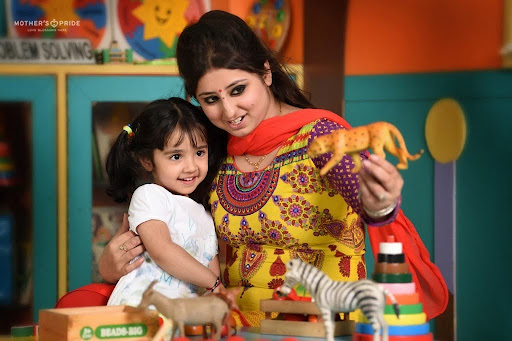
Positive parenting at Mother’s Pride, one of the best schools in Gurgaon, is genuinely central to how the school engages families. Chairperson Mrs. Sudha Gupta has been conducting parenting seminars for enrolled families across branches for years. Parents who've attended describe leaving with something real shifted in them, not a new technique to try, but a different way of seeing their child altogether.
The school strongly values the idea that childhood should feel happy and emotionally safe. Its approach reflects warmth, creativity, and gentle guidance during the foundational years. Instead of focusing only on academic readiness, the school also pays attention to communication skills, confidence-building, emotional comfort, and social interaction.
One of the best schools in Sector 5, Gurgaon, Mother’s Pride is designed as a “castle of love”. Classrooms take lighting, acoustics, colour, and air quality seriously. There is an Intellectual Development Centre where children work on problem-solving and motor skills three times a week, a Play Zone, a Ball Pool, a Doll House activity area, and a computer lab running a 1:10 student-to-computer ratio.
The environment at the school includes engaging activities, celebrations, stage exposure opportunities, co-curricular learning, and interactive experiences that help children express emotions confidently. Young learners receive opportunities to participate, communicate, and explore their interests without fear.
What Parents Need to Remember
Choosing positive parenting is a commitment to a kinder future. It requires patience and a shift in our own mindset. We must move away from the "power over" dynamic of the past embrace a "power with" approach.
In the end, remember, positive parenting is not about doing everything perfectly. It is about making children feel valued while helping them grow responsibly, one conversation at a time.
For more information on this and similar other schools, check out this list of the best schools in Gurgaon.













 as a preferred source on