






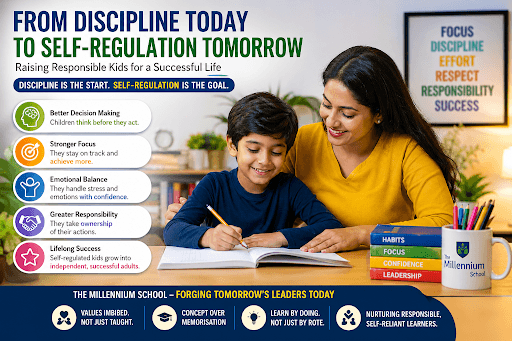

It’s the time your child sits down to study, not because you reminded them, not because you threatened consequences, but simply because they wanted to. In that quiet moment, something shifts in you. You realise you've been working toward something far bigger than good grades. You've been raising a person. That shift from a child who follows rules to one who makes choices is the difference between discipline and self-regulation. And understanding it might be the most important thing you do as a parent this year.
So, are you ready to understand your child’s mind and explore what discipline and self-regulation actually mean, why they're easy to confuse, what the research says about raising children who can govern themselves, and how the right school in Greater Noida West, like The Millennium School environment, can make all the difference?
Also Read | From Hobby Clubs to Global Exposure: How the Right School Opens Doors for Your Child - The Millennium School
Discipline Is the Starting Line, Not the Finish Line
Most of us grew up believing discipline was the goal. Sit still. Don't talk back. Finish your plate. And for years, it worked at least on the surface. Discipline, in its truest form, is external. It's the boundary a parent sets, the rule a teacher enforces, the consequence that follows a choice. It provides structure when a child's brain isn't yet capable of providing it for itself, and it's developmentally necessary.
The problem begins when we mistake compliance for capability. A child who only behaves because someone is watching hasn't learned self-control; they've learned to perform for an audience. So if discipline is only the beginning, what does the finish line actually look like?
What Does Self-Regulation Actually Look Like?
Self-regulation is the internal engine that discipline is meant to build over time. It's a child choosing to pause before reacting, deciding to finish homework before play, or recognising they're frustrated and choosing not to lash out.
Research from the National Library of Medicine consistently shows that self-regulation in early childhood predicts school readiness, academic achievement, higher self-worth, better stress management, and reduced risk behaviours in adulthood. It's not a soft skill. It's one of the strongest predictors of a child's long-term success.
The difference in practice? Discipline says, "Don't hit your sister." Self-regulation is the moment your child stops, breathes, and walks away on their own. But here's what makes this so hard - The two can look identical from the outside, which is where most of us go wrong.
Why Do We Confuse the Two and Why Does It Matter?
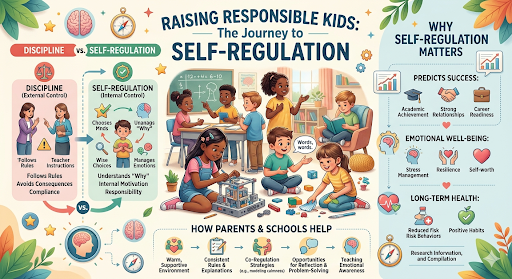
A quiet, obedient classroom could mean deeply regulated children or deeply fearful ones. As parents, we celebrate the stillness and forget to ask why it exists. An NLM research spanning two decades and 27,285 children found that positive discipline consistently produces better outcomes, while harsh or punitive discipline is linked to lower self-regulation.
This matters because so many of us parent the way we were parented, not out of cruelty, but out of habit. The shift we need isn't dramatic. It's intentional. And that intention has to start somewhere in small, deliberate moments that gradually hand a child their own compass.
The Bridge from "Because I Said So" to "Because I Know Better"
The transition from external discipline to internal self-regulation doesn't happen overnight, and it doesn't happen by accident. It happens when a parent explains why a boundary exists instead of just enforcing it. When a teacher lets a child sit with a wrong answer long enough to find the right one. When a school treats every child as someone capable of thinking, not just obeying.
According to NLM Research, self-regulation develops through consistent, supportive environments that challenge children without overwhelming them. The six hours a child spends in school each day are not neutral; that environment is either building self-regulation or quietly eroding it. Which raises the most practical question of all: what does a school that actually builds self-regulation look like?
Check Out | How Peer-Led Learning Builds Stronger Students: TMS, Greater Noida West
What to Look for in a School That Raises Self-Regulated Children?
The questions worth asking go beyond fees and board affiliation. Ask: Does this school give children room to make mistakes? Does it teach them how to think, or only what to think?
The answers reveal whether a school is raising followers or leaders. Here are the markers that matter:
-
Concept over memorisation
Schools that teach children how ideas work build cognitive self-regulation alongside academic knowledge, not just exam performance.
-
Values lived, not lectured
When honesty, empathy, and responsibility are modelled daily by adults in the building, children internalise them rather than performing them for approval.
-
Room for reflection
Schools that build pause into the day, through creative expression, open discussion, or independent problem-solving, give children daily practice in regulating themselves.
These aren't nice-to-haves. According to developmental research, early childhood self-regulation trajectories vary based on the consistency and quality of a child's environment. The school you choose is one of the most powerful of those environments.
With all of that in mind, here is one school in Greater Noida West that takes these principles seriously.
The Millennium School - Forging Tomorrow’s Leaders Today
For parents in Greater Noida West, thinking about discipline, self-regulation, and what kind of school actually builds both, The Millennium School is worth a closer look. The school holds that values are imbibed, not taught, with honesty, compassion, tolerance, and respect woven into daily school culture. That's not a tagline; it's precisely the environment research identifies as essential for building genuine self-regulation in children.

This school operates on a powerful belief that values like honesty, compassion, tolerance, and respect cannot be force-taught from a textbook; they must be silently imbibed from the very culture a child swims in. That is not a hollow tagline; it is precisely the kind of emotionally rich environment that research has proven essential for raising children who truly control themselves from within, not out of fear.
Spread over a sprawling four acres with an almost impossibly luxurious student-teacher ratio of 12:1, the school offers a rigorous CBSE education from nursery to Class 12 while declaring total war on meaningless rote learning. The legendary Millennium Learning System does not just blend creativity with curriculum; it sets them on fire together, ensuring children learn by doing, by tinkering, by failing forward, and never by performing like trained parrots.
Discipline gives a child a fence to stay within. The next time your child chooses right without being told - pause. That's not just good behaviour. That's a future taking shape.
For more information on similar schools in the area, see this list of the best schools in Greater Noida West.






 as a preferred source on