






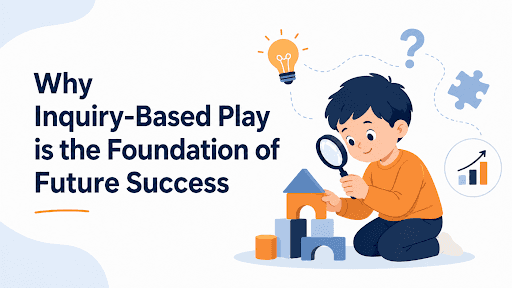

Children have the capability to learn through the early years of childhood. Early Learning is a part of the education, skills, and developmental experiences children receive from birth through age 5 or 8, often before kindergarten. However, the entire concept of Early learning has many skeptics specially around the way it is used and how it works. In fact, for many, early learning, or sometimes also called play-based learning, becomes something devoid of any serious learning, which is the furthest thing from the truth.
For children, learning has always been a sort of messy thing to understand. What if the moments that we ignore as play and not real learning are some of the most powerful experiences that your child might have?
And that is what we wanted to explore through this article. We will try to get to the point of early learning, and how early learning and play-based learning play an important role in the development of human beings. This article will also mention the working of one of the best schools in Bangalore, Naavu School, and how the school works on early learning to establish the entire set of learning.
Science of Early Learning
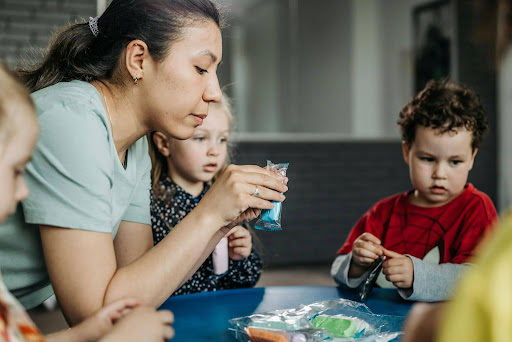
Early childhood offers a very critical window of opportunity to shape the trajectory of a child’s holistic development and build a foundation for their future. For children to achieve their full potential, they need health care and nutrition, protection from harm and a sense of security, opportunities for early learning, and responsive caregiving – like talking, singing, and playing – with parents and caregivers who love them. All of this is needed to nourish developing brains and fuel growing bodies.
A study that set out to explore and explain the effects of play-based learning, young children gain valuable life experiences in various roles that will encourage growth and ultimately translate into adulthood. Research states that play is essential to developing key abilities, including social, behavioural, language, and cognitive.
Science believes that while rote learning activates a very small portion of the brain, activity-based learning or play-based learning directly activates the prefrontal cortex, which is responsible for problem-solving, emotional regulation, and critical thinking.
Read More| The Hidden Benefits of Early Schooling
Looking Beyond Play
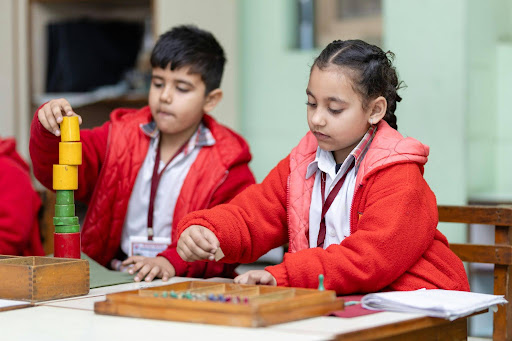
To create an understanding of what exactly is Play-based learning, you need to see it from the inside, so let’s go through a couple of plays that teach and talk about how they teach.
1. Building a Tower
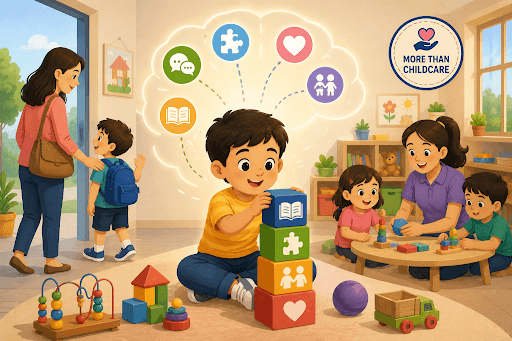
A child stacking blocks may seem like they’re just passing the time. But in reality, they are:
- Understanding balance and gravity
- Experimenting with trial and error
- Developing fine motor skills
- Learning patience and persistence
This is early exposure to physics, problem-solving, and resilience—all in one activity.
2. Pretend Play: Running a Café
When children pretend to run a café, they are doing far more than “playing house.” They are:
- Practising communication and language
- Exploring numbers and transactions
- Understanding roles and responsibilities
- Building social and emotional intelligence
This kind of role-play introduces real-world concepts in a safe, imaginative environment.
Building the Future
Early Learning, when dependent on rote learning, results in kids who can learn things to tell you the things without any analysis when asked. But slowly, we as a civilization are moving towards a future where we do not need people to remember the answer, but instead to ask the right questions. And so to prepare your kids for the future, it is important to teach them the way to ask the right questions, which is a part of inquiry-based learning.
An inquiry-based early childhood education prepares children for a world that doesn't exist yet. It teaches them to be comfortable with ambiguity, to enjoy the process of discovery, and to view "not knowing" as an invitation rather than a deficit. By encouraging curiosity today, we are creating the innovators, engineers, and empathetic leaders of tomorrow.
Also Read| Foundations of Lifelong Learning
Effects in the Real World
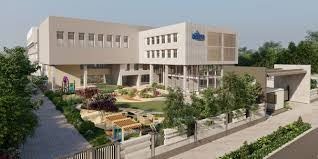
Fortunately, this structure of learning is not just a theoretical vision; it is a reality that is slowly becoming a common trend. And we see this common trend at one of the best IB schools in Bangalore, Naavu School, through its Early Years Programme, where learning is intentionally designed around play and inquiry.
The school does not consider early learning as a stage before the ‘serious’ education starts. It instead thinks of it as the most critical stage of the educational journey. The school’s curriculum is specifically designed to transform the universal instinct for play into a sophisticated framework for learning.
Translating Theory into "The Naavu Experience"
The concepts of observation, hypothesis, and application look like this in a Naavu classroom:
- The Environment as the "Third Teacher": The school’s spaces are inspired by the best global practices, like the Reggio Emilia and the IB philosophies, with the purpose of provoking wonder. The examples of the school’s greenhouse, or the nature-rich outdoor areas, or the specialized "Brick Labs," are perfect to show how every corner of Naavu is an invitation to ask, "Why?"
- From Butterflies to Biology: To take another example, when students at Naavu watch a butterfly, the educators don't just let the moment pass. They use it to introduce vocabulary about life cycles, encourage the sketching of wings to develop fine motor skills, and spark conversations about the environment.
- The Café and the Community: The role-play areas are more than just toys. They are structured environments where children develop early numeracy (counting orders), literacy (writing menus), and social-emotional intelligence (serving others).
A Focus on Self-Awareness
One of the most distinct elements of the Naavu approach is its commitment to Self-Awareness. With the Early Years Programme, the school prioritizes the "inner world" of the child just as much as the "outer world" of academics. Through daily reflection, mindful movement, and a 6:1 student-to-teacher ratio, the school ensures that every child feels safe enough to take the risks that learning requires.
Conclusion
When a little one is growing, the point is not getting ahead academically. But instead, it is about giving them the capability to learn, explore, and grow.
As multiple studies show, when children are given the freedom to play, question, and discover, they develop skills that go far beyond textbooks. They become thinkers, problem-solvers, and confident individuals.
Because in the end, the goal of education is not just to prepare children for the next class, it is to prepare them for life. And that is what the Naavu School is working towards with their aim being to provide the very little ones the best education possible by building their skills from the ground up.
For more information on similar schools in the area, see this list of the best schools in Bangalore


 as a preferred source on