








Your child's brain decided on learning before their teacher said a single word today. It was decided based on how safe they felt, how seen they were, how much they laughed at breakfast, whether to open or to shut. That decision changed everything that followed.
This isn't parenting philosophy. It is neuroscience. And once you understand it, you cannot unsee it in your child's classroom, in their report card, in the look on their face when they come home.
What happens inside a happy child's brain that makes knowledge stick ten times faster, why emotional safety is not softness but strategy, what stress silently does to a child's ability to learn, and how school's environment determines the kind of learner your child becomes.
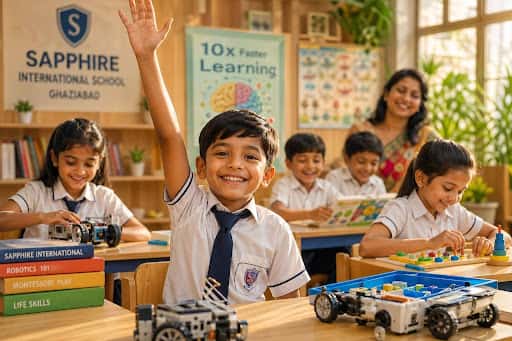
If you are residing in Ghaziabad and looking for the best schools in Ghaziabad, it’s your sign to know how the Sapphire International School is making your child learn 10x faster than ever. And how it’s answering all your confused queries in this article.
The Moment a Child's Brain Decides to Learn - or Survive
Before a child reads a single word on the board, their brain has already run a silent scan. Is this place safe? Am I going to be embarrassed? Does anyone here actually see me? If the answer tilts toward threat, the amygdala, the brain's alarm system, floods the body with cortisol and shuts down the prefrontal cortex, the seat of memory, reasoning, and learning.
The child is now biologically in survival mode. They may sit in the classroom. They are not learning from it. Research on social-emotional competence confirms that children who feel happy, understood, and secure perform measurably better academically, not because of effort or intelligence, but because of brain chemistry.
You cannot pour knowledge into a brain that is busy protecting itself, but here's what actually opens it.
Dopamine Is the Real Teacher
The thing that opens the brain isn't a better textbook or a stricter schedule. It is one chemical, and a happy child produces it naturally. Dopamine is released when a child feels joy, curiosity, or achievement. It is the most powerful learning accelerant that exists. It does not just make learning feel good. It makes the brain retain what it learns.
Neuroscience research shows that positive emotions increase cognitive flexibility, the brain's ability to form new connections and store information in ways that can actually be retrieved later. The child who laughs easily, who feels confident enough to raise a wrong hand, is releasing the exact chemicals that make learning 10x more efficient.
The child grinding through fear-based pressure may memorise tonight and forget by morning because stress hormones actively interfere with memory consolidation during sleep. Happiness isn't a distraction from learning.
In the most literal, biological sense, it is learning. Which raises the harder question: if joy is this powerful, why do so many parents unknowingly take it away?
The Pressure Trap Every Loving Parent Falls Into
No parent decides to pressure their child. It happens quietly, an extra class here, a comparison there, the low hum of anxiety about whether they are ready. But the child's brain doesn't distinguish between a threat in the environment and one at the dinner table. Chronic low-grade stress occupies the same cognitive resources that learning requires.
Studies tracking emotional well-being and academic outcomes consistently link emotional difficulties to underachievement, not from lack of ability, but from a mental bandwidth that is already full before the school bell rings. The highest-achieving children are not the most pressured ones.
They are secure enough to fail, curious enough to try again, and joyful enough that learning feels like discovery. Joy is not the reward that comes after achievement. It is the condition that makes it possible. And that condition is built or broken by the school a child walks into every morning.
The School Environment Is a Biological Input
A school's real curriculum is not printed anywhere. It lives in whether a teacher's eyes light up when a struggling child finally gets it, in whether corridors feel like a place to belong or a place to perform. The emotional climate of a school shapes the neurological climate of every child inside it daily and cumulatively.
Schools that invest in co-curricular depth and nurturing teacher relationships are not being idealistic. They are being the most strategically sound institutions possible. Which is why the right question when choosing a school isn't just "what is the fee structure?"
It is: will my child's brain be open or closed inside those walls? One school in Crossings Republik has built its entire identity around answering that correctly.
Check Out | Building a Culture of Safety at Sapphire International School, Ghaziabad
Sapphire International School - The School That Decided a Child's Joy Is Not Negotiable
Sapphire International School, where every child is treated like a leader, is not decorative. It is the operating principle behind every classroom, every activity, and every teacher on campus.

Established in 2016 and affiliated with CBSE, SIS starts its programmes as early as 18 months, not to rush children into academics, but to meet them where they are. Learning here unfolds through inquiry, play, and globally informed teaching methodologies rooted in Indian values, where curiosity is celebrated long before correctness is demanded. With classes from Pre-Nursery through Class 12 and a student-teacher ratio of 15:1, no child here disappears into the crowd.
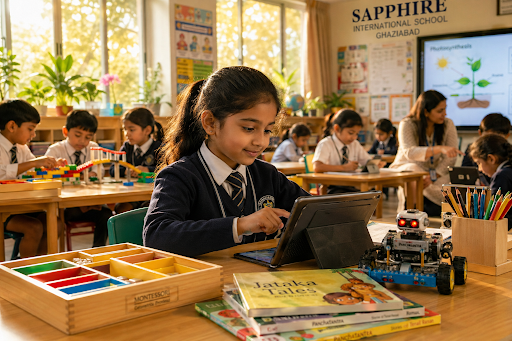
That visibility, that sense of being seen, is exactly what a child's brain needs to stay open and engaged. The school's "No Child Left Behind" policy, 25+ co-curricular activities, and facilities like a Robotics Lab, Montessori Lab, and Music Room reflect an institution that treats happiness and academic rigour not as opposites, but as the same thing. Every grade, every skill, every confident adult they will one day become, follows from it.
Conclusion
You now know the science. The last bridge is the smallest one, and it's yours to cross. Before you ask your child what they have a test on, ask what they are excited about. Before you check their homework, check their face. A child who feels genuinely happy carries a brain already primed to absorb, retain, and lead, and your job, like the best school's job, is simply to protect that state.
If you’d like to learn more about this and other schools, explore the list of top schools in India.






 as a preferred source on